

Underbench vs Pass-Through Dishwasher: Which One Does Your Kitchen Actually Need?
Choosing between an underbench and a pass-through dishwasher is one of the first decisions any new or growing hospitality venue has to get right. Choose correctly and your dishwashing keeps pace with service without eating into floor space or your power budget. Choose the wrong type and you are either under-equipped for your cover numbers or paying for a machine that is bigger and more expensive than your operation actually needs.
This guide explains what separates underbench and pass-through commercial dishwashers, which type suits which venue, and what to check in your kitchen before you buy.
What Is an Underbench Dishwasher?
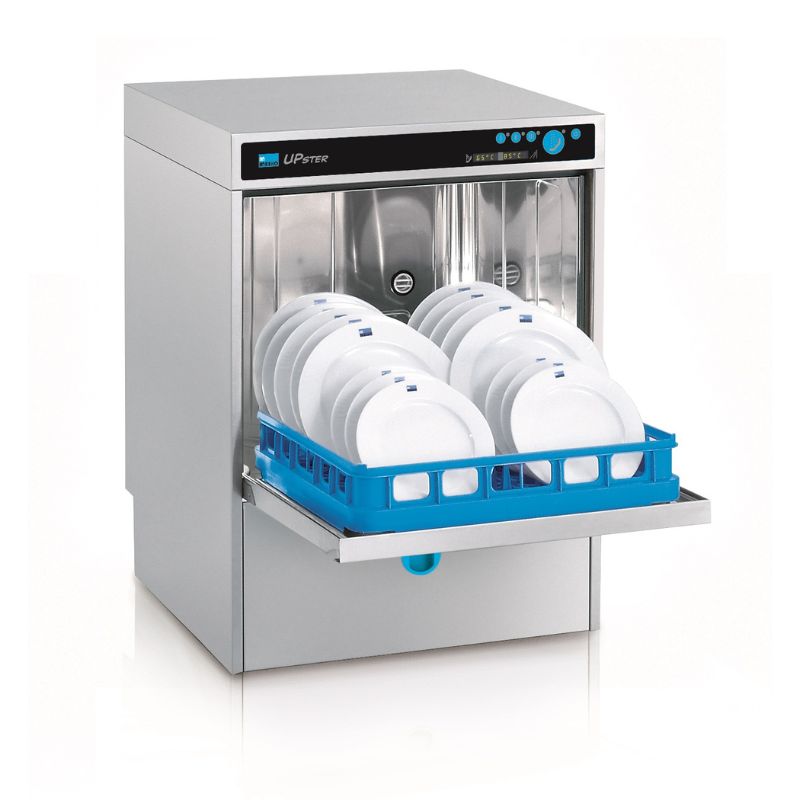
An underbench dishwasher (also called an undercounter dishwasher) is a compact, front-loading commercial dishwasher that fits under a standard bench height of around 850 to 900mm. These machines wash a standard 500 x 500mm basket and complete a full cycle in as little as 60 to 120 seconds, depending on the model and cycle selected.
Underbench dishwashers are the most common type of commercial dishwasher found in Australian kitchens. They suit small to medium-sized venues where counter space is limited, service volumes are manageable and the kitchen does not need to process hundreds of racks per session. Most models run on standard 240V/15A single-phase power, which makes installation straightforward in most commercial kitchen setups.
What Is a Pass-Through Dishwasher?
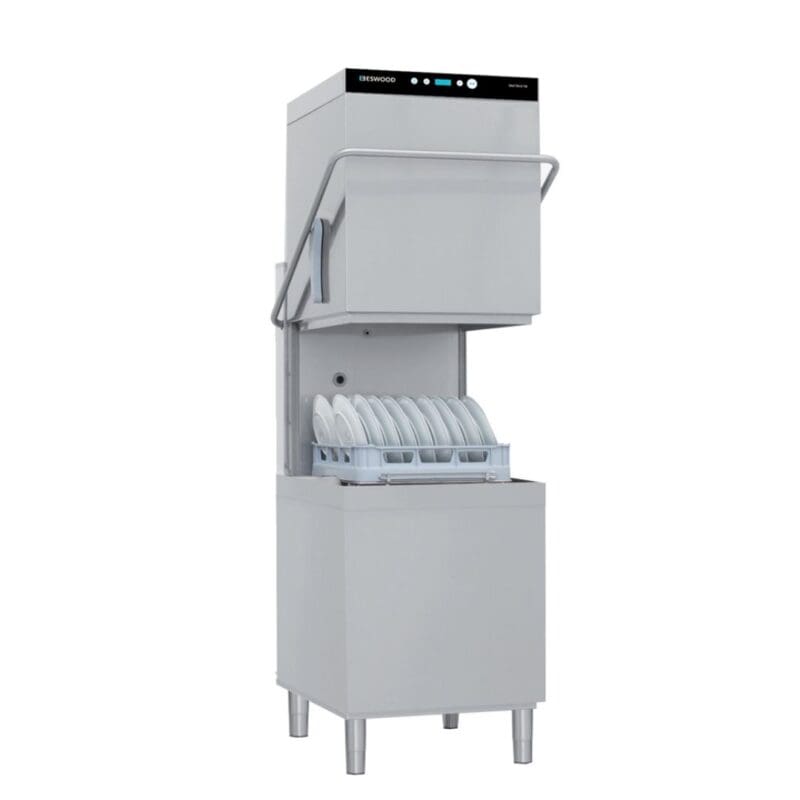
A pass-through dishwasher (also called a hood-type dishwasher) operates differently to an underbench unit. Instead of a front-loading door, it has a hood that lifts upward so a full rack can be loaded in from one side and removed from the other. This design allows the machine to keep running almost continuously, as the operator can load the next rack without waiting for the previous cycle to fully complete.
Pass-through dishwashers deliver significantly higher throughput than underbench units. They are the standard choice for medium to large restaurants, hotels, clubs, pubs, aged care facilities, schools, stadiums and any operation that processes a large volume of plates, glasses and cutlery through service.
The Key Differences
Throughput is the most important practical difference between the two types. A commercial underbench dishwasher typically processes around 20 to 30 racks per hour depending on cycle time. A pass-through dishwasher can wash 40 to 60 racks per hour or more in higher-output models. If your venue regularly serves 100 or more covers per service, an underbench machine may fall behind during a busy period.
Footprint is the second key difference. An underbench unit is compact and slots under an existing bench run with minimal disruption. A pass-through machine is a standalone unit that requires dedicated inlet bench space on one side and outlet bench space on the other side. Budget for that additional floor and bench area when planning your kitchen layout.
Power requirements also differ. Most underbench commercial dishwashers in Australia run on 240V/15A single-phase power. Many pass-through machines also operate on single phase, but higher-output models may require 415V three-phase power. If your site does not already have three-phase supply, factor in the cost of an electrical upgrade when comparing prices.
When to Choose an Underbench Dishwasher
An underbench dishwasher is the right choice for your kitchen when:
Your venue serves fewer than 80 to 100 covers per service. Your kitchen has limited floor space and the machine needs to fit under an existing bench run. Your power supply is standard 240V/15A single phase and you want to avoid an electrical upgrade. You are opening a cafe, small restaurant, bar, takeaway or food service venue with moderate daily dishwashing volume.
Browse our range of commercial underbench dishwashers from Eswood, Meiko, Fagor and Asber, all with fast delivery Australia-wide.
When to Choose a Pass-Through Dishwasher
A pass-through dishwasher is the right choice when:
Your venue regularly serves 100 covers or more per service. You need continuous dishwashing through a long service period without stopping to reload after each cycle. You have sufficient floor space for inlet and outlet bench areas on both sides of the machine. You are equipping a large restaurant, hotel, club, canteen, aged care facility, school or high-volume catering operation.
Browse our range of commercial pass-through dishwashers for higher-volume operations.
Power Requirements: What to Check Before You Buy
Before ordering any commercial dishwasher, confirm your site power supply with a licensed electrician. In Australia, most underbench commercial dishwashers run on 240V/15A single-phase power. Pass-through models vary: some run on 240V/15A while others require 415V three-phase power, depending on the model and output level.
If your site needs a power upgrade, that cost needs to be factored into your total budget before you commit to a machine. A dishwasher that looks affordable on the product page can become noticeably more expensive once electrical work and plumbing are included. Getting the site assessment done early avoids surprises after delivery.
What Does Each Type Cost?
As a general guide, commercial underbench dishwashers typically start from the mid-$3,000s to $5,000 or more ex GST, depending on brand, output and features. Pass-through dishwashers generally start from around $7,000 and go well beyond $15,000 for higher-output models from premium brands such as Meiko and Hobart.
Both types are available with finance through SilverChef if you prefer to spread the cost over time rather than pay the full amount upfront. SilverChef offers rental and hire-to-purchase options with fast approvals and no property security required.
Frequently Asked Questions
For most cafes and small to medium restaurants, yes. An underbench dishwasher with a 60 to 90 second cycle can process around 20 to 30 racks per hour, which is sufficient for most venues serving up to 80 to 100 covers per service. If your venue regularly exceeds that volume, a pass-through machine is worth considering.
Yes. Both underbench and pass-through dishwashers require a licensed plumber for water inlet and drain connections. Budget for plumbing costs in addition to the machine price, and check that your site has a suitable drainage point and floor drain near the planned install location.
Ben’s Hospitality Equipment stocks underbench and pass-through dishwashers from Eswood, Meiko, Fagor and Asber. Eswood machines are designed and manufactured in Australia, with local spare parts support available for over 10 years. Meiko machines are German-engineered and known for quiet operation and consistent wash results
Not always. Some pass-through dishwashers run on 240V single-phase power while others require 415V three-phase, depending on the model and output level. Always confirm the power requirements of your chosen model with your electrician before placing an order.
Yes. Commercial dishwashers sold and installed in Australia must carry WaterMark certification in compliance with AS/NZS 3718. All dishwashers in the Ben’s Hospitality Equipment range meet this requirement.
Ready to Choose?
Browse the Ben’s Hospitality Equipment range of commercial underbench dishwashers and pass-through dishwashers online. Both types are available with fast Australia-wide delivery and SilverChef finance on all models. Not sure which type suits your venue? Call us on 1300 434 125 and our team can help.