

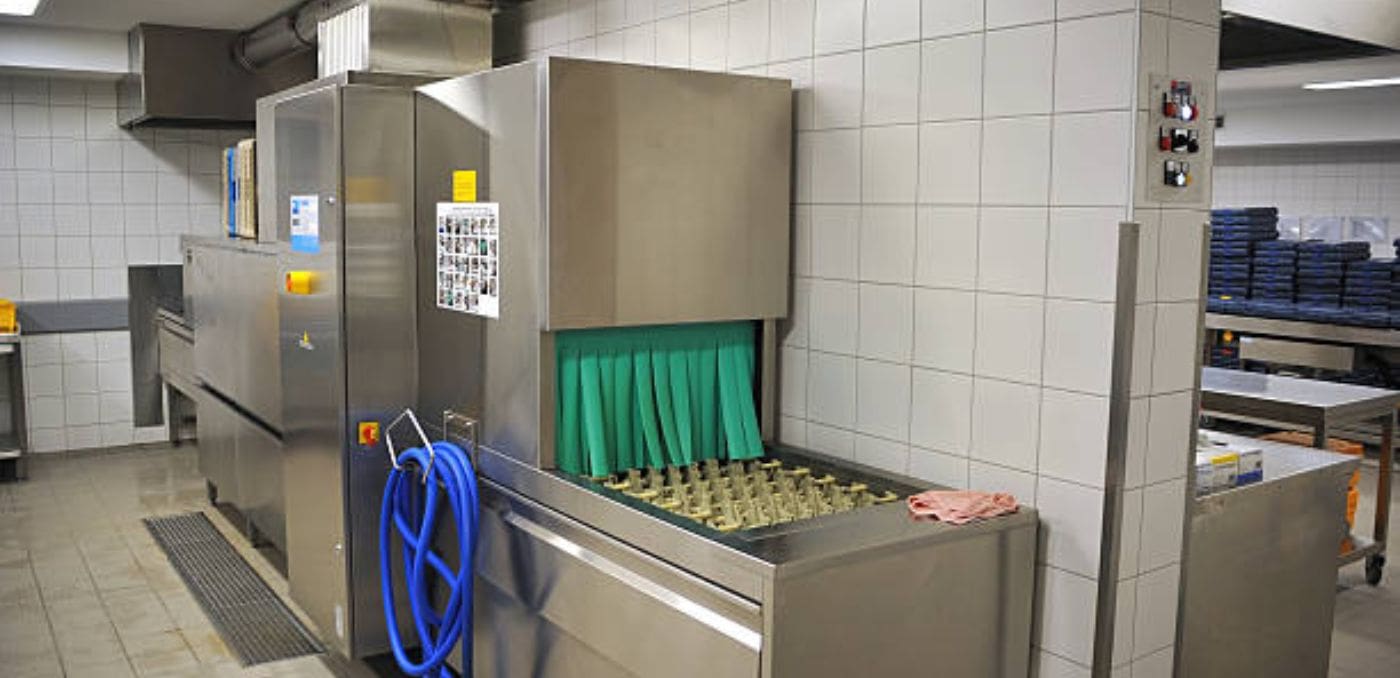
How Much Can a Commercial Dishwasher Improve Kitchen Efficiency and Save a Business?
In hospitality, speed matters, labour matters, and workflow matters. A kitchen can have good chefs, good service staff, and solid equipment, but if dirty dishes start piling up and clean plates, cups, and utensils are not coming back into circulation fast enough, the whole operation starts to slow down.
That is why a commercial dishwasher is far more than a cleaning appliance. In a real working café, restaurant, pub, takeaway, bakery, or catering kitchen, it is a productivity tool. It helps keep service moving, reduces pressure on staff, improves hygiene, and can save a business a surprising amount of money over a year.
A lot of operators still look at a commercial dishwasher and think mainly about the upfront purchase cost. But the better question is this: what is slow dishwashing already costing the business every day?
In Australia, labour is expensive and getting one extra productive hour from your team has real value. The National Minimum Wage is $24.95 per hour from 1 July 2025, and Australian Bureau of Statistics data shows average hourly total cash earnings in Accommodation and Food Services at $32.10 per hour. That means even small daily inefficiencies in the wash-up area can quietly cost thousands across the year.
For many hospitality businesses, a commercial dishwasher can improve kitchen efficiency dramatically and save anywhere from a few thousand dollars a year to well into five figures, depending on volume, staffing, and how inefficient the current setup is.
Why dishwashing affects the whole kitchen, not just the sink area
Dishwashing is one of the most underestimated bottlenecks in hospitality. When plates, glasses, cutlery, trays, and utensils start backing up, it does not stay in the wash-up corner. It flows into the whole venue.
Front-of-house cannot reset tables as fast. Bar staff start running short on glassware. Kitchen staff may need to stop prep and search for clean inserts, pans, or service tools. Benches get cluttered. Closing gets delayed. Stress rises quickly.
That is why the dishwasher has such a big effect on kitchen efficiency. It supports the whole operating rhythm of the business. A good pass-through dishwasher gives you consistent throughput instead of stop-start hand washing.
Commercial models are designed for fast turnaround. Market examples in Australia show undercounter machines commonly rated around 30 to 40 racks per hour, while pass-through and higher-capacity machines are designed for significantly heavier volume.
That kind of throughput changes what one staff member can realistically manage during service.
The clearest saving is labour

The easiest way to understand the value of a commercial dishwasher is to look at labour.
Let’s say a café or restaurant saves just one hour of manual dishwashing labour per day because staff are no longer standing at the sink scrubbing, rinsing, soaking, and rehandling dishes for long periods.
Using the National Minimum Wage of $24.95 per hour, one hour saved per day across a 6-day week equals:
$24.95 × 6 = $149.70 per week
$149.70 × 52 = $7,784.40 per year
Using the ABS industry average hourly figure of $32.10 per hour, that becomes:
$32.10 × 6 = $192.60 per week
$192.60 × 52 = $10,015.20 per year
And that is still a conservative example.
Many busy kitchens can save more than one hour per day once you factor in loading, unloading, reduced rewash, quicker closing, and less interruption to chefs or floor staff. If the business saves two hours per day, the direct labour value jumps to around $15,568.80 per year at minimum wage, or $20,030.40 per year using the industry average hourly earnings figure. That is before adding super, overtime, admin overhead, or the value of moving staff onto more productive work. The extra overhead point is an inference based on normal employment costs.
It is not only about reducing labour, but using labour better
This is the part many owners miss. A commercial dishwasher does not always mean fewer staff. In many venues, it means the same team can operate more effectively.
Instead of a staff member being trapped in the dish area, they can help with prep, plating, table clearing, bar support, restocking, receiving deliveries, or end-of-day cleaning. In other words, the business gets more useful output from the same payroll spend.
That matters even more in hospitality because one bottleneck tends to drag other staff into it. A slow dish area does not stay neatly contained. It pulls in chefs, kitchen hands, wait staff, and supervisors. That creates hidden wage waste across the whole shift.
A commercial dishwasher helps stop that spread.
The impact is even bigger when you are short of staff

One of the biggest advantages of a commercial dishwasher shows up when staffing is tight.
In the real world, hospitality businesses are often short a person. Someone calls in sick. A casual does not show up. One worker has to move from kitchen hand duties to front counter support. A chef ends up doing extra prep because the roster is thin.
When that happens, manual dishwashing becomes even more damaging.
Without a proper commercial dishwasher machine, the remaining team has to spend more time hand washing or slowly cycling through an underpowered setup. Dirty dishes pile up. Clean items do not come back fast enough. Staff start jumping between stations. One shortage becomes multiple smaller problems.
With a commercial dishwasher, one person can clear and reload baskets efficiently and get essential items back into service much faster. The venue is still short-staffed, but the damage is contained.
Let’s put a simple dollar figure on that.
Imagine a short-staffed day causes:
30 minutes of lost productive time from 2 other staff
Plus 1 extra hour spent catching up after service
Using the ABS Accommodation and Food Services average hourly earnings of $32.10, that cost looks like this:
0.5 hour × 2 staff × $32.10 = $32.10
1 additional hour × $32.10 = $32.10
Total daily impact = $64.20
If that happens only 3 times a month, the annual labour impact is:
$64.20 × 3 = $192.60 per month
$192.60 × 12 = $2,311.20 per year
And that example still does not include lost sales, delayed table turns, slower drink service, or a stressed customer experience.
Faster warewashing protects revenue
A commercial dishwasher does not just save wages. It can help protect income.
Think about what happens in a busy café when clean cups are not available fast enough. Coffee service slows down. The queue starts growing. Staff scramble. The customer experience suffers.
The same happens in a restaurant if plates are delayed, or in a bar if clean glasses run short during a rush.
A commercial dishwasher helps protect turnover because it supports faster service flow. If the machine keeps dishes circulating, the venue can keep serving without hitting those avoidable slowdowns.
This is particularly important in businesses that rely on volume and speed, such as cafés, quick-service venues, pubs, clubs, food courts, and high-turnover restaurants.
Even one extra table served during a peak period each day can be meaningful. If faster plate and glass turnaround helps a venue serve an extra $80 worth of sales on just 3 peak days a week, that is:
$80 × 3 = $240 per week
$240 × 52 = $12,480 per year
That sales example is illustrative rather than a published benchmark, but it reflects the real commercial effect of avoiding service bottlenecks.
Commercial dishwashers can also improve water and energy efficiency
Another common misconception is that commercial dishwashers waste water. In reality, modern machines are built for controlled and repeatable water use.
ENERGY STAR says certified commercial dishwashers are about 12% more energy efficient and 50% more water efficient than standard models, and can save businesses about $360 annually on utility bills on average, with lifetime utility savings of more than $3,290 depending on the product type. Those are US programme figures, so they should be treated as directional rather than direct Australian utility savings, but they still support the point that efficient commercial warewashing can reduce operating costs over time.
In real kitchen terms, a commercial dishwasher uses set wash and rinse volumes rather than relying on constant running water, inconsistent sink filling, and excessive rinsing by hand. That repeatability often leads to more efficient resource use, especially in venues with disciplined loading and sensible pre-rinse habits.
So, while labour is still the biggest saving, lower utility use can add another layer of long-term value.
Consistency and hygiene also save money
A proper commercial dishwasher helps with more than speed. It also improves consistency.
Manual dishwashing depends on how rushed the staff are, how well they rinse, how hot the water is, how long items soak, and whether anyone cuts corners when the kitchen gets slammed. That creates inconsistency.
In contrast, a commercial dishwasher gives you the same wash cycle over and over. That means cleaner results, more reliable sanitation, and less need to rewash items because a glass is still marked or a plate is not fully clean.
Even a small amount of rewash has a real labour cost.
Let’s say a venue wastes 20 minutes a day on rewashing or rehandling items because the current process is inconsistent. At $32.10 per hour, that works out to:
20 minutes = 0.33 hour
0.33 × $32.10 = about $10.70 per day
$10.70 × 6 = $64.20 per week
$64.20 × 52 = $3,338.40 per year
That is a lot of money leaking away from something many businesses barely notice.
Breakages can drop as well
When staff are hand washing large volumes under pressure, there is naturally more handling. More handling means more chances for chipped plates, cracked cups, broken glasses, or damaged crockery.
A commercial dishwasher reduces repeated handling because items are loaded into racks, washed, and returned to service in a more organised process.
The saving from reduced breakage varies from venue to venue, but even modest reductions add up. If a business cuts just $40 a week in glass and crockery replacement, that is $2,080 a year. That is an illustrative figure, not a published statistic, but it is very realistic for many venues with high glassware turnover.
Closing becomes faster and less painful
Ask almost any hospitality operator where time disappears, and one of the biggest answers will be closing.
When the dish area falls behind during service, the close becomes a blowout. Staff stay back. Fatigue increases. Overtime creeps in. Morale drops.
A commercial dishwasher helps avoid that by keeping up during trading and reducing the end-of-day backlog.
If the machine trims just 45 minutes off closing time, 4 days a week, using the industry hourly average of $32.10, the labour value is:
0.75 hour × $32.10 = $24.08 per day
$24.08 × 4 = $96.32 per week
$96.32 × 52 = $5,008.64 per year
That is a strong saving from one improvement alone.
Different venues will see different levels of savings
Not every business will save the same amount, because warewashing demand varies.
A small coffee shop with low food volume may mainly benefit from faster cup turnover, reduced hand washing, and a cleaner close. The saving may be a few thousand dollars a year, but that can still be worthwhile.
A medium café, restaurant, bakery, or pub kitchen may save much more because there is heavier turnover of plates, trays, utensils, and glassware all day.
Larger venues such as clubs, caterers, hotels, schools, hospitals, and aged care facilities can justify higher-output systems because warewashing is a core part of production. Australian market examples show standard undercounter output around 30 to 40 racks per hour, while higher-capacity machines serve far heavier volumes.
The busier the operation, the more expensive dishwashing inefficiency becomes.
A practical annual saving example
Here is a realistic combined example for a mid-volume hospitality business in Australia:
1.5 labour hours saved per day
6 trading days per week
labour valued at $32.10 per hour
$40 per week less breakage
15 minutes less rewash or rehandling each day
Direct labour saving:
1.5 × $32.10 = $48.15 per day
$48.15 × 6 = $288.90 per week
$288.90 × 52 = $15,022.80 per year
Reduced breakage:
$40 × 52 = $2,080 per year
Reduced rewash time:
0.25 hour × $32.10 = $8.03 per day
$8.03 × 6 = $48.18 per week
$48.18 × 52 = $2,505.36 per year
Total estimated annual value:
$19,608.16 per year
That example is illustrative, but it is built on current Australian wage data and realistic kitchen assumptions. It shows why a commercial dishwasher should be seen as a business efficiency investment, not just another expense.
The real cost of not having the right dishwasher
A lot of hospitality businesses delay upgrading because they focus on the upfront cost. But the bigger cost is often the one they are already paying:
wasted labour
slower service
extra stress when short-staffed
longer closing times
more rewash
more clutter in the kitchen
more breakages
poorer service flow during peak periods
When you add those up across a full year, a slow or undersized warewashing setup can cost far more than expected.
Final thoughts
A commercial dishwasher can make a major difference to kitchen efficiency and business profitability. It can reduce labour hours, help short-staffed venues stay afloat during busy periods, keep plates and glasses circulating faster, cut down rewash and breakage, and support smoother closing. With Australia’s National Minimum Wage at $24.95 per hour and average hourly cash earnings in Accommodation and Food Services at $32.10, even small daily improvements have meaningful dollar value. Australian market examples also show commercial dishwasher machines deliver throughput around 30 to 40 racks per hour for many undercounter units, with larger systems designed for much higher demand, while ENERGY STAR data points to utility savings from efficient commercial models as well.
For many businesses, the better question is no longer whether a commercial dishwasher is worth it. It is whether the business can afford to keep losing time and money without one.


