Countertop Prep Fridge vs Full Prep Station: Which One Should You Choose?
![Turbo air 3 Door Salad Prep Table Fridge [BUFFET], KSR18-3(FB), turbo air open top salad fridge, turbo air buffet table fridge, turbo air salad fridge for sale, open top table fridge for sale](https://bendgs.com.au/wp-content/uploads/2023/04/KSR18-3-768x768-1.jpg)
Choosing the right prep fridge can make a huge difference to speed, food safety, and workflow in a commercial kitchen. For many cafés, takeaways, pizza shops and food trucks, the decision often comes down to two options: a countertop prep fridge or a full commercial prep station.
Both are designed to keep ingredients chilled and organised during food preparation, but they suit very different kitchen sizes, service volumes, and menus. This guide breaks down the real differences, pros and cons, and which option makes the most sense for your business.
Table of Contents
Countertop Prep Fridge
A countertop prep fridge is a compact refrigerated unit designed to sit on top of an existing bench or counter. It keeps commonly used ingredients chilled and organised in GN pans, positioned directly under a refrigerated lid so staff can prepare food quickly without stepping away from the workstation. These units are designed for speed and convenience, not bulk storage. Because they do not include a refrigerated base, countertop prep fridges rely on a separate fridge or freezer for storing backup ingredients. They are most commonly used in operations where space is limited, menus are simple, and ingredients need to be within arm’s reach during service.
Countertop prep fridges are widely used in cafés, food trucks, small takeaways, sandwich and salad bars, as well as bubble tea and dessert shops. They are particularly well suited to businesses with limited space or simple menus where ingredients need to be kept within arm’s reach. In these settings, staff typically prep smaller quantities more frequently, making a countertop unit a practical and efficient choice.
Benefits of a Countertop Prep Fridge
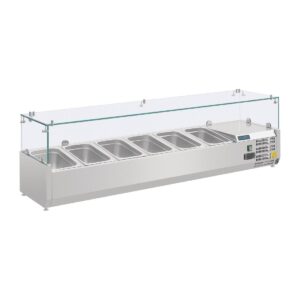
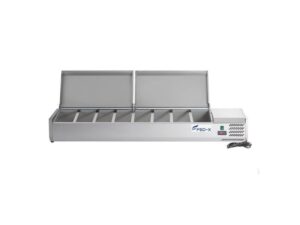
One of the main advantages of a countertop prep fridge is its compact, space-saving design. By sitting on an existing bench, it provides refrigerated ingredient access without taking up valuable floor space. This makes it ideal for narrow kitchens, food trucks, kiosks, and front-of-house prep areas behind counters. Countertop units are also more affordable than full commercial prep stations, making them a popular option for startups, pop-up venues, and businesses looking to control upfront costs.
Another benefit is flexibility. Countertop prep fridges can be placed on stainless steel benches, under shelves, or behind service counters, allowing them to integrate easily into existing kitchen layouts without major changes. They are particularly effective for light to medium prep tasks such as preparing sandwiches, wraps, salads, desserts, fruit and drink garnishes, where quick access to ingredients is more important than large storage capacity.
Limitations of Countertop Prep Fridges
However, countertop prep fridges do have limitations. Because they are designed to hold only active ingredients, all additional stock must be stored in a separate upright fridge, underbench fridge, or cool room. During busy periods, this can mean staff need to move between stations to restock ingredients. Capacity is also limited, as countertop units typically hold fewer GN pans than full prep stations, making them less suitable for high-volume kitchens or menus with a large number of ingredients.
In environments with heavy or continuous service, such as busy pizza shops or large sandwich operations, frequent refilling can slow down workflow. In these cases, a full commercial prep station with refrigerated storage below the work surface is often a better long-term solution. For smaller operations, however, a countertop prep fridge offers a smart, space-efficient way to improve prep speed and organisation without the footprint or cost of a full prep station.


Use Cases
A small café typically uses a countertop prep fridge to keep sandwich fillings, salad toppings and spreads chilled and organised right on the bench. During breakfast and lunch service, staff can quickly assemble toasties, wraps and salads without stepping away from the prep area. Ingredients are stored neatly in GN pans under a refrigerated lid, making it easy to see stock levels at a glance and maintain food safety. Bulk items such as extra vegetables, meats and dairy are stored in a nearby upright fridge or under bench fridge, allowing the café to restock quickly between service rushes. This setup improves speed, reduces bench clutter, and helps keep service smooth in tight kitchen spaces.
In a food truck, where floor space and power capacity are extremely limited, a countertop prep fridge plays an even more important role. Mounted on a stainless steel bench, the unit holds sauces, garnishes and prepped ingredients that need to stay chilled throughout service. Because everything is within arm’s reach, staff can assemble orders faster and serve customers more efficiently during busy periods. The compact design eliminates the need for a full prep station, freeing up space for cooking equipment while still meeting food safety requirements. For food trucks, the key benefit is maximising workflow without sacrificing valuable space.
A bubble tea or dessert shop uses a countertop prep fridge to store fruit, pearls, jellies and toppings in individual GN pans, making drink and dessert assembly quick and consistent. During peak hours, staff can move seamlessly from one order to the next without opening and closing a separate fridge. The clear layout helps with portion control and presentation, while the refrigerated lid ensures ingredients stay fresh and visually appealing. This setup reduces wait times, improves consistency, and supports a fast-paced service environment where speed and accuracy are essential.
For a growing takeaway business, a countertop prep fridge often serves as the first step toward a more advanced prep setup. In the early stages, the unit provides a cost-effective way to keep key ingredients chilled and organised without committing to a large commercial prep station. As order volume increases and service becomes busier, the limitations of capacity become more noticeable. Many businesses then upgrade to a full prep station with refrigerated storage below the work surface. Starting with a countertop unit allows the business to scale gradually, manage upfront costs, and invest in larger equipment only when demand justifies it.
Countertop Prep Fridge Sizes & Features
Countertop prep fridges come in a variety of widths, configurations and feature options to suit different kitchen spaces and service styles. Choosing the right size and configuration helps balance ingredient capacity, workflow efficiency and customer service speed.
1200mm Wide
This versatile size suits mid-sized kitchens with moderate ingredient variety. It usually accommodates 4 of 1/3 GN pans and can be specified with a glass canopy or stainless steel lid. The glass canopy is especially useful in environments where customers order at the counter, as it showcases fresh ingredients while protecting them from contamination. A stainless steel lid, on the other hand, is robust and ideal for back-of-house use.
1500mm Wide
Perfect for busy cafés and takeaways, this unit typically houses up to 6 of 1/3 GN pans. Both glass canopy and stainless steel lid options are available, giving you flexibility depending on where the prep fridge will be located. The glass canopy option enhances ingredient visibility for staff and customers, while the stainless steel lid keeps the design simple, hygienic and easy to maintain.
1800mm Wide
Suited for pizza shops, sandwich bars and larger tempo kitchens, this wide unit often holds 8 of 1/3 GN pans. With a glass canopy, it doubles as a display case for toppings, herbs and garnishes, helping staff prep faster and customers see fresh options at a glance. The stainless steel lid version is a great choice when a clean, professional appearance and easy sanitation are priorities.
2000mm Wide
For high-volume kitchens, catering setups or multi-station workflows, the 2000mm unit offers 9 of 1/3 GN pans of capacity. Large countertop prep fridges in this size are available with glass canopies, ideal for open-plan assembly lines where ingredient visibility speeds service, or with stainless steel lids for robust performance and quick cleaning.
Browse Benchtop Prep & Salad Bar Fridges to see your options
Glass Canopy vs Stainless Steel Lid – Which One Should You Choose?
When choosing between a glass canopy and a stainless steel lid, think about your kitchen layout, workflow and customer interaction:
🔹 Glass Canopy
Best for front-of-house, deli counters or buffet-style prep lines
Improves visibility of toppings and ingredients
Enhances presentation and professionalism
Helps staff find ingredients quickly during service
Great for sandwich bars, pizza counters and salad bars
🔹 Stainless Steel Lid
Ideal for back-of-house prep areas
More robust and easy to clean
Often lower cost than glass canopy versions
Excellent for kitchens with high hygiene standards
Great for cafés, takeaways and kitchens prioritising durability
A glass canopy can transform a prep fridge into a visual station, helping both staff and customers see available ingredients instantly. This speeds decision-making, improves order accuracy and enhances the overall service experience.
A stainless steel lid, meanwhile, offers durability and simplicity. It’s quick to wipe down during cleaning routines and is less prone to scratching or chipping over long-term use — a practical choice for high-traffic back-of-house environments.
| Feature | Stainless Steel Lid | Glass Canopy |
|---|---|---|
| Visibility of ingredients | Medium | High |
| Front-of-house display | Fair | Excellent |
| Cleaning & durability | Very High | High |
| Ideal for busy kitchens | Excellent | Great |
| Best for customer ordering zones | Moderate | Excellent |
Full Commercial Prep Station
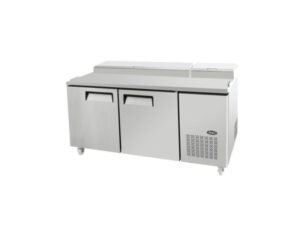
A full commercial prep station, also known as a commercial prep fridge, is an all-in-one food preparation unit that combines a refrigerated storage base with a prep top and cutting board in a single piece of equipment. Ingredients are stored in refrigerated compartments below the work surface, while frequently used toppings, sauces and fillings are held in GN pans along the top under a refrigerated lid or glass canopy. This design allows staff to prep, assemble and restock ingredients from one station without stepping away, making it ideal for busy kitchens where speed and organisation are critical.
Full prep stations are widely used in pizza shops, busy cafés, restaurants, takeaways, and high-volume sandwich and salad bars. In a pizza shop, for example, a prep station holds dough trays and bulk toppings below, with cheeses, meats and vegetables laid out on top for fast assembly during peak service. In cafés and restaurants, prep stations streamline sandwich and salad production by keeping all ingredients in one place, reducing staff movement and improving consistency across orders. High-volume takeaway kitchens benefit from the ability to keep large quantities of ingredients chilled and ready throughout long service periods.
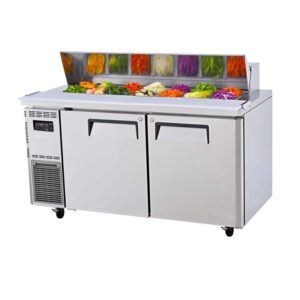
Benefits of a Full Prep Station
One of the biggest advantages of a full prep station is its all-in-one efficiency. Because ingredients are stored directly beneath the prep surface, staff spend less time walking to separate fridges and more time preparing food. This not only speeds up service during busy periods but also improves workflow and reduces fatigue. Full prep stations are designed for higher capacity, making them suitable for kitchens that handle continuous prep and large ingredient volumes throughout the day. The integrated layout also supports better organisation, stock rotation and food safety.
There are two main types of full commercial prep stations. Salad or Sandwich prep stations are designed for general cold food preparation such as wraps, salads, burgers and poke bowls. Pizza prep fridges are a specialised variation, typically featuring a deeper and wider cutting board to accommodate pizza dough, along with larger or additional GN pan layouts for toppings. Both types follow the same core design, with differences focused on prep surface size and top configuration rather than refrigeration performance.
Full prep stations are available in a range of sizes to suit different kitchen demands. 1200mm models are popular in small to mid-sized cafés and takeaways, offering a good balance between capacity and footprint. 1500mm units provide additional ingredient space for busier kitchens with broader menus. 1800mm prep stations are commonly used in pizza shops and high-volume sandwich or salad operations, allowing multiple staff members to work side by side during peak service. Larger models (such as 2400mm wide pizza prep fridges) are also available for very high-output kitchens that need extended prep lines.
Configuration options further increase flexibility. Full prep stations are available with stainless steel lids, which are durable and easy to clean for back-of-house use, or glass canopies, which improve ingredient visibility and are well suited to front-of-house or open-kitchen environments. These options allow businesses to match the unit to their workflow, hygiene requirements and service style.
Limitations
The main limitation of a full prep station is its larger footprint. Because it includes a refrigerated base, it requires dedicated floor space and proper installation, which may not suit very small kitchens or food trucks. There is also a higher upfront investment compared to countertop prep fridges. However, for businesses with steady or growing demand, this investment often pays off through improved workflow, faster service, reduced labour movement and better overall efficiency.
Key Differences
| Feature | Countertop Prep Fridge | Full Prep Station |
|---|---|---|
| Installation | Sits on existing bench | Free-standing unit |
| Refrigerated Base | No | Yes |
| Capacity | Low to medium | Medium to high |
| Floor Space Required | Minimal | Moderate |
| Best For | Small cafés, food trucks | Busy kitchens, pizza shops |
| Upfront Cost | Lower | Higher |
| Service Speed | Moderate | High |
Which One Is Right for Your Business?
Choose a Countertop Prep Fridge If:
You run a small café or takeaway
Space is limited
Your menu uses fewer ingredients
You already have adequate fridge storage
You want a lower upfront cost
Choose a Full Prep Station If:
You run a busy café, pizza shop or restaurant
Speed during peak service is critical
You prep food continuously throughout the day
You want ingredients stored directly below the prep area
You need higher capacity and efficiency
What About Food Trucks?
Food trucks often start with countertop prep fridges due to limited space and power capacity. However, larger trucks or trailers with higher output often upgrade to compact full prep stations to improve workflow and reduce service delays.
To Sum Up
There’s no one-size-fits-all answer. A countertop prep fridge is a smart, budget-friendly solution for small operations and light prep, while a full commercial prep station is built for speed, capacity and efficiency in high-volume kitchens. Many growing businesses start with a countertop unit and upgrade to a full prep station as demand increases.
Need help deciding which prep fridge is right for your kitchen? With years of hands-on experience equipping cafés, restaurants, takeaways and food trucks across Australia, our team at Bens Hospitality Equipment can guide you to the best choice for your space, workflow and budget. Contact us today for expert advice tailored to your business.