

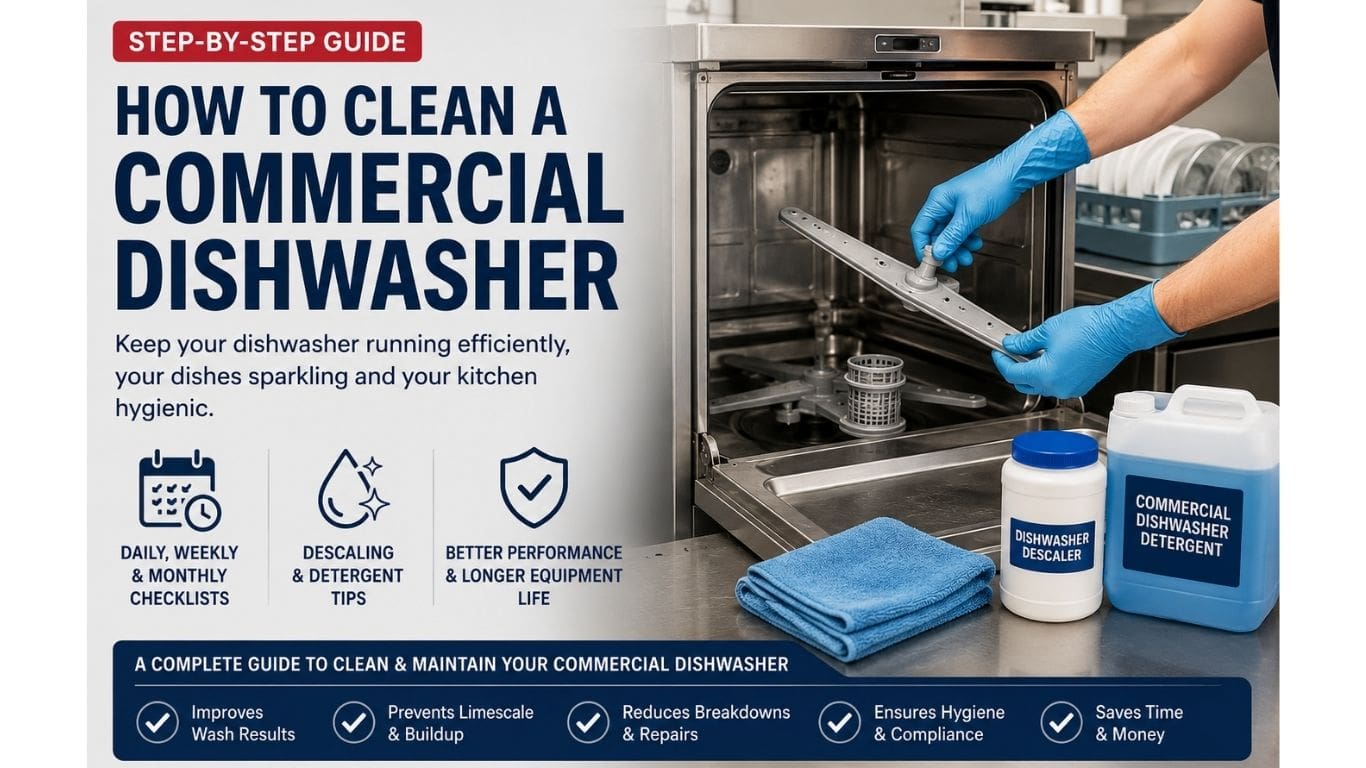
How to Clean a Commercial Dishwasher: A Step-by-Step Guide
A commercial dishwasher works harder than almost any other piece of equipment in your kitchen, running multiple cycles an hour throughout service. Without regular cleaning, grease, food scraps and limescale build up quickly inside the machine, leading to cloudy glassware, weaker wash results and costly breakdowns. The good news is that keeping a commercial dishwasher clean does not need to be complicated. With a simple daily, weekly and monthly routine, your machine will run more efficiently, use less energy and last a lot longer. This guide walks through exactly what to clean, how often, and what products are safe to use on a commercial dishwasher.
Why Regular Cleaning Matters
Commercial dishwashers sold in Australia must meet AS/NZS 3718 and reach minimum rinse temperatures to properly sanitise crockery, glassware and cutlery between covers. A dirty machine struggles to reach and hold these temperatures, which means dishes are not just dirtier, they may not be properly sanitised either. Build-up inside the tank and wash arms also forces the machine to work harder, which increases power and water use and puts extra strain on the pump and heating element. A few minutes of cleaning at the end of each shift is far cheaper than an unexpected service call in the middle of a busy week.
Daily Cleaning Tasks
At the end of each day, switch off and drain the dishwasher, then remove and empty the strainers, filters and any food scraps caught in the base of the tank. Wipe down the interior walls, door seals and detergent dispenser with a damp cloth to remove grease and food residue before it has a chance to dry on. Leave the door propped open overnight rather than closed, since this lets the inside dry out properly and stops mould or odours building up in a warm, damp space.
Weekly Cleaning Tasks
Once a week, take a closer look at the wash arms and spray jets, since these are the parts most likely to clog with food particles and limescale over time. Unclip the arms if your model allows it and rinse the jets under running water to clear any blockages, since even one blocked jet can noticeably reduce wash coverage. It is also worth checking the detergent and rinse aid dispensers for any dried residue, and giving the door seals a proper wipe down to stop grease building up in the folds.
Monthly Deep Clean and Descaling
Once a month, run a full descale using a commercial-grade descaling solution suited to your dishwasher model, following the dosage and contact time on the product label. How often you actually need to do this depends a lot on your water supply, which is covered in more detail below. After descaling, always run a couple of empty rinse cycles with clean water to flush out any leftover solution before washing dishes again.
Hard Water and Limescale: What's Really Going On
Limescale is one of the most common reasons a commercial dishwasher loses wash performance over time, and it almost always comes back to the hardness of the water feeding the machine. Hard water simply means water carrying higher levels of dissolved calcium and magnesium. When this water is heated inside a dishwasher, those minerals come out of solution and form limescale, a chalky deposit that builds up on the heating element, wash arms and spray jets. Over time, limescale insulates the heating element so it takes longer to reach wash temperature, narrows the holes in the spray jets so coverage gets patchy, and leaves a cloudy or spotty film on glasses and cutlery. None of this happens overnight, but in a hard water area it can creep up gradually until wash results noticeably drop off.
Is Your Water Actually Hard?
Water hardness in Australia is generally measured in milligrams per litre of calcium carbonate, with under 60 mg/L considered soft, 60 to 120 mg/L moderately hard, 120 to 180 mg/L hard, and anything above that very hard. Sydney’s town water is actually on the soft side by Australian standards, generally sitting between around 30 and 58 mg/L depending on which supply zone serves your address, with western Sydney suburbs such as Penrith and St Marys at the higher end of that range. Other parts of the country see noticeably harder water, particularly Perth and Adelaide, along with many regional towns that rely on bore water or groundwater rather than dam supply. If you are not sure where your venue sits, your local water authority usually publishes hardness figures such as Sydney Water’s Water Analysis for your supply zone, or a plumber can test it on site in a few minutes.
Signs Your Water Is Hard
The most obvious sign is a white or chalky film building up on glasses and stainless steel surfaces inside the machine, even straight after a wash cycle. You might also notice the dishwasher taking longer to heat up, weaker spray pressure from the wash arms, or needing to descale far more often than the routine above suggests. If you can see a visible crust forming around the heating element when you check inside the tank, that is limescale, and it is worth dealing with sooner rather than later since it only gets harder to remove the longer it sits.
What to Do If Your Water Is Hard
If your venue is in a moderately hard or hard water area, the first line of defence is simply descaling more often than you would in a soft water area, since regular descaling keeps mineral build-up from getting a foothold in the first place. For venues with consistently hard water, fitting an external water softener or scale reduction unit to the dishwasher’s water inlet is a more permanent fix, and this is a job for a licensed plumber rather than a DIY install. Some commercial dishwasher models also offer an internal water softener as an optional feature, so if hard water is a known issue at your venue, it is worth asking us about this when you enquire about a new machine.
Choosing the Right Cleaning Products
Always use a detergent, rinse aid and descaler designed for commercial dishwashers rather than reaching for household dish soap, since regular detergent foams up inside a commercial machine and can affect both wash quality and the pump. We stock Jantex dishwashing liquid concentrate as part of our dishwasher accessories range, along with replacement racks if yours are worn, bent or missing pegs. Avoid bleach unless your manufacturer specifically approves it, since it can damage seals and discolour stainless steel over time.
Signs Your Dishwasher Needs More Than a Clean
If cloudy glassware, slow draining or unusual noises continue after a proper clean and descale, the problem may be mechanical rather than a hygiene or hard water issue. Worn door seals, a failing pump or a heating element coated in years of limescale are common culprits, and these are best left to a qualified technician rather than DIY repair. Our troubleshooting guide for commercial dishwashers runs through the most common problems and what usually causes them, which is a good next step if cleaning alone has not solved the issue.
Frequently Asked Questions
Daily wipe-downs and filter checks, weekly wash arm cleaning, and a full descale once a month is a good baseline for most venues, though machines in harder water areas may need descaling more often.
No. Household dish soap foams excessively in commercial machines and can interfere with the pump and wash quality. Always use a detergent made for commercial dishwashers.
Cloudy glassware is usually caused by either limescale build-up from hard water, low rinse aid, or detergent residue from blocked wash jets. Descaling and a thorough clean of the wash arms will fix most cases.
No, not by Australian standards. Sydney’s water is generally classified as soft, typically between 30 and 58 mg/L of calcium carbonate, though it does vary slightly between supply zones. Perth and Adelaide generally have harder town water, as do many regional areas on bore water.
If you are descaling your dishwasher more often than recommended, seeing visible limescale on the heating element, or getting consistently cloudy glassware after a wash, a water softener is worth considering. Fitting one involves plumbing work, so a licensed plumber should do it.
Only if your manufacturer specifically recommends it. Bleach can damage rubber seals and discolour stainless steel surfaces over time, so a dedicated commercial dishwasher cleaner is generally a safer choice.
A daily wipe-down takes around five minutes, a weekly clean of the wash arms and seals takes about fifteen minutes, and a monthly descale including rinse cycles takes roughly half an hour from start to finish.