
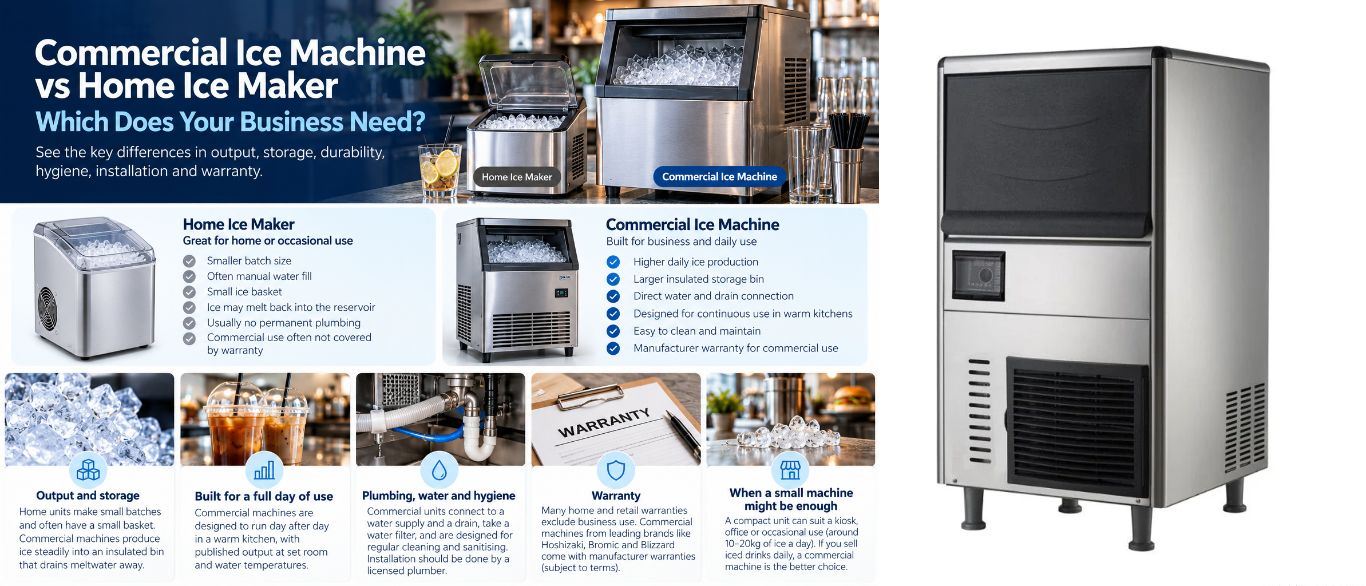
A portable ice maker from a retail store might look like a bargain, especially when it promises fresh ice in just a few minutes. But will it keep up when your café gets busy or your bar starts serving drinks back-to-back?
For occasional use, a home ice maker can be perfectly suitable. For a hospitality business that depends on ice every day, there's more to consider than the purchase price.
The biggest differences between a home ice maker and a commercial ice machine are daily production, ice storage, installation, cleaning requirements and warranty coverage.
Here's what to look for before choosing a machine for your business.
Home Ice Maker vs Commercial Ice Machine: Key Differences
Home or Portable Ice Maker
- Generally designed for occasional household use
- Usually requires manual water filling
- Produces relatively small batches of ice
- Typically has a small ice basket
- Ice may melt back into the water reservoir
- Usually doesn't need permanent plumbing
- Business use may be excluded from warranty
Commercial Ice Machine
- Designed for regular business operation
- Available in a wide range of daily capacities
- Usually connects directly to a water supply
- Commonly includes insulated ice storage
- Automatically stops when the bin is full
- Designed for routine cleaning and maintenance
- Commercial manufacturer warranty terms apply
1. Ice Production: Can a Home Ice Maker Keep Up?
This is where the difference becomes noticeable.
Many portable ice makers advertise their production capacity in kilograms per day. However, that figure doesn't mean you'll have the entire amount of ice ready at once.
For example, a portable ice maker advertised at 12kg per day might only hold a small amount in its basket. Someone may need to empty it regularly to keep production going.
Commercial ice machines are available with much higher output capacities and are generally designed to produce ice regularly throughout the trading day.
Daily Production Isn't the Same as Storage Capacity
These are two important specifications to understand.
- Daily production: How much ice a machine can make in 24 hours under specified test conditions.
- Storage capacity: How much finished ice the storage bin can hold at one time.
For example, a commercial ice machine rated at 50kg per day with a 15kg bin can produce up to its rated daily output, but only store around 15kg of ice at one time.
When the storage bin is full, production normally stops until ice is removed or melts.
For busy cafés and bars, both figures matter.
2. Why Ice Storage Matters During Busy Service
Imagine running a café where iced coffees and cold drinks become popular as soon as lunchtime arrives.
A small portable ice maker might produce enough ice across a whole day, but its basket could empty after just a few customer orders.
Staff then have to wait for another batch or collect ice from somewhere else.
Most portable countertop machines don't have refrigerated ice storage. Ice left in the basket gradually melts, and some models return that water to the reservoir.
Commercial underbench ice makers generally use insulated storage bins that slow melting and drain meltwater away.
Remember: An insulated ice bin isn't a freezer. Ice still melts over time, but proper storage helps keep a supply ready for busy periods.
3. Built for Regular Business Use
Home ice makers are convenient for parties, home bars and occasional entertaining.
Commercial ice machines are designed for business operating conditions, although their actual performance still depends on temperature, ventilation and water supply.
A machine installed beside a hot commercial stove may produce less ice than the same machine operating in a cooler room.
What to Look for in a Commercial Ice Machine
- Daily ice production under realistic conditions
- Storage bin capacity
- Maximum permitted ambient temperature
- Ventilation clearance
- Cleaning and maintenance requirements
- Water and electricity consumption
For more help choosing the right capacity, read our commercial ice machine buying guide .
4. Plumbing and Water Supply: What's Different?
Most portable home ice makers are straightforward to set up. Fill the reservoir with drinking-quality water, connect the power and start making ice according to the manufacturer's instructions.
A commercial underbench ice maker usually needs more planning.
Depending on the model, installation may require:
- A permanent drinking-water connection
- Suitable water pressure
- A compatible water filter
- A drainage connection
- An appropriate electrical supply
- Enough space for ventilation
Some commercial machines use gravity drainage, so the position of the drain matters.
If the drain connection is higher than the machine's outlet, a suitable external drain pump may be needed, where permitted by the manufacturer.
Before buying: Check where the machine will sit, how water will reach it and where wastewater will drain.
Plumbing work must meet applicable Australian requirements. Use an appropriately licensed plumber and compliant plumbing products, including WaterMark-certified products where required.
5. Ice Hygiene: Important for Every Food Business
Ice served in drinks is food, whether it comes from a small portable ice maker or a large commercial machine.
That means the water, equipment, storage areas and handling practices must be hygienic.
Good Ice-Handling Practices
- Always use drinking-quality water
- Clean and sanitise the machine as instructed
- Store ice in a clean, protected area
- Use a dedicated, clean ice scoop
- Avoid touching ice with bare hands
- Keep cleaning chemicals away from stored ice
- Check for scale, slime or contamination
Commercial models often provide access to components intended for routine cleaning and maintenance. However, cleaning procedures differ by model.
A water filter may help with certain water-quality issues, but filtration doesn't replace proper cleaning and sanitising.
See our step-by-step ice machine cleaning guide for practical maintenance advice.
6. Warranty: Check Before Using a Home Ice Maker in a Business
A home ice maker may cost less upfront, but the warranty can become an issue when you use it in a café, restaurant or takeaway.
Some consumer appliances have warranty conditions that limit or exclude commercial use.
Before purchasing, check whether the manufacturer covers your intended business application.
Commercial ice machines are sold for business applications, with warranty terms varying by brand and model.
At Bens Hospitality Equipment, we supply commercial ice makers from brands including Hoshizaki, Bromic and Blizzard.
We can help you check the applicable warranty, installation requirements and servicing arrangements before choosing a machine.
7. How Much Ice Does Your Business Need?
Before deciding between a home and commercial ice maker, work out how much ice you expect to use on your busiest day.
Example: A Small Café
Say your café sells 80 iced drinks on a busy day, with approximately 200g of ice in each drink.
80 drinks × 200g = 16kg of ice
That's 16kg of daily ice demand before allowing for extra drinks, wastage or other uses.
Adding a 25% planning allowance brings the estimated requirement to:
20kg of ice per day
This doesn't automatically mean a 20kg-per-day machine will be enough. You also need to consider storage capacity, operating conditions and when your customers place their orders.
How to Estimate Your Daily Ice Demand
- Count iced drinks sold on your busiest day.
- Estimate how much ice goes into each drink.
- Add ice used for food displays or other purposes.
- Allow for wastage and unexpected demand.
- Compare daily output and storage capacity.
For cafés with a concentrated lunchtime rush, having enough ice stored before service is especially important.
For bars serving drinks throughout the evening, both continuous production and storage matter.
8. When Is a Small Portable Ice Maker Enough?
You don't always need a large commercial machine.
A portable ice maker may be practical for:
- Home entertaining
- A home bar
- An office staff room
- Occasional events
- Very low-volume ice requirements
For business use, confirm the appliance is suitable for its intended application and meets applicable food safety requirements.
If your business regularly needs 10kg to 20kg of ice a day, it's worth comparing compact commercial models rather than assuming a household machine will manage the workload.
Even a small venue can experience a busy period where ice is needed much faster than a portable machine can produce it.
9. Is a Commercial Ice Machine Worth the Extra Cost?
For a business that serves iced drinks every day, a commercial ice machine can be a worthwhile investment.
The main benefits are practical:
- Higher-capacity options
- Dedicated ice storage
- Automatic water supply on plumbed models
- Less manual refilling
- Equipment designed for commercial applications
- Commercial servicing and warranty support
However, don't compare purchase prices alone.
A commercial ice machine may require plumbing, filtration, electricity, water, cleaning and regular servicing.
A portable home ice maker may be cheaper initially, but it could require more staff attention and struggle to meet demand during busy periods.
The better choice is the one that provides enough ice without making daily service harder.
10. Choosing the Right Commercial Ice Machine
For Small Cafés and Takeaways
Look at compact underbench ice makers with production and storage capacities suited to your busiest trading period.
For Busy Bars and Restaurants
Consider higher-output machines with sufficient storage to handle peak demand.
For Hotels and High-Volume Venues
A modular ice machine paired with a separate storage bin may provide greater flexibility.
Also consider which ice type suits your business. Cube ice is popular for cold drinks and cocktails, while nugget and flake ice serve different needs.
Browse our commercial ice makers to compare available options.
Find the Right Ice Maker for Your Business
A portable ice maker can be handy for occasional use, but when your café, restaurant or bar depends on ice throughout the day, a properly sized commercial machine is generally the better long-term choice.
At Bens Hospitality Equipment, we supply commercial ice makers for Australian hospitality businesses, from compact underbench models to high-capacity systems.
Tell us how many iced drinks you sell, how much ice you use and where the machine will be installed. We'll help you narrow down the options.
Shop Undercounter Ice MachinesOr call 1300 434 125 for friendly advice.
Fast Australia-wide delivery available.