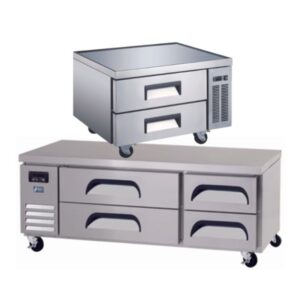
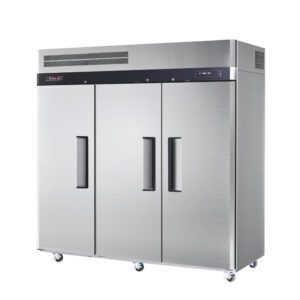
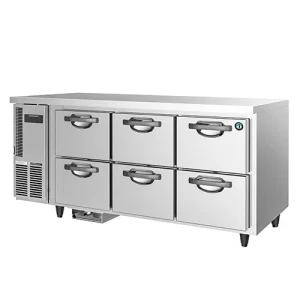
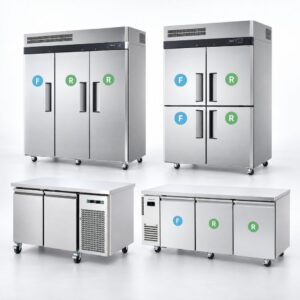
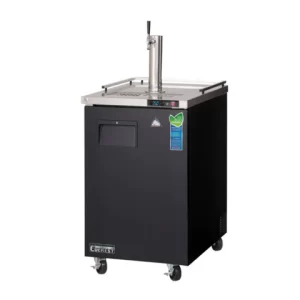
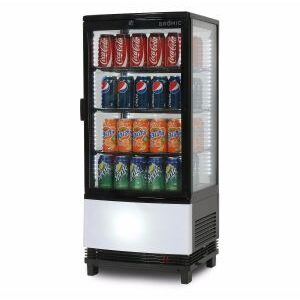
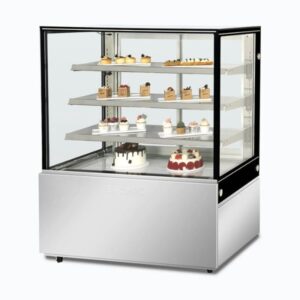
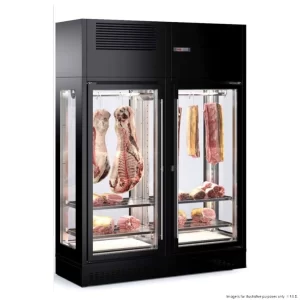
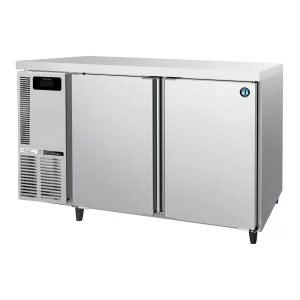
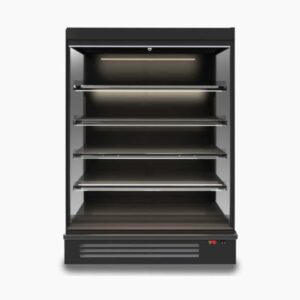
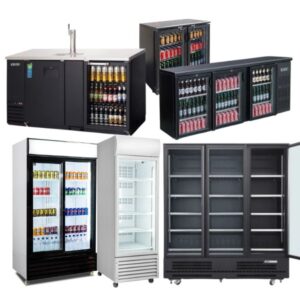
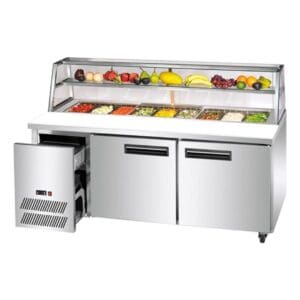
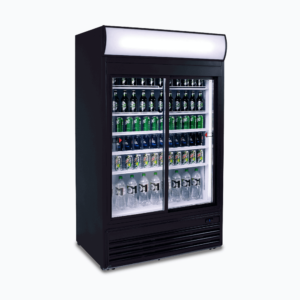
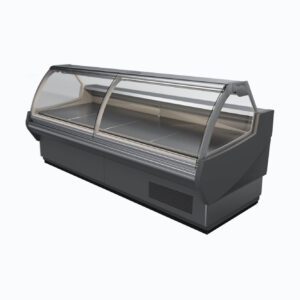
Looking for a reliable commercial fridge for your restaurant, cafe, bar, takeaway, bakery or food business? Ben’s Hospitality Equipment stocks a wide range of commercial fridges for sale across Australia, covering everything from compact under bench fridges and bar fridges to large upright fridges and specialised display refrigeration. Whether you need extra cold storage for a busy kitchen or a display fridge to showcase food and drinks, you can compare commercial refrigerators by size, capacity, door configuration, temperature range and brand to find the right fit for your business.
Different businesses need different types of refrigeration. Rather than choosing on capacity alone, think about where the fridge will sit, what you're storing, and how often staff or customers need access to it. Our range of commercial fridges makes it easy for restaurants, cafes, supermarkets and other food businesses across Sydney, Melbourne, Brisbane and the rest of Australia to find the right model for their storage needs.
Capacity is one of the most common questions we get asked, and getting it right matters. Too small and you're overcrowding shelves and losing cooling performance. Too big and you're paying to run empty space. As a rough guide:
| Business type | Recommended capacity |
|---|---|
| Small cafe or food truck | 200 – 400 litres |
| Mid-size restaurant | 400 – 600 litres |
| Large kitchen, butcher or high-volume venue | 600 – 1,000+ litres |
These figures are a starting point, not a hard rule. Your menu, delivery frequency and prep style will shift the number up or down. As a rule of thumb, leave 20 to 30 percent of stated capacity free for airflow and easy access rather than packing a fridge to its limit.
Before you buy, work through a few practical points. Start with size. Measure the space you have, including door clearance and airflow room around the back and sides, since a fridge pushed too tight against a wall won't cool properly. Most units need 50mm to 100mm of clearance around the compressor, though larger models may need more, so check the spec sheet for your chosen model.
Think about how staff will use the fridge day to day. If ingredients need to come out constantly during service, an under bench or drawer fridge close to the cook line saves time. If you're storing bulk stock, an upright fridge makes better use of vertical space.
Check the door type too. Solid doors hold temperature better and suit general storage, while glass doors work better where staff or customers need to see what's inside, like drink fridges and cake displays.
If your fridge will sit near ovens, fryers or in a hot back-of-house area, look for a model with a higher ambient temperature rating. This means it's built to keep cooling properly even when the surrounding air is warm, rather than straining the compressor.
Under the Australian Food Safety Standard, cold food must be held at 5°C or below. Most commercial fridges are set between 1°C and 4°C to keep a safe buffer, even with the door opening constantly during service.
Since a commercial fridge runs 24 hours a day, small efficiency features add up over time. LED interior lighting, auto-defrost and modern refrigerants all help keep running costs down.
Finally, look at build quality and brand support. A commercial fridge runs all day, every day, so a reliable compressor and easy access to spare parts matter more than a low price tag.
We stock commercial refrigerators from established brands including Bromic, Turbo Air, FED-X, Atosa, Thermaster, Williams, Polar, AG Equipment and Hoshizaki.
Different brands and models suit different applications, budgets and kitchen conditions. When comparing commercial fridges, look past the brand name and check the cabinet dimensions, cooling system, ambient rating, warranty and parts support to see what actually matters for your operation.
If you're comparing several models and aren't sure which one suits your business, contact our team and we'll help narrow down the options.
What's the difference between a commercial fridge and a domestic fridge?
Commercial fridges are built to run continuously and recover temperature quickly after the door is opened dozens of times a shift. Domestic fridges aren't designed for that duty cycle and tend to fail early in a busy kitchen.
What temperature should a commercial fridge run at?
Australian food safety standards require cold food to be held at 5°C or below. Most commercial fridges are set between 1°C and 4°C to maintain that safely.
Solid door or glass door, which one do I need?
Solid doors hold temperature more efficiently and suit back-of-house storage. Glass doors work better for front-of-house display, since customers and staff can see what's inside without opening the door.
Do I need a fridge with a higher ambient rating?
If it's sitting near ovens, fryers or in a warm back-of-house area, yes. A higher ambient rating means the fridge is built to hold its temperature reliably even when the surrounding air is hot.
Buying a commercial refrigerator online also means planning how it will reach its final spot. Ben's Hospitality Equipment works with freight providers to deliver commercial fridges to businesses throughout Sydney, Melbourne, Brisbane and other locations across Australia.
Depending on your location, equipment size and site access, additional delivery services may be available, including positioning, packaging removal and removal of an existing unit. For large commercial fridges, contact us before ordering if you have stairs, narrow access, restricted loading areas or other delivery concerns.
Also upgrading your cold storage setup? Explore our commercial freezers for frozen food storage and commercial ice makers for bars, cafes, restaurants and hospitality venues.
Our buyer’s guides help owners and chefs in cafés, restaurants and catering businesses understand what to look for when buying commercial fridges, freezers, ice makers, cooking equipment, ovens, dishwashers and other essential kitchen gear. Browse our professional guides.
Simply click the code below to copy the coupon, and paste it in the field at Check-out
Contact us by phone, email, live chat, or visit us in store. We’re here to help.