
Instant Asset Write-Off for Commercial Kitchen Equipment in Australia (2025-26)
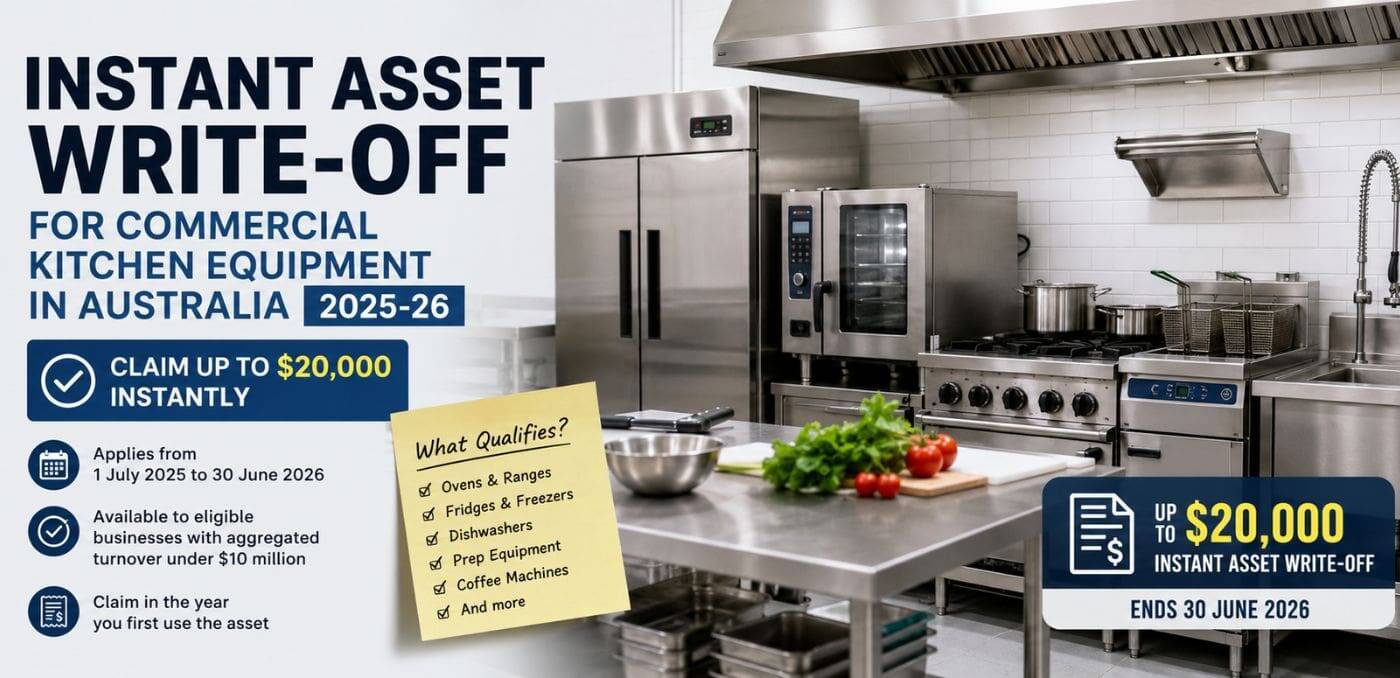
If you are planning to buy commercial kitchen equipment before 30 June 2026, the $20,000 instant asset write-off (IAWO) could let you claim the full cost of each eligible purchase as a tax deduction in the same financial year rather than depreciating it over several years.
For a cafe or restaurant buying multiple pieces of equipment, that can represent a significant reduction in taxable income. Most individual items of commercial kitchen equipment fall well under the $20,000 threshold, which means most purchases qualify directly without any additional calculation.
Here is a breakdown of how it works, what qualifies, who is eligible, and what you need to do before the deadline.
What the Instant Asset Write-Off Actually Means
The instant asset write-off is a tax concession that allows eligible small businesses to immediately deduct the full cost of a qualifying asset in the income year it is purchased and first used, rather than claiming smaller depreciation amounts over several years. The ATO sets the threshold for the current financial year at $20,000 per asset.
The key word is “immediately.” Instead of claiming, say, 15% of the asset cost this year and 30% each subsequent year, you claim the full purchase price in one hit against your taxable income for 2025-26.
For a business paying 25% company tax, writing off $18,000 worth of equipment this year rather than over several years represents a genuine cash flow difference of around $4,500 in the current tax return.
Who Is Eligible
To use the instant asset write-off for 2025-26, your business must have an aggregated annual turnover of less than $10 million. This covers the vast majority of independent restaurants, cafes, takeaway businesses, bakeries, catering operations, and food service venues in Australia.
Aggregated turnover includes the annual turnovers of any related or connected entities, not just your own business alone. If you run multiple venues under different structures, check this with your accountant before assuming you qualify.
The write-off applies to sole traders, partnerships, companies, and trusts, as long as the turnover threshold is met and your business uses the simplified depreciation rules set out by the ATO.
What Commercial Kitchen Equipment Qualifies
Most standard commercial kitchen equipment qualifies for the instant asset write-off because it falls comfortably under the $20,000 per-asset threshold. This includes:
- Commercial fridges and industrial freezers are among the most common claims for hospitality businesses. An underbench fridge, an upright two-door fridge, a chest freezer, or a commercial display fridge will typically cost between $800 and $8,000, well within the threshold.
- Commercial dishwashers, including undercounter and passthrough models from brands like Eswood, Meiko, and Hobart, are typically priced between $2,000 and $15,000, depending on capacity. Most models in this range qualify in full.
- Commercial cooking equipment such as deep fryers, griddles, char grills, wok burners, and induction cooktops generally fall well under the threshold individually. A commercial deep fryer, for example, is often priced between $1,500 and $8,000.
- Prep fridges used for pizza, salad bars, and cold assembly typically range from $1,800 to $7,000, qualifying in full.
- Commercial ice machines, hot food displays, commercial blenders, and stainless steel benches also typically qualify, as these items are individually priced well under $20,000.
- Mid-range combi ovens can sit anywhere from $5,000 to $18,000, depending on the brand and capacity, so many qualify directly. High-end models from brands such as Rational or Unox may push above $20,000, in which case the pool depreciation rules apply instead.
- Both new and second-hand assets are eligible for the instant asset write-off, provided they meet the other requirements.

The Rule That Catches People Out: "Installed Ready for Use"
This is the most important detail, and it is the one that causes the most confusion.
The asset does not just need to be ordered or paid for by 30 June 2026. It must be first used or installed ready for use by that date. If you order equipment on 20 June and it does not arrive until 5 July, you cannot claim it in the 2025-26 return.
For a busy supplier like us with Australia-wide delivery, equipment ordered in early to mid-June generally arrives well before the end of the financial year. But if you are ordering in late June, account for delivery time and confirm receipt before the financial year closes.
The same principle applies to installation. If a piece of equipment requires plumbing or electrical connection before it can operate, the clock does not start until that connection is made and the equipment is ready to use.
What Happens If the Equipment Costs $20,000 or More
Assets that cost $20,000 or more do not qualify for the instant write-off, but they are not lost. They are placed into the small business general depreciation pool, where they depreciate at 15% in the first income year and 30% in each following income year.
For example, a Rational combi oven purchased for $32,000 (excluding GST) in September 2025 would attract a deduction of $4,800 (15%) in the 2025-26 return, followed by $8,160 (30% of the remaining balance) in 2026-27, and so on.
This is less favourable than the instant write-off, but it is still a legitimate depreciation claim. For high-value equipment, this is simply how the deduction works.
GST and the $20,000 Threshold
Whether GST is included or excluded in the threshold calculation depends on your registration status.
If your business is registered for GST, the $20,000 threshold applies to the GST-exclusive price. A fryer that costs $18,700 including GST is $17,000 excluding GST, so it qualifies. You claim the GST separately through your BAS as normal, and the instant write-off applies to the $17,000 base price.
If your business is not registered for GST, the $20,000 threshold applies to the full price you paid, including any GST component.
The Deadline and What Happens After 1 July 2026
Start with the equipment that gives you the biggest operational benefit or the most urgent replacement need. The write-off rewards purchases you were already planning to make rather than encouraging unnecessary spending, but it does make the timing of planned purchases matter more than usual.
If you are buying multiple pieces of equipment, each item is assessed individually against the $20,000 threshold. There is no cap on the total number of items you can claim, only the per-item limit. Three fridges at $6,000 each represent three separate $6,000 deductions, not one $18,000 item assessed against a single threshold.
Keep all invoices, purchase records, and evidence that the equipment was installed ready for use before 30 June 2026. The ATO does not require you to submit these with your return, but you must be able to produce them if asked.
As always, confirm your eligibility and strategy with your accountant before making decisions based on tax outcomes.
How to Make the Most of It Before 30 June
First impressions matter, even in the kitchen. Stainless steel kitchen benches give your kitchen a clean, professional appearance that both staff and health inspectors will appreciate. The sleek, modern finish is easy to maintain and continues to look great year after year.
For businesses where the kitchen is visible to customers, such as open-plan kitchens, food trucks, market stalls, or cooking demonstrations, a stainless steel bench gives off the right image. It communicates cleanliness, professionalism, and quality.
Frequently Asked Questions
Yes. Both new and second-hand assets qualify for the instant write-off under the 2025-26 rules, provided the asset is first used or installed ready for use between 1 July 2025 and 30 June 2026 and costs less than $20,000 (excluding GST for GST-registered businesses).
Yes. The $20,000 threshold applies per asset, not per business. You can write off as many individual items as you purchase in the same financial year, as long as each item individually costs less than $20,000. There is no cap on the total amount.
The $10 million turnover threshold is based on your aggregated annual turnover, which includes connected or related entities. If your combined turnover across multiple venues is under $10 million, you are still eligible. Confirm this with your accountant if you operate through more than one entity.
This depends on the structure of the finance arrangement. Under a chattel mortgage or hire purchase, your business takes ownership of the asset, so the write-off can generally apply. Under an operating lease, the finance company retains ownership and the write-off does not apply in the same way. Check the structure of any finance arrangement with your accountant before assuming you can claim.
You need records that confirm the asset was purchased, its cost, and that it was first used or installed ready for use before 30 June 2026. Tax invoices, delivery receipts, and bank or credit card statements are the standard supporting documents.
This article is general information only and does not constitute tax advice. For advice specific to your business and circumstances, speak with your accountant or registered tax agent.