
How to Choose the Right Commercial Convection Oven in Australia
A commercial convection oven is one of the hardest working machines in a café, restaurant or bakery. It bakes your croissants at 6am, roasts your vegetables at lunch and reheats your pies when the afternoon rush hits. Pick the right one and your kitchen runs smoothly. Pick the wrong one and you end up with slow service, uneven food or a power problem you did not plan for.
This guide is written for Australian chefs, café owners and new business owners. It covers what to look for, how many trays you need, what you can expect to pay, and how a convection oven compares with a combi oven. It also answers the question many people ask: “can you use a commercial convection oven at home?”
The Short Answer
Choose your oven by working through four things in this order: what you cook, how many trays you need per batch, what power your site has, and how much you want to spend. A small café that bakes and reheats can get a very good result from a compact 3 or 4 tray oven. A busy bakery or catering kitchen will need a bigger 600 x 400mm tray oven, or a model with 5 to 10 trays. If you cook a lot of steamed or moist food, look at a combi oven instead.
What Is a Commercial Convection Oven?
A commercial convection oven has a fan inside the cooking chamber. The fan moves hot air around the food, so heat reaches every tray evenly. This is why convection ovens cook faster and brown more evenly than a basic static oven. They are also built tougher than home ovens, with stainless steel bodies, stronger doors and parts made to run for many hours a day.
What Do Chefs Use a Commercial Convection Oven For?

In Australian cafés, restaurants and bakeries, a convection oven is a true all-rounder. Here is how kitchens use them every day.
Cafés use them for muffins, scones, croissants, danishes, quiches, sausage rolls, pies and toasted sandwiches. A morning baker might do a tray of almond croissants, then switch straight to a savoury batch for the lunch cabinet.
Restaurants use them to roast vegetables, cook chicken pieces, bake fish, finish steaks and reheat prepared meals. Because the air moves, a full tray of roast potatoes browns evenly instead of burning at the back and staying pale at the front.
Bakeries use bigger convection ovens for biscuits, cookies, small breads, pastries and cakes. Models with steam injection help bread get a crisp crust.
Caterers and function kitchens use them to cook and reheat large batches, then send food out quickly.
One practical tip chefs share: fan-forced cooking is quicker, so many cooks lower the temperature by about 10 to 20°C compared with a regular recipe and check the food a little early. Every oven is different, so test your top menu items on the first week.
Start With Your Menu
The best question to ask before you shop is simple: what will this oven cook most of the time? Your answer decides almost everything else.
If your menu is mostly baked goods, you want even heat and the right tray size, and steam is a bonus if you bake bread. If you mostly reheat pies, pastries and frozen items, a compact digital oven with simple controls is plenty. If you cook a mix of roast, bake and grill dishes, look for a convection oven with a grill function. If you also need moist cooking such as steaming or poaching, a combi oven may suit you better (see the comparison below).
Number of Trays and Tray Sizes: Why They Matter
Tray number and tray size decide how much food you can cook in one batch. They also decide which pans you can use, so they matter more than most buyers expect.
There are two main tray standards you will see in Australia. A gastronorm (GN) 1/1 tray measures 530 x 325mm. This is the standard pan size used in combi ovens, bain maries and fridges, so the same pan can go from prep to oven to service. A bakery tray measures 600 x 400mm. It is the standard in bakeries and patisseries and is larger, so it holds more croissants, cookies or pastries per tray.
Many smaller convection ovens use their own tray sizes. For example, compact benchtop ovens on the market use trays of roughly 342 x 242mm, 435 x 350mm or 460 x 330mm. These are lovely and small, but your normal GN pans and bakery sheets will not fit inside them. If you already own pans, or plan to buy standard ones, check the oven’s internal tray size first.
Here is a simple way to think about it. A 3 tray oven suits a small café, food truck or takeaway. A 4 tray oven is the sweet spot for most cafés and small restaurants. A 5 to 10 tray oven is for bakeries, hotels, caterers and busy production kitchens.
Also check the gap between shelves. If you bake tall items such as loaves, deep dishes or high muffins, you need enough space between the racks so the top of the food does not touch the tray above. It is worth stocking the right trays from the start. You can browse a range of commercial baking trays and sheets that suit common oven sizes.
How to Calculate the Oven Capacity You Actually Need
Start with your busiest production period. How many muffins, pastries, meals or trays do you need ready, and how much time do you have to cook them?
A useful starting point is:
Trays per batch × batches per hour = estimated tray output per hour.
For example, a 4 tray oven with a 20 minute cooking cycle has a theoretical output of 12 trays per hour. However, that assumes immediate changeovers. Loading, unloading and allowing the oven to recover between batches can reduce your actual output.
Tray spacing matters too. Tall loaves or deep roasting dishes may require leaving some levels empty, so a four-level oven will not necessarily hold four trays of every product.
Check capacity using your actual menu, tray dimensions and cooking times. If the oven will handle several jobs during service, allow room in the schedule for those competing demands.
Features to Look For
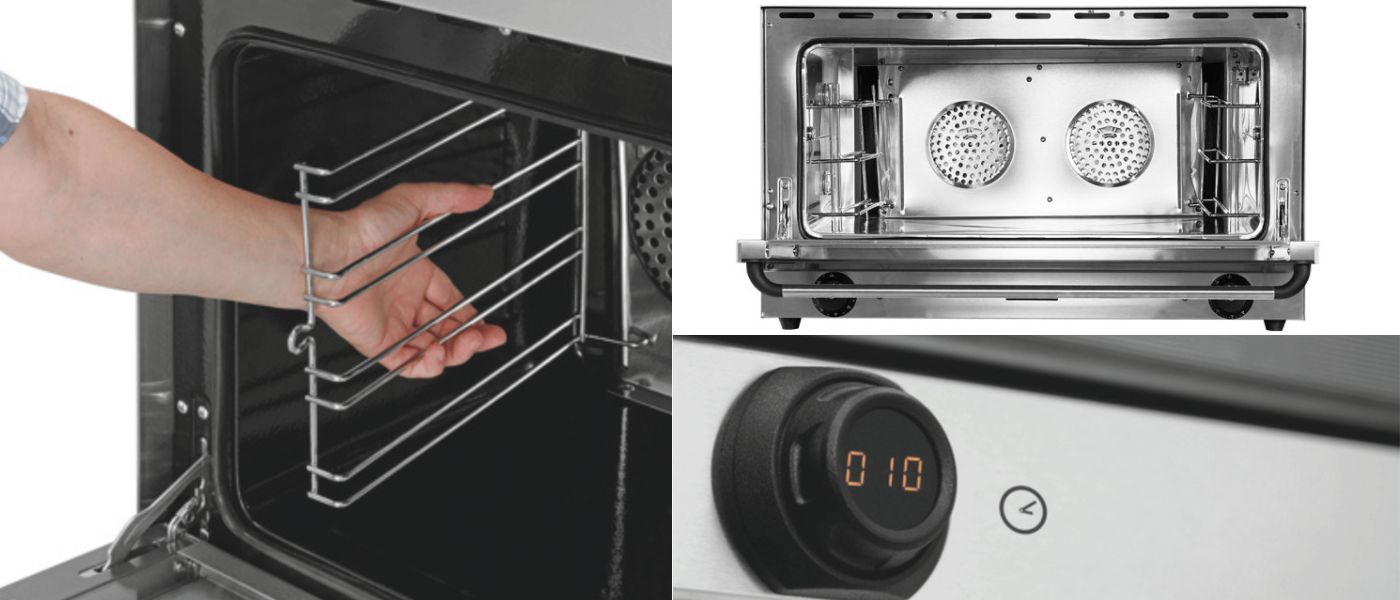
When you compare commercial convection ovens, these are the features that make a real difference in a working kitchen.
- Controls. Manual dials offer straightforward operation. Repair costs depend on the model and the fault. Some digital models let you store cooking programs, so a new staff member can press one button and get the same result as your head chef. If you have a high staff turnover, digital controls are worth the extra cost.
- Steam injection. A burst of steam into the chamber helps bread and pastry get a shiny, crisp crust and a soft inside. Without steam, fan-forced heat can dry out the surface of dough before it has finished rising. If you bake bread often, choose a model with steam.
- Grill function. A top grill is handy for browning cheese, finishing a dish or giving food a golden top. Several compact convection ovens now include one.
- Temperature range and recovery. A good oven gets back to temperature quickly when you open the door. This matters in a busy kitchen where the door opens all day.
- Build quality and cleaning. Look for a stainless steel body, a door that seals well, a glass door that is easy to wipe and racks that slide out for cleaning. A kitchen that cleans an oven easily will keep it in better condition for longer.
- Door and glass. A glass door lets you check your food without losing heat. Double glazed glass keeps the outside cooler, which is safer for staff in a tight kitchen.
Fan Speed and Airflow: Important for Cakes and Pastries
When choosing a commercial convection oven for cakes, cookies, croissants or other baked goods, look beyond tray count. Check how much control you have over the fan.
Some models have a fixed-speed fan, while others offer adjustable speeds or a reversing fan. These features give you different ways to manage airflow around your food. For delicate baking, ask whether a gentler fan setting is available and suitable for your recipes.
A reversing fan changes the direction of airflow during cooking. It is a useful feature to compare, but it does not replace correct loading, suitable trays and enough space for air to circulate.
If baking is central to your business, ask about a demonstration using your main products. A full batch of your muffins, cookies or pastries will tell you more than an empty oven demonstration. Check the colour, rise and finish across the different tray positions.
Check Your Power Before You Buy
This is the mistake that costs the most time. Power requirements vary a lot between models, and in Australia the plug type matters.
A standard 10A power point can supply about 2,400W, which is enough for small benchtop ovens. For example, the ConvectMax YXD-1AE compact oven is rated at 2,400W and runs on a regular 10A plug. Bigger commercial ovens often draw more. The ConvectMax YXD-8A-3E, a 3 tray 600 x 400mm oven, is rated at 3,500W and needs a 15A outlet. Larger ovens and combi ovens can need 3 phase power or gas.
If you are unsure what your site has, ask a licensed electrician before you order. It is far cheaper to confirm first than to find out when the oven arrives. Commercial cooking equipment also usually needs proper ventilation, so check the rules with your fit-out supplier, building certifier or local council.
Does a Commercial Convection Oven Need a Water Connection?
It depends on the model. A dry-heat convection oven may not need a water connection, while a model with steam or moisture injection may require a connected water supply or another manufacturer-specified water arrangement.
Before ordering a moisture-injection oven, check:
Whether it needs a mains water connection.
The required water pressure and water quality.
Whether water treatment is specified.
Whether a drain connection is required.
What plumbing fittings and installation work are included.
Follow the installation manual for the exact model. Do not assume that every oven with steam injection has the same plumbing requirements.
Also, steam injection does not automatically make an oven a combi oven. Adding moisture during baking is different from providing dedicated steam cooking and controlled combination cooking modes. If you want to steam vegetables, cook rice or prepare other steamed dishes, check the oven’s cooking functions before you buy.
Commercial Convection Oven Price Ranges in Australia
Prices depend on size, brand, controls and extras like steam and grill. Here is what the range looks like in Australia in October 2026, based on current prices at Ben’s Hospitality Equipment (all prices ex GST).
Compact 3 to 4 Tray Ovens (10A Plug)
Price: About $700 to $1,500
Best for: Small cafés, food trucks, takeaways and reheating
Examples: ConvectMax compact 10A oven (around $934) and Spidocook 3 tray oven (around $1,273)
4 Tray Ovens With Digital Controls, Steam or Grill
Price: About $1,800 to $2,500
Best for: Cafés, bakeries and restaurants
Example: Tecnodom 4 tray 600 x 400mm oven (around $2,379)
Heavy Duty Benchtop Ovens (Premium Brands)
Price: About $4,000 and up
Best for: Busy kitchens that want extra durability
Example: Lincat 4 tray 600 x 400mm oven (around $4,271)
5 to 10 Tray Bakery Convection Ovens
Price: About $17,000 to $21,000
Best for: Bakeries, hotels, caterers and high output kitchens
Examples: Moretti Forni 5 tray oven ($17,100) and 10 tray oven ($21,400)
Prices change with promotions and stock, so always check the current price on the product page.
Rent or Finance Your Oven
If upfront cost is a worry, you have options. Selected convection ovens at Ben’s Hospitality Equipment can be rented from around $20 a week (ex GST). Equipment finance is also available through SilverChef.
Comparison
Spidocook SPE-SF043AS Caldobake
An option for kitchens using 600 × 400mm bakery trays with a 15A power supply. Trays are purchased separately.
| Specification | Details |
|---|---|
| Price ex GST | $2,750.00 |
| Tray capacity | 4 × 600 × 400mm |
| Tray spacing | Confirm before ordering |
| Electrical requirements | 240V, 3.5kW, 15A |
| Fan system | Ventilated convection; adjustable speed not specified |
| Moisture injection | Not specified in the listing |
| Included trays | Not included |
| Temperature range | 30°C–260°C |
View the Spidocook SPE-SF043AS
Tecnodom TDE-4CD Nerone EKO
Worth considering if you want smaller trays, a 10A connection and digital controls. Its memory stores up to nine recipes to make repeat batches easier.
| Specification | Details |
|---|---|
| Price ex GST | $1,869.15 |
| Tray capacity | 4 × 435 × 350mm |
| Tray spacing | 84mm |
| Electrical requirements | 240V, 2.35kW, 10A |
| Fan system | Twin fans; adjustable speed not specified |
| Moisture injection | Not specified in the listing |
| Included accessories | 1 solid tray and 3 wire racks |
| Temperature range | 50°C–280°C |
ConvectMax YXD-8A/15E with Steam
An option for kitchens wanting 600 × 400mm bakery trays, reversing fans and press-button steam. Four aluminium baking trays are included.
| Specification | Details |
|---|---|
| Price ex GST | $2,073.00 |
| Tray capacity | 4 × 600 × 400mm |
| Tray spacing | 80mm |
| Electrical requirements | 240V, 3.3kW, 15A |
| Fan system | Two reversing fans; adjustable speed not specified |
| Moisture injection | Yes—press-button steam |
| Included trays | 4 aluminium baking trays |
| Temperature range | 50°C–300°C |
View the ConvectMax YXD-8A/15E
Which One Suits Your Kitchen?
For a 10A connection and saved recipes, consider the Tecnodom.
For 600 × 400mm tray capacity, compare the Spidocook and ConvectMax.
For press-button steam and included bakery trays, consider the ConvectMax.
Match your choice to your menu, existing trays and available services. Four tray levels do not necessarily provide the same output when the tray dimensions differ.
Budget for the Installed Oven, Not Just the Purchase Price
The advertised price is only part of your budget. Before comparing commercial convection ovens, find out what it will cost to have each option delivered, installed and ready to use.
Ask your supplier to confirm:
Delivery and placement: Does freight include unloading and moving the oven into your kitchen?
Electrical connection: Can your existing supply support the oven, or is electrical work required?
Ventilation: Is your current extraction arrangement suitable for the oven and the food you will cook?
Plumbing: Does the model need water, water treatment or drainage?
Accessories: Are trays, racks, a stand or a stacking kit included?
Setup and training: Is commissioning or an operating demonstration available?
Ongoing costs: What cleaning products, servicing and replacement consumables will you need?
A lower purchase price does not always mean a lower total cost. Compare quotes with the same installation work and accessories included, so you can see what you are actually paying for.
Best Picks for the Right Menu

Here is a simple way to match an oven to your kitchen. These are examples of typical kitchens, not specific customers.
Small café or coffee cart
Picture a 20 seat café that bakes muffins and reheats pies and sausage rolls. A compact 3 or 4 tray oven on a 10A plug is the smart, low-cost choice. It plugs into a normal power point, takes up little bench space and gets the job done. A digital model makes timing easier when you are also making coffee.
Busy café with a full breakfast and lunch menu
Picture a 50 seat café that bakes in the morning and cooks toasted sandwiches, quiche and roast veg at lunch. A 4 tray oven with 600 x 400mm trays, digital controls and a grill is a strong fit. The bigger tray holds more per batch, and the grill gives you a golden finish on top.
Bakery or patisserie
Picture a small bakery making croissants, danishes and bread rolls. You want 600 x 400mm trays, steam injection and enough capacity to bake several trays at once. A 5 or 10 tray bakery convection oven is the right level, and for the best crust on bread you might also look at a deck oven.
Restaurant kitchen
Picture a restaurant that roasts vegetables, bakes fish and reheats prepared sauces and sides. A 4 tray GN oven works well, because the same 1/1 pans move from prep to oven to service without any transfer.
Caterer or function venue
Picture a caterer cooking for 150 guests. Here, capacity and repeatable results matter most. Look at a larger 5 to 10 tray oven, or compare it with a combi oven, which gives you steam as well as dry heat.
Convection Oven vs Combi Oven
This is one of the most common questions buyers ask, and the answer comes down to steam. A convection oven cooks with hot, dry, moving air. A combi oven can cook with dry heat, with steam, or with both at once. Every combi oven has a convection mode, so it can do what a convection oven does and more.
Steam matters for foods that need moisture: fish, steamed vegetables, rice, dumplings, braised dishes and reheating food without drying it out. It also helps with cooking times and keeps meat juicy. On the other hand, a combi oven costs a lot more and needs more care.
Look at the price gap on the current range. A 4 tray convection oven can cost around $2,000 to $2,500. Combi ovens in the current range are mostly well above $12,000, with a compact 6 tray model around $12,700 and large 20 tray units climbing past $50,000. Combi ovens also need good water supply and filtration, regular descaling and more servicing, because they make steam. Many makers require water filtration to keep the warranty valid.
So which one should you buy? Choose a convection oven if your menu is mostly baking, roasting and reheating, and you want a simpler, cheaper machine. Choose a combi oven if you cook many different styles of food, want one machine to replace an oven and a steamer, or need precise moisture control for consistent results at volume. If you are on the fence, browse both ranges side by side: commercial convection ovens and commercial combi ovens.
Can a Commercial Convection Oven Be Used at Home?
It is possible, but it is not always a good idea. Here is what to think about first.
Power. Small compact models on a 10A plug can run from a normal power point. Bigger commercial ovens draw much more power and may need a 15A outlet or 3 phase, which means paying an electrician to upgrade your wiring.
Warranty. Many manufacturers do not cover warranty claims if a commercial oven is installed in a home. Some even say so clearly in their product documents. Always read the warranty terms before you buy.
Insurance. Check with your home insurer before installing commercial cooking equipment.
Heat, noise and space. Commercial ovens give off more heat and have stronger fans, so they can warm up a small home kitchen and sound louder than a regular oven. They are also bigger and heavier than they look.
Cooking style. A convection oven cooks differently from your home oven. Recipes often need a lower temperature and a shorter time. If you plan to sell home-baked goods, check your local council’s rules for food businesses too.
If you run a small home-based food business, a compact 10A convection oven is the most practical option. For a normal family kitchen, a good home fan-forced oven is usually the better fit.
Check Warranty, Spare Parts and Local Service Support
Before buying a commercial convection oven, find out what happens if it needs attention during a busy trading week.
Check the warranty period and whether cover includes parts and labour or parts only. Ask whether service is provided on site or whether the oven must be returned to a service centre. Confirm any travel charges or service limitations for your location.
It is also worth asking:
Are replacement door seals, fans, elements and controls available in Australia?
Who handles warranty requests?
Is there a service technician covering your area?
What cleaning and maintenance does the manufacturer require?
Are there installation or water-quality conditions attached to the warranty?
If the oven will be used in a home-based business, confirm that the manufacturer accepts the intended installation and use before ordering.
Clear answers help you compare the support behind each oven as well as its purchase price.
Common Mistakes to Avoid
The first is buying on tray number alone and ignoring tray size. Always check that your pans fit. The second is skipping the power check. Confirm the plug and amps before you order. The third is buying more oven than you need. A combi oven is brilliant, but if you only bake and reheat, you are paying for features you will not use. The fourth is forgetting space around the oven. Leave room for airflow, door opening and safe access, and check the stand or bench can take the weight. You can also pair your oven with a matching stand from our oven stands and accessories range.
Essential Checklist Before Buy
- The delivery route, including doorways and tight corners.
- The installed footprint, including handles and connections.
- Door-opening space.
- Manufacturer-specified clearances.
- Access needed for cleaning and servicing.
- The loading height when mounted on the proposed stand.
Frequently Asked Questions
Most cafés do well with a 4 tray oven. Very small cafés can use a 3 tray compact model, and busy cafés with a big food menu can step up to a 600 x 400mm tray oven.
Possibly. In Australia, the requirement depends on the oven’s maximum power input, the other cooking equipment in the room, and the fumes, smoke, steam and grease produced during cooking.
Under the NCC 2022 Deemed-to-Satisfy provisions, a commercial kitchen requires an exhaust hood complying with AS 1668.1 and AS 1668.2 when:
| Situation | Threshold that triggers the requirement |
|---|---|
| Any individual electric cooking appliance | Maximum electrical input exceeds 8 kW |
| Any individual gas cooking appliance | Gas input exceeds 29 MJ/hour |
| More than one electric cooking appliance in the room | Combined maximum input exceeds 0.5 kW per m² of room floor area |
| More than one gas cooking appliance in the room | Combined gas input exceeds 1.8 MJ/hour per m² of room floor area |
These are maximum input ratings, rather than average energy consumption during service. The applicable NCC edition and state or territory requirements should be confirmed for your project. ABCB
An oven below these thresholds is not automatically exempt from extraction requirements. Food Safety Standard 3.2.3 requires sufficient ventilation to effectively remove fumes, smoke, steam and vapours. FSANZ advises that natural ventilation is generally suitable only where little or no cooking produces steam or greasy air. A small oven can therefore still need mechanical extraction, depending on its use and the premises. foodstandards.gov.au
For example, roasting meat and baking bread place different demands on ventilation. FSANZ specifically gives an example of a bakery needing an exhaust hood and extraction fans because oven condensation was causing mould and flaking paint. Baking alone does not guarantee that a hood is unnecessary.
Before buying or installing your oven, provide its specification sheet, installation manual, proposed menu and full cooking equipment list to your mechanical ventilation designer and building certifier. Check any food premises approval requirements with your local council’s environmental health officer as well. Ask them to confirm whether the proposed ventilation arrangement is suitable for that particular oven and kitchen.
They work on the same idea: a fan moves hot air around the food. Commercial models are built with stronger parts, bigger capacity and features like digital programs and steam injection, so they can handle all-day use.
There is no single answer. Running costs depend on the model, what you cook, batch sizes, operating hours and how much time the oven spends preheating or sitting hot between jobs.
The kW rating tells you about electrical input, but it does not tell you exactly how much electricity the oven will consume throughout a service. Heating elements cycle during operation, and energy use changes with the cooking conditions.
To calculate electricity cost, use:
Energy consumed in kWh × electricity tariff per kWh = electricity cost.
For example, if an oven consumes 6 kWh and your usage rate is $0.30 per kWh, the electricity cost is $1.80. This is an illustration only and excludes other electricity charges.
For a useful comparison, ask for energy-consumption information under stated operating conditions. Compare ovens preparing the same amount of food to the same standard, rather than choosing purely on the lowest kW rating.
Also consider water, cleaning, servicing and labour. A combi oven may justify its additional costs if its cooking functions save preparation time or replace other equipment.
Ready to Choose Your Commercial Convection Oven?
The right oven comes down to your menu, your tray needs, your power and your budget. If you want help matching an oven to your kitchen, the team at Ben’s Hospitality Equipment can guide you. Call 1300 434 125 or email info@bendgs.com.au. We deliver Australia wide, with finance and rental options available on selected models.