

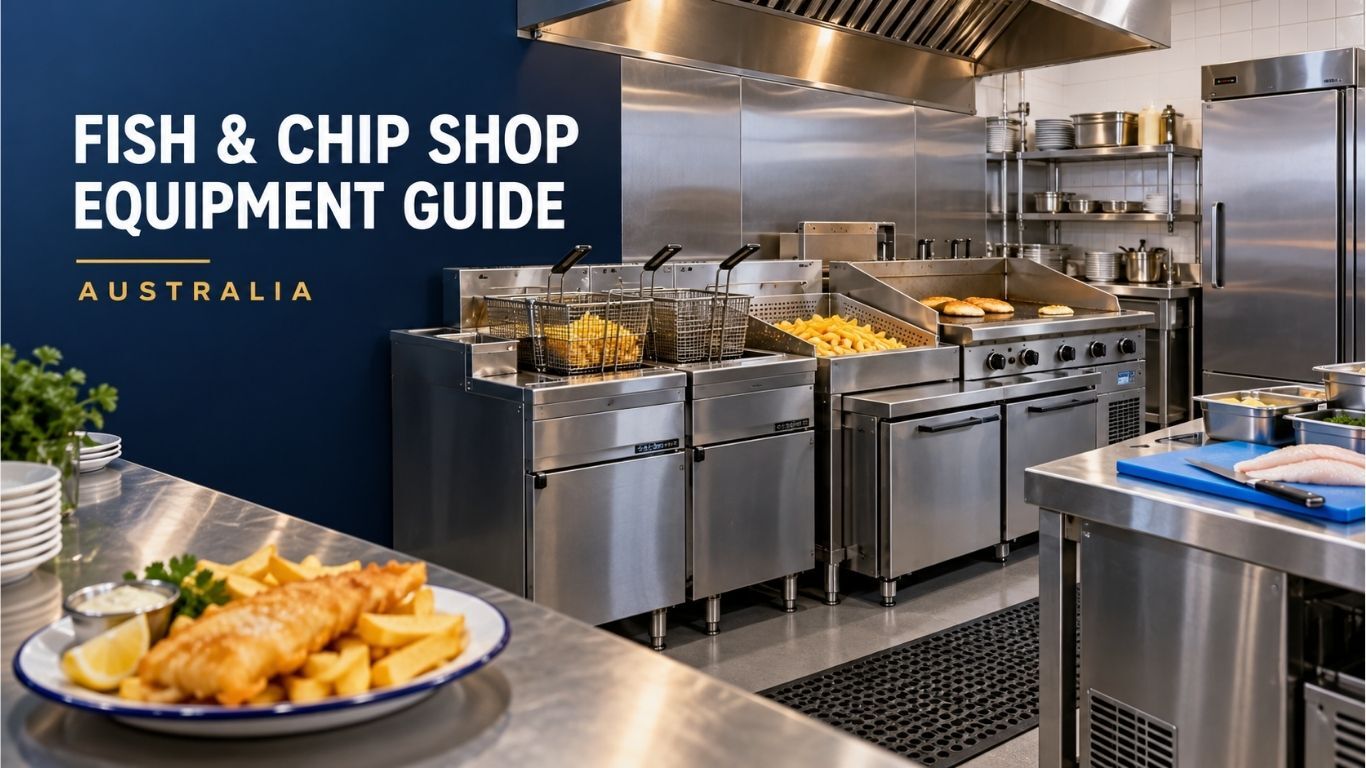
Fish and Chip Shop Equipment List Australia: The Complete 2026 Setup Guide
Opening a fish and chip shop is not simply a matter of buying a fryer and a freezer. The equipment has to support your peak-hour output, keep raw seafood separated from ready-to-eat food, fit the available services and give staff a clear path from delivery to preparation, cooking and collection.
This guide provides a practical equipment checklist for a small-to-medium Australian fish and chip shop or seafood takeaway. It includes recommended sizes, starting quantities, a simple method for estimating fryer capacity and the fit-out details that are easy to overlook.
Quick answer: A typical fish and chip shop needs a commercial fryer bank, exhaust canopy, refrigeration and freezer storage, fish-preparation area, stainless-steel benches and sinks, a dedicated handwash basin, chip holding equipment, dishwasher, food-safe utensils, temperature controls, cleaning equipment and an efficient order-collection area. The correct sizes depend on the menu and the number of meals expected during the busiest hour, not the daily average.
Table of Contents
Start With Peak-Hour Demand, Not Floor Area
Two shops of the same size can need completely different equipment. A neighbourhood takeaway producing 25 orders in its busiest hour should not be fitted out like a beachfront shop expecting 100 orders after sunset.
Before requesting equipment quotes, record:
expected orders during the busiest 60 minutes;
average portions of chips, fish and other fried products per order;
fresh versus frozen seafood volume;
dine-in seats and takeaway percentage;
grilled-food, salad and beverage requirements;
whether gluten-free or allergen-controlled food will be offered;
available gas, electrical, exhaust, water and drainage capacity;
delivery frequency and the maximum stock held between deliveries.
A Simple Fryer Capacity Estimate
Use this planning calculation before selecting a fryer:
Peak portions per hour × raw product weight per portion = required hourly product throughput
Then add at least 20% operating headroom for order surges, recovery between loads and menu variation.
Example:
60 chip portions in the busiest hour
300g frozen chips per portion
60 × 0.30kg = 18kg per hour
with 20% headroom: 21.6kg per hour
This does not mean that any fryer advertised at 22kg per hour will automatically suit the shop. Basket size, oil recovery, frozen-product loading, filtration time and simultaneous fish orders all affect real service output. Ask the supplier to confirm practical production for your product and batch size.
Core Fish and Chip Shop Equipment
The following schedule is a sensible starting point for a small-to-medium shop handling approximately 50–100 orders during a busy service.
| Equipment | Practical starting size | Typical quantity | Why it matters |
|---|---|---|---|
| Commercial deep fryer | Twin pan or 2 × 20–25L tanks | 2 units or a multi-pan fryer bank | Separates products and provides capacity during peak service |
| Flat-top griddle | 600–900mm | 1 | Adds grilled fish, burgers, eggs and vegetables without occupying fryer capacity |
| Chip dump or warmer | 1/1 GN or freestanding | 1 | Supports fast plating and packing without holding chips longer than necessary |
| Exhaust canopy | Engineered to the cooking line | 1 system | Removes heat, grease-laden vapour and cooking fumes |
| Commercial upright fridge | 600–1,000L | 1–2 | Stores seafood, dairy, sauces and prepared ingredients |
| Commercial upright freezer | 600–1,000L | 1 | Accessible frozen stock for daily production |
| Chest freezer | 400–700L | 1 | Economical bulk storage for chips and frozen seafood |
| Underbench or preparation fridge | 1,200–1,800mm | 1 | Keeps high-use chilled ingredients at the workstation |
| Salad preparation fridge | 2 or 3 doors | 1 if salads/burgers are offered | Speeds cold assembly while protecting chilled ingredients |
| Stainless-steel benches | 1,200–1,800mm | 2–3 | Creates separate raw-fish, salad and general preparation zones |
| Fish-preparation sink | Single or double bowl with drainboard | 1 | Dedicated seafood preparation and rinsing point |
| Pot-washing sink | Double bowl with drainboard | 1 | Handles fryer baskets, pots and large utensils |
| Dedicated handwash basin | Wall-mounted | 1–2 | Gives staff an accessible handwashing point away from food and pot washing |
| Commercial dishwasher | 500 × 500mm basket | 1 | Provides repeatable washing for plates, utensils and kitchenware |
| Glasswasher | 400 × 400mm basket | Optional | Useful for licensed dine-in venues with meaningful glass volume |
| Ice machine | 40–100kg per day | Optional | Required where the menu, bar or fresh-seafood display creates genuine ice demand |
| Wall and mobile shelving | Commercial grade | 5–8 sections combined | Keeps food, packaging and clean equipment off the floor |
Browse relevant ranges of commercial fryers, commercial griddles, commercial fridges and commercial freezers when building the equipment schedule.
How Many Fryers Does a Fish and Chip Shop Need?
For most shops, the better question is how many independent frying zones are needed.
A workable starting arrangement is:
one zone primarily for chips;
one zone primarily for battered fish;
one flexible zone for calamari, prawns, potato scallops and other products.
A busy shop may need four or more zones so that staff can maintain output without mixing flavours or delaying orders. Independent tanks also provide some operational resilience if one side is being filtered or serviced.
Do not promise “allergen-free” or “gluten-free” food simply because a separate basket is used. Shared oil, preparation benches, batter, tongs, trays, flour dust and storage can all create cross-contact. A genuine allergen-control process may require a dedicated fryer, dedicated oil, identified utensils, protected ingredients and documented staff procedures.
Features Worth Comparing in a Commercial Fryer
verified recovery after frozen-product loads;
usable oil capacity, not only external dimensions;
basket dimensions and the number of portions per safe batch;
cold zone and crumb management;
built-in or mobile oil filtration;
drain position and safe oil handling;
gas or electrical load;
cleaning access;
parts availability and local service coverage;
warranty conditions.
An inexpensive fryer that struggles to recover during the dinner rush can cost more through slow tickets, pale chips, excess oil absorption and lost repeat business.
Refrigeration and Frozen Storage
Seafood quality depends on disciplined temperature control and rapid access. A practical setup normally separates:
raw seafood;
ready-to-eat salads and sauces;
dairy and batter ingredients;
frozen chips;
frozen seafood;
packaged beverages.
Avoid sizing refrigeration to the exact volume currently purchased. Shelves need space for air circulation and staff need to find stock without leaving doors open while moving containers around. As a planning rule, allow roughly 20–30% usable headroom after accounting for shelves, containers and seasonal demand.
An upright fridge suits bulk storage. An underbench or preparation fridge reduces walking during service. A chest freezer is useful for bulk cartons, but an upright freezer provides faster access and clearer stock rotation. Many shops benefit from both rather than forcing one cabinet to perform every job.
The Workflow That Prevents Bottlenecks
The best equipment list can still fail if the layout makes staff cross paths. Plan a mostly one-directional workflow:
Delivery → cold/frozen storage → raw fish preparation → battering → cooking → draining/holding → seasoning → packing or plating → collection
Dirty utensils and returned plates should move towards the washing area without travelling back through clean preparation or order-collection zones.
The Workflow That Prevents Bottlenecks
| Zone | Main equipment | Keep away from |
|---|---|---|
| Raw seafood preparation | Fish sink, blue boards, knives, scales, trays | Salad and cooked-food assembly |
| Batter and frying | Batter station, fryers, baskets, filtration | Customer traffic and wet washing areas |
| Grilling | Griddle, turners, oil bottles, draining racks | Raw seafood storage where splashing may occur |
| Cold assembly | Preparation fridge, green/white boards, salad spinner | Flour dust and raw seafood tools |
| Washing and waste | Dishwasher, pot sink, bins, chemicals | Clean utensils, food packaging and service counter |
Confirm final clearances and service access from the manufacturers. A unit that technically fits between two benches may still be impossible to clean or service if panels, filters, doors or drains cannot be reached.
Fish-Preparation Tools and Starting Quantities
| Item | Recommended type or size | Starting quantity |
|---|---|---|
| Flexible filleting knives | 180–250mm | 3 |
| Boning knives | 130–160mm | 2 |
| Fish scalers | Stainless steel | 2 |
| Pin-bone tweezers | Stainless steel | 2 |
| Seafood scissors | Heavy duty | 2 |
| Cut-resistant gloves | Washable, sized for staff | 3 pairs |
| Honing steels | 250–300mm | 2 |
| Commercial knife sharpener | Suitable for selected knives | 1 |
| Blue raw-fish boards | Approximately 600 × 400mm | 3 |
| Green vegetable boards | Approximately 600 × 400mm | 2 |
| White ready-to-eat boards | Approximately 600 × 400mm | 2 |
| Portion scale | Approximately 15kg capacity with suitable graduations | 1 |
| Platform scale | Approximately 30kg capacity | 1 |
| Stainless-steel trays | Assorted sizes | 12 |
| GN pans and lids | 1/1, 1/2, 1/3 and 1/6 GN | 20–30 assorted |
| Food-grade fish tubs | 20–60L with lids | 8–12 |
| Batter bowls | 8–15L stainless steel | 4 |
| Heavy-duty whisks | Commercial | 3 |
| Digital probe thermometers | Accurate to ±1°C | 3 |
| Multi-channel timers | Commercial | 3 |
Colour coding is a useful management system, but colour alone does not prevent contamination. Boards and utensils must also be identified, stored separately where practical and properly cleaned and sanitised between tasks. Browse commercial cutting boards for sizes suited to the preparation bench.
Frying, Draining and Service Tools
| Item | Starting quantity |
|---|---|
| Standard fryer baskets | 2 per fryer plus 2 spares |
| Long or flat fish baskets | 2–4 |
| Chip scoops | 2 |
| Spider strainers | 2 |
| Fine skimmers | 2 |
| Fryer crumb tools | 1 per fryer |
| Oil filter machine | 1 if not integrated |
| Oil-quality test strips or electronic tester | 1 system |
| Long-cuff heat-resistant gloves | 2 pairs |
| 1/1 GN draining trays and wire racks | 4–6 |
| Salt shakers | 2 |
| Clearly identified chicken-salt shakers | 2 |
| Wide slotted fish turners | 3 |
| Heavy-duty griddle turners | 3 |
| Grill scrapers | 2 |
Check that replacement fry baskets match the fryer model, tank opening and safe basket-loading limit.
Cleaning, Food Safety and Staff Safety
The cleaning list is part of the operating system, not an afterthought. A sensible opening pack includes:
two commercial mop buckets with three colour-coded mop heads;
commercial floor cleaner and degreaser;
food-contact sanitiser and labelled dilution bottles;
separate, labelled spray bottles for each chemical;
colour-coded cleaning cloths;
60–80L pedal bins and suitable external waste bins;
non-slip drainage mats where appropriate;
waterproof aprons and heat-resistant gloves;
paper-towel and liquid-soap dispensers at handwash basins;
two floor squeegees and at least two wet-floor signs;
a lockable chemical cabinet away from food and packaging;
food labels, date labels, temperature records and cleaning schedules;
a workplace first-aid kit and burns kit;
fire blankets, extinguishers and signage selected by a qualified fire contractor.
Australia’s Food Standards Code requires food businesses handling potentially hazardous food to have an accessible thermometer accurate to ±1°C. Potentially hazardous food generally needs to be kept at 5°C or colder or 60°C or hotter unless another safe time-and-temperature control is used. Refer to Food Standards Australia New Zealand’s food safety guidance and confirm local requirements with the relevant council or food regulator.
Use a sanitised probe thermometer to check food temperature. An infrared thermometer reads a surface and is useful for screening, but it does not replace an internal measurement where that is required.
Services to Confirm Before Ordering Equipment
This is where expensive fit-out mistakes happen. Prepare an equipment schedule showing the exact model, dimensions and service needs for every fixed appliance.
Electrical
Record voltage, phase, amperage, plug type and maximum input. Do not assume that two appliances with 10A plugs can safely share the nearest circuit. Refrigeration, fryers, hot-holding equipment, dishwashers and hot-water systems can create substantial simultaneous demand.
Gas
Record gas type, inlet size, pressure and MJ/h for every appliance. Have a licensed gas fitter confirm the available supply, pipe sizing, regulator requirements, isolation points and commissioning.
Exhaust and Make-Up Air
Fryer and griddle selection affects hood dimensions, exhaust volume, ductwork and make-up air. Engage the appropriate mechanical and building professionals before finalising the cooking line.
Plumbing, Drainage and Grease Management
Map hot and cold water, tundishes, floor wastes, sink wastes, dishwasher connections and grease-trap requirements. Check whether the proposed equipment can be removed for service without dismantling nearby plumbing.
Access and Delivery
Measure doors, corridors, lifts, stairs and turning points, not only the final kitchen space. Record packed dimensions and weight. Large refrigeration or cooking equipment may fit the kitchen but not pass through the building.
Common Equipment-Buying Mistakes
Buying for the average day instead of the busiest hour. Peak demand determines fryer, holding and packing capacity.
Choosing equipment before checking services. A bargain three-phase appliance is not a bargain if the premises needs a costly electrical upgrade.
Using one fryer for every menu item. This can create flavour transfer, slow production and serious allergen-control problems.
Underestimating refrigeration. Overfilled cabinets restrict airflow, slow access and complicate stock rotation.
Forgetting oil management. Filtration, safe draining and used-oil storage affect food quality, labour and safety every day.
Designing around appliances but not people. Staff crossing between raw preparation, frying, washing and collection creates delay and contamination risk.
Buying domestic equipment for commercial duty. Domestic products may not tolerate continuous service and may not have suitable commercial warranty coverage.
Ignoring service access and parts support. Downtime during a Friday-night service can be more costly than the original saving.
Buying every small utensil individually. Build station packs for fish preparation, battering, frying, grilling, salad and cleaning, then add 10–20% spare high-use items.
Signing an equipment contract before approval. Confirm the fit-out with council, certifier, landlord and relevant trades first.
Opening Budget: Use Categories, Not a Single Misleading Figure
Fit-out costs vary too widely for one national price to be useful. Building condition, power upgrades, ductwork, fire systems, grease traps, refrigeration capacity and equipment quality can move the total dramatically.
Build the budget under these headings:
| Budget category | Include |
|---|---|
| Cooking line | Fryers, griddle, chip warmer and filtration |
| Refrigeration | Upright, underbench, preparation and display cabinets |
| Stainless steel | Benches, sinks, shelves, splashbacks and custom fabrication |
| Washing | Dishwasher, glasswasher, sinks and chemicals |
| Mechanical | Canopy, ductwork, fan, make-up air and fire system |
| Services | Electrical, gas, plumbing, drainage and grease management |
| Smallwares | Knives, boards, GN pans, baskets, containers and utensils |
| Front of house | POS, counter, drinks display, crockery and furniture |
| Professional and approval costs | Design, certification, applications and inspections |
| Contingency | Allowance for site conditions and scope changes |
Request like-for-like quotes using the same written schedule. A lower quote may exclude delivery, installation, commissioning, accessories, regulators, baskets, shelves or warranty travel.
Final Pre-Purchase Checklist
Before paying deposits, confirm:
busiest-hour order estimate and menu mix;
required fryer zones and allergen procedure;
equipment model, capacity and external dimensions;
packed dimensions, weight and delivery path;
gas type, MJ/h, pressure and inlet details;
voltage, phase, amperage and plug or hardwire requirements;
canopy, exhaust and make-up-air design;
hot water, drainage, floor wastes and grease-trap requirements;
refrigeration storage plan with operating headroom;
raw, ready-to-eat, wash-up and service workflow;
cleaning and service clearances;
warranty coverage, spare parts and local service arrangements;
local council, certifier, landlord and trade approvals;
delivery, installation and commissioning responsibilities.
Frequently Asked Questions
The fryer system is usually the production centre, but it cannot be selected in isolation. Fryer output depends on exhaust, gas or electricity, oil management, cold storage, preparation capacity and packing workflow.
It may be enough for a low-volume shop with a limited menu. A busier operation normally benefits from at least three independent frying zones so chips, battered fish and other products can be managed without constant production conflicts.
If you make a gluten-free or allergen-control claim, a separate basket alone is generally inadequate. Consider a dedicated fryer and oil, protected ingredients, separate preparation tools, clear storage and documented procedures. Obtain appropriate food-safety advice for the claim you intend to make.
Compare real recovery, production capacity, energy availability, installation cost, ventilation requirements, service support and the total cost of operation. The best option depends on the premises and service volume rather than fuel type alone.
Calculate maximum stock between deliveries, include containers and prepared food, then allow operating headroom. Separate bulk storage from high-use service refrigeration where possible.
Approval requirements vary by state, territory, council, building and scope of work. Speak with the relevant council or environmental health officer, certifier, landlord and licensed trades before committing to fixed equipment.
Need Help Planning Your Fish Shop Equipment?
Ben’s Hospitality Equipment can help compare commercial fryers, refrigeration, griddles, dishwashers, stainless-steel benches and smallwares for a new or upgraded fish and chip shop. For a useful recommendation, send your menu, kitchen plan, expected busiest-hour orders, preferred fuel type and delivery postcode.
Call 1300 434 125 or email info@bendgs.com.au for an equipment quote and practical product advice. Australia-wide delivery is available.