
How Energy-Efficient Commercial Refrigeration Saves Australian Businesses Money
If you run a café in Melbourne, restaurant or pub in Sydney, takeaway business in Brisbane, supermarket or any other food business in Australia, your commercial fridges and freezers work around the clock. Unlike ovens, grills and some lighting, refrigeration rarely gets a break.
That makes refrigeration one of the most important places to look for long-term savings. Choosing an energy-efficient commercial fridge or freezer may cost more upfront, but lower electricity use can reduce operating costs for years to come. The right unit can also provide more stable temperatures, place less strain on key components and help protect valuable stock.
Why commercial refrigeration can cost so much to run
Commercial refrigeration has a demanding job. It must maintain food safe temperatures while doors are opened throughout service, warm stock is loaded and kitchen temperatures rise.
According to the Australian Government’s refrigeration guidance for businesses, refrigeration can account for 25% to 85% of a company’s total energy use. The actual share depends on the type of business, equipment, opening hours, ambient conditions and how the system is operated.
A cabinet’s purchase price is therefore only part of its real cost. The lifetime cost also includes electricity, servicing, repairs and any spoiled stock or lost trade caused by a breakdown.
How much could an efficient commercial fridge save?
There is no single saving that applies to every business. Two cabinets with a similar capacity can use different amounts of electricity, and the result also depends on your tariff, climate, kitchen layout and usage.
The simplest way to estimate the running cost is:
Annual energy use in kWh × electricity price per kWh = estimated annual electricity cost
For example, suppose an existing cabinet uses 5,000 kWh per year and a comparable replacement uses 30% less energy:
Existing annual consumption: 5,000 kWh
Estimated reduction: 1,500 kWh
Example electricity rate: $0.32 per kWh
Estimated saving: $480 per year
Estimated saving over 10 years: $4,800, before allowing for tariff changes, maintenance or financing costs
This is an illustration, not a promise of savings. For a meaningful comparison, use the published daily or annual energy consumption for each model and your business’s actual electricity tariff.
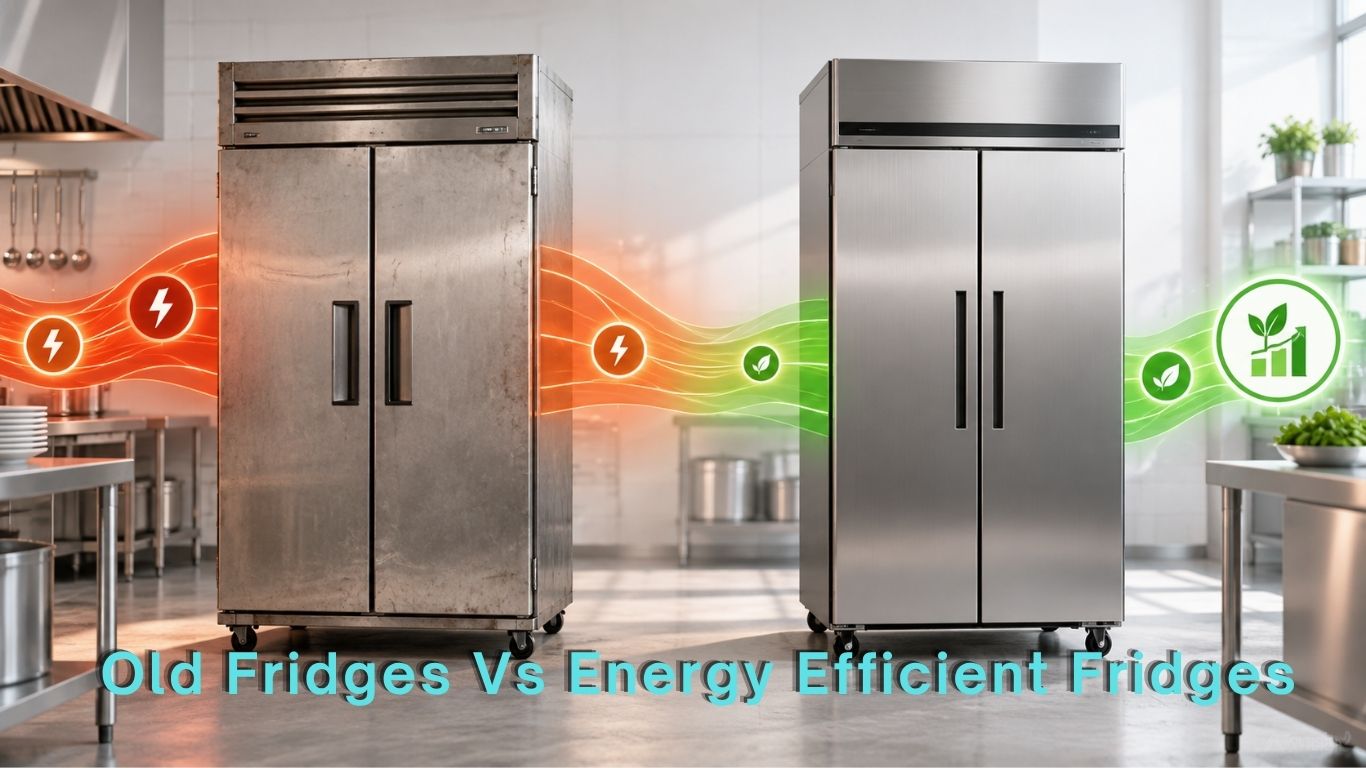
The Australian Government advises businesses to consider replacing refrigeration systems that are more than 10 years old, noting that an efficient new system could reduce energy use by up to 30%. It also notes that newer compressors, fans and electronic controls using DC inverter technology can reduce consumption by about 25% in suitable applications.
Purchase price VS whole-of-life cost
It is tempting to choose the cheapest commercial refrigerator on the quote, especially when fitting out a new venue. However, a lower purchase price can become expensive if the cabinet consumes more electricity every day.
When comparing two models, consider:
purchase and installation costs
energy consumption in kWh per 24 hours or per year
your electricity tariff, including any demand charges
warranty coverage and local service support
expected maintenance costs
cabinet capacity and usable shelf space
operating temperature and climate class
likely service life
An efficient cabinet that costs a little more upfront may be the better-value choice if it saves several hundred dollars each year. This matters even more for venues operating several upright fridges, under-bench units, display cabinets and freezers.
What makes commercial refrigeration energy efficient?
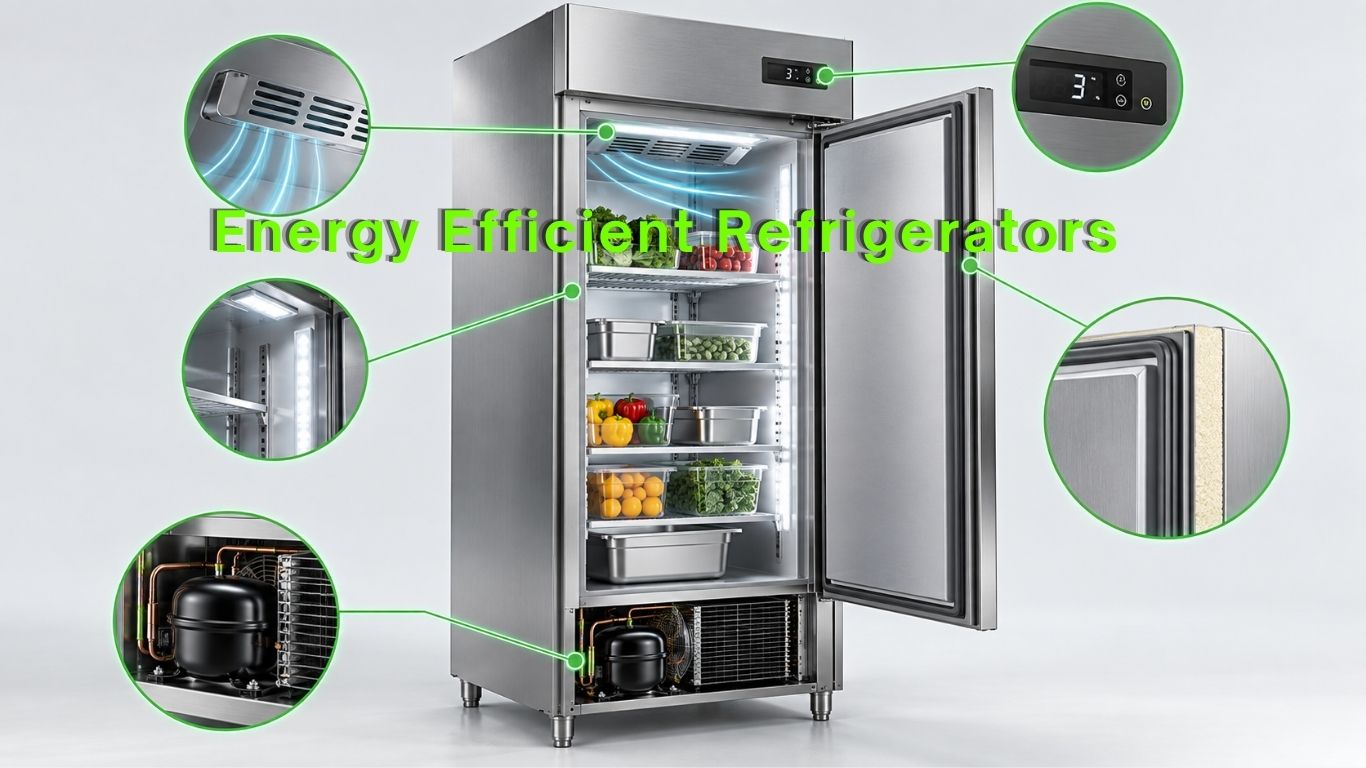
Energy efficiency is not determined by one feature alone. Look at how the complete cabinet is designed and how much energy it is expected to use under standard test conditions.
Efficient compressors and controls
Variable-speed or inverter-driven compressors can adjust their output as cooling demand changes instead of repeatedly operating at full capacity. Smart electronic controls can also manage temperature and defrost cycles more accurately.
Quality insulation and door seals
Good insulation slows heat transfer into the cabinet. Tight, correctly fitted door gaskets help prevent cold air escaping and reduce the workload on the refrigeration system.
Doors on display cabinets
Open display cabinets can lose a large amount of cold air into the shop. Where suitable for the business, glass doors can substantially reduce heat gain while keeping products visible.
LED lighting
LEDs generally use less electricity and produce less heat inside the cabinet than older lighting technologies. Less internal heat means less work for the refrigeration system.
Demand-based anti-condensation heaters
Glass-door cabinets may use heaters to control condensation. Efficient designs operate these heaters only when required instead of running them continuously.
Low-global-warming-potential refrigerants
Refrigerants such as R290 and R600a have a much lower global warming potential than many older refrigerants and can perform efficiently in equipment designed for them. Refrigerant type alone, however, does not prove that one cabinet will cost less to run. Compare the complete unit’s energy data.
Understanding GEMS registration and energy ratings
Many commercial refrigerated cabinets sold in Australia are regulated under the Greenhouse and Energy Minimum Standards, or GEMS, framework. Covered models must be registered and meet the applicable minimum energy performance requirements.
Unlike household appliances, commercial refrigerated cabinets are not required to display the familiar Energy Rating Label. Some suppliers voluntarily publish an Energy Rating Icon, and registered models can be checked in the Australian Government’s Energy Rating Product Database.
Only compare ratings and energy consumption between cabinets with a similar:
cabinet type
size or net volume
operating temperature
climate class
duty classification
A display fridge and a storage freezer perform very different jobs, so their star ratings or energy figures should not be compared directly.
Comparing the Energy Efficiency of Three 600mm Deep Under Bench Fridges
To show how energy efficiency can affect a real buying decision, let’s compare three 1800mm-wide, three-door under-bench fridges: the Turbo Air KUR18-3S-N, Besttop CUR18-3-600 and Thermaster TS1800TN-3D. Although these models have similar dimensions, their capacity, cooling design and available energy data differ.
| Model | Capacity | Published energy use | Refrigerant | Notable efficiency features |
|---|---|---|---|---|
| Turbo Air KUR18-3S-N | 400L | 1.89 kWh/24 hours | R290 | Digital controls, fan-controlled cooling, magnetic gaskets and high-density insulation |
| Besttop CUR18-3-600 | 380L | Not currently published | R290 | 60mm insulation, self-closing doors, magnetic gaskets and fan-forced cooling |
| Thermaster TS1800TN-3D | 360L | 3.12 kWh/24h | R290 | Fan-forced cooling, automatic defrost and 43°C tropical ambient rating |
Turbo Air KUR18-3S-N: lowest published energy consumption
The Turbo Air has the lowest published daily energy consumption in this comparison. It uses approximately 1.89 kWh per 24 hours, equal to around 690 kWh per year under the stated test conditions.
At an example electricity rate of $0.32 per kWh, its estimated electricity cost would be approximately $221 per year. Actual running costs will depend on your electricity tariff, kitchen temperature, ventilation, stock loading, door openings and maintenance.
It also offers the largest capacity of the three models at 400 litres. Its R290 refrigerant, digital temperature controls, magnetic door gaskets, fan-controlled cooling and high-density insulation help it maintain temperature efficiently.
A front-breathing refrigeration system also makes the unit suitable for a narrow work line, although the manufacturer’s ventilation and clearance requirements must still be followed.
Besttop CUR18-3-600: useful energy-saving features at a competitive price
The Besttop provides 380 litres of refrigerated storage and includes several features that may help reduce unnecessary energy use. These include:
- 60mm CFC-free insulation
- Self-closing doors
- Magnetic door gaskets
- R290 natural refrigerant
- Fan-forced cooling
- Digital temperature controls
Its listed 250W figure is the unit’s rated power input, not its total daily energy consumption. Because the compressor cycles on and off, wattage alone cannot be fairly compared with a tested kWh-per-24-hour figure.
The Besttop may be a good value-focused option, but its tested daily energy consumption should be obtained before calculating its estimated yearly running cost or comparing it directly with the other models.
Thermaster TS1800TN-3D: tropical-rated refrigeration for hotter kitchens
The Thermaster provides 360 litres of storage and has published energy consumption of approximately 3.12 kWh per 24 hours. This equals about 1,139 kWh per year.
At an example electricity rate of $0.32 per kWh, the estimated electricity cost would be approximately $364 per year.
While its energy consumption is higher than the Turbo Air’s, the Thermaster has a stated 43°C tropical ambient rating. This makes it worth considering for hot restaurant and takeaway kitchens where a fridge must continue operating reliably in demanding conditions.
Its other features include R290 refrigerant, fan-forced evaporator cooling, automatic defrost and self-evaporating drainage.
Turbo Air versus Thermaster: estimated energy savings
Based on the published figures, the Turbo Air uses approximately 1.23 kWh less electricity per day than the Thermaster.
That difference could amount to:
- Approximately 449 kWh less electricity per year
- Around 39% lower energy consumption
- Approximately $144 saved per year at $0.32 per kWh
- Around $1,440 saved over ten years, assuming the same electricity rate and comparable operating conditions
These calculations are estimates rather than guaranteed savings. For the fairest comparison, daily energy figures should come from testing under equivalent ambient temperatures, temperature settings and operating standards.
Which under-bench fridge should you choose?
Based on the available information:
- Choose the Turbo Air if low published energy consumption, 400L capacity and a three-year parts-and-labour warranty are your priorities.
- Consider the Besttop if you want a lower upfront price with 60mm insulation and self-closing doors, but request its daily energy-consumption figure before comparing lifetime running costs.
- Consider the Thermaster if your fridge will operate in a particularly hot commercial kitchen where its 43°C ambient rating may outweigh the higher published energy consumption.
This comparison highlights why purchase price and wattage should not be considered in isolation. When choosing an energy-efficient commercial fridge, compare its tested daily energy consumption, storage capacity, ambient rating, insulation, door design, warranty and after-sales support. The best-value fridge is the one that can maintain safe temperatures efficiently and reliably in your actual kitchen conditions.
Correct sizing can save energy too
Bigger is not always better. An oversized cabinet costs more to buy, occupies valuable floor space and may use more energy than your business needs. An undersized cabinet can become overcrowded, restrict airflow and struggle when warm stock is added during busy periods.
Choose capacity by looking at your peak stock level, delivery schedule, menu, shelf configuration and expected business growth. Allow enough room for cold air to circulate, but avoid paying to cool space you are unlikely to use.
Placement matters as well. Keep condensers away from ovens, direct sunlight and poorly ventilated corners. Follow the manufacturer’s clearance requirements so heat can escape properly.
Browse our commercial fridges and commercial freezers to find the best fit for your business
Simple ways to reduce refrigeration running costs
Even an efficient cabinet will waste energy if it is poorly maintained or incorrectly used. These practical habits can help:
Clean condenser coils and filters as recommended by the manufacturer.
Check door gaskets for gaps, splitting or loss of tension.
Keep air vents clear and avoid overloading shelves.
Minimise unnecessary door opening during service.
Let hot food cool safely before placing it in the refrigerator, following your food-safety process.
Check that temperature and defrost settings suit the application.
Position equipment away from heat sources and provide adequate ventilation.
Arrange regular servicing before small issues become expensive failures.
Monitor energy use where practical so unusual increases are noticed early.
These steps support lower running costs while helping the cabinet maintain safer, more consistent temperatures.
Are rebates available for commercial refrigeration upgrades?
Eligible Australian businesses may be able to access incentives, but programs, approved products and discount amounts change over time.
In NSW, the Energy Savings Scheme includes eligible commercial refrigerated-cabinet activities. In Victoria, Victorian Energy Upgrades offers incentives for eligible energy-efficient products and upgrades, including certain refrigerators, freezers and cold-room systems.
Check the current rules and obtain confirmation from an accredited provider before ordering. Not every commercial fridge, freezer or installation will qualify, and the final incentive can depend on the model, site and provider.
In conclusion
An energy figure is useful, but it is not the only consideration. A commercial fridge must also cope with the conditions in which it will operate.
Before buying, check the cabinet’s climate class and maximum rated ambient temperature. A model that performs well in a mild, air-conditioned shop may not suit a hot kitchen. Also confirm the power connection, dimensions, door clearance, ventilation requirements, warranty terms and service coverage for your location.
The best result comes from choosing a cabinet that is efficient, correctly sized and genuinely fit for the environment.
Commercial refrigeration runs 24 hours a day, so small differences in daily energy use can become meaningful savings over the life of the equipment. Instead of comparing purchase prices alone, calculate the likely annual running cost and consider the whole-of-life value of each unit.
At Ben’s Hospitality Equipment, we supply a wide range of commercial fridges, commercial freezers and refrigerated display units for cafés, restaurants, supermarkets and other Australian food businesses.
Need help comparing capacity, energy consumption, climate class or warranty? Call 1300 434 125, email info@bendgs.com.au or request a quote online. We offer Australia-wide delivery, and SilverChef finance is available on eligible equipment.