
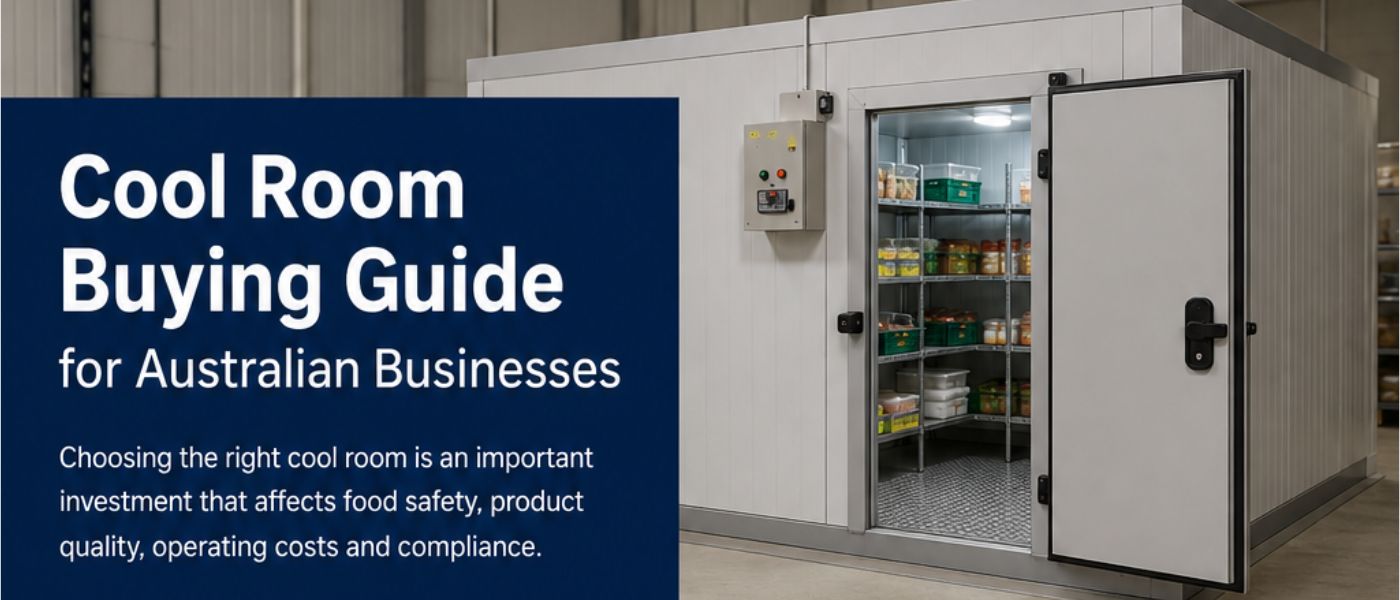
Cool Room Buying Guide for Australian Businesses
If your commercial fridges are constantly full, deliveries are getting harder to organise, or staff are moving stock from one refrigerator to another just to find space, it may be time to consider a commercial cool room.
A well-designed cool room gives restaurants, cafés, butchers, supermarkets, pubs, caterers and food production businesses significantly more chilled storage within one organised area. But choosing one involves more than deciding how many square metres you need.
The room size, insulation, refrigeration system, flooring, door location, ambient conditions and the type and quantity of food going into the room can all affect performance and operating costs.
This guide explains the main things Australian businesses should consider before buying a cool room, so you can have a more informed conversation with your cool room supplier, refrigeration contractor or shopfitter.
What Is a Cool Room?
A cool room, sometimes called a cold room, walk-in fridge or walk-in refrigerator, is an insulated refrigerated room designed to maintain chilled products at a controlled temperature.
Commercial cool rooms are commonly used for storing:
- Fresh meat and poultry
- Seafood
- Dairy products
- Fruit and vegetables
- Prepared ingredients
- Sauces and condiments
- Drinks
- Desserts
- Packaged chilled foods
- Bulk ingredients
A cool room is different from a freezer room.
Cool rooms are generally designed for chilled storage, while freezer rooms operate at much lower temperatures and require refrigeration equipment and insulation suitable for frozen storage.
For potentially hazardous food, Australian food-safety requirements generally require food to be kept at 5°C or colder during storage, unless the business can demonstrate that another temperature is safe.
Do You Actually Need a Cool Room?
Not every food business needs one.
A small café, takeaway or restaurant with regular deliveries may be better served by a combination of quality upright and under-bench commercial fridges.
A cool room starts to become particularly useful when:
- Existing refrigerators are regularly running out of space
- You receive large or less frequent deliveries
- You buy ingredients in bulk
- Stock is spread across too many separate cabinets
- Your business is expanding
- You need better organisation of chilled stock
- Staff spend too much time searching through multiple refrigerators
- Peak periods require considerably more cold storage than normal
Businesses that commonly use cool rooms include restaurants, hotels, pubs, clubs, caterers, bakeries, supermarkets, grocers, butchers, delis and food production facilities.
Before committing, compare the cost and usable storage of a cool room with additional commercial refrigerators. For some smaller businesses, another upright fridge may still be the more practical solution.
How Big Should Your Cool Room Be?
One of the most common mistakes is choosing a room based only on how much stock you have today.
A cool room that is completely full from the day it is installed leaves little room for busy periods, larger deliveries or business growth.
Start by thinking about your maximum stock level, rather than your average stock level.
Consider:
Delivery Frequency
A restaurant receiving fresh produce every day may need considerably less standing storage than a butcher or caterer receiving one or two large deliveries each week.
Peak Trading Periods
Think about weekends, Christmas, Easter, events, functions and other periods when your stock requirements increase.
Product Variety
Twenty different ingredients generally need more usable shelving space than the same volume of only two or three products.
Future Growth
If you expect the business to grow, allow some spare storage capacity now. Expanding an existing cool room later can be considerably more complicated than allowing additional capacity from the start.
Working Space
Don’t calculate capacity using the external dimensions alone.
Staff need enough room to safely:
- Walk inside
- Access shelving
- Move cartons
- Use trolleys where required
- Open the door
- Rotate stock
- Clean floors and shelving
A cool room can look large on a floor plan but feel very small once shelving and stock are installed.
Cool Room Size and Refrigeration Capacity Are Not the Same Thing
This is an important distinction.
Knowing the dimensions of the room does not automatically tell you what refrigeration unit you need.
The refrigeration system needs to be selected according to the total heat load of the room.
Factors can include:
- Internal room dimensions
- Required operating temperature
- Panel construction and insulation thickness
- Ambient temperature surrounding the room
- Indoor or outdoor installation
- Number of door openings per day
- Door dimensions
- Lighting
- Number of people entering the room
- Quantity of stock loaded each day
- Temperature of incoming stock
- Product type
- Evaporator location
- Condenser location
For example, a cool room mainly holding cartons of drinks that arrive already chilled may have a very different refrigeration requirement from a butcher or commercial kitchen loading significant quantities of warmer product into the room every day.
This is why refrigeration capacity should be properly calculated rather than chosen simply from the room’s length and width.
Types of Commercial Cool Rooms
Modular Cool Rooms
Modular cool rooms are assembled from prefabricated insulated panels.
They are popular because different combinations of panels can be used to create a room that suits the available space.
Depending on the design, modular cool rooms may also be easier to dismantle or alter than a room that has been permanently incorporated into the building.
They are commonly used in:
- Restaurants
- Cafés
- Butcher shops
- Supermarkets
- Commercial kitchens
- Pubs
- Catering facilities
Custom or Built-In Cool Rooms
A custom cool room can be designed around a particular building layout.
This may be useful when:
- The available area is an unusual shape
- Structural columns need to be accommodated
- Specific door locations are required
- A larger food-production area is being constructed
- The room is being incorporated into a complete kitchen or supermarket fit-out
Outdoor Cool Rooms
Where suitable indoor space isn’t available, some businesses install an external cool room.
Outdoor installations require additional consideration of weather exposure, drainage, ventilation, condensing-unit location and local site conditions.
Always discuss the installation requirements with appropriately qualified contractors before purchasing equipment.
Cool Room Panels: What Does the Insulation Do?
The insulated panels form the walls and ceiling—and, depending on the installation, the floor—of the cool room.
Their job is to reduce heat transfer between the surrounding environment and the refrigerated space.
Common insulation materials include:
EPS
Expanded polystyrene, or EPS, is widely used in insulated panel construction and can be an economical option for suitable applications.
PIR
Polyisocyanurate, or PIR, offers strong thermal performance and is used where particular insulation and fire-performance characteristics are required.
PU
Polyurethane, commonly referred to as PU, also provides high thermal insulation performance and is widely used in refrigerated panel systems.
There isn’t one panel material or thickness that is automatically right for every cool room.
Panel selection should consider:
- Target temperature
- Room dimensions
- Location
- Ambient temperature
- Fire and building requirements
- Refrigeration design
- Whether the room is chilled or frozen
A cool room in a hot commercial kitchen or tropical Australian location can have very different heat loads from an equivalent room in a cooler environment.
Self-Contained vs Remote Refrigeration
The insulated room itself doesn’t create cold. You also need a properly sized refrigeration system.
Two common arrangements are self-contained refrigeration and remote refrigeration.
Self-Contained Refrigeration
A packaged or self-contained system keeps much of the refrigeration equipment together at or close to the cool room.
Advantages can include:
- Simpler installation
- Less refrigeration pipework
- Suitable for many smaller installations
- Convenient servicing access depending on the layout
However, you need to think carefully about where the heat from the condenser goes.
Remote Refrigeration
With a remote refrigeration system, the condensing unit is installed away from the evaporator—for example outdoors, on a roof or in another suitable location.
This can help remove compressor and condenser heat and noise from the immediate kitchen or storage area.
Remote systems are commonly considered for:
- Larger cool rooms
- Busy commercial kitchens
- Installations where indoor heat is already high
- Locations where noise needs to be minimised
Neither arrangement is automatically more efficient in every installation. Performance depends on correct equipment selection, refrigeration load, pipework, ventilation, ambient temperature, installation quality and maintenance.
Where Will the Condenser Heat Go?
This is one of the most overlooked parts of planning a cool room.
A refrigeration system doesn’t simply “make cold”. It removes heat from inside the cool room and releases that heat through the condenser.
If a condensing unit is installed in a small, poorly ventilated area, the surrounding temperature can rise and make the refrigeration equipment work harder.
When planning the installation, discuss:
- Condenser location
- Available ventilation
- Manufacturer-required clearances
- Surrounding ambient temperature
- Access for cleaning and servicing
- Heat discharge
- Noise
The cheapest location to install the refrigeration unit is not always the best location for long-term operation.
Flooring: Do You Need an Insulated Cool Room Floor?
The correct flooring depends on the design of the room and its operating conditions.
Possible arrangements include:
- Insulated panel floors
- Existing concrete slabs
- Recessed or flush-mounted floors
- Raised floors with access ramps
Consider:
- Trolley traffic
- Load capacity
- Cleaning
- Drainage
- Slip resistance
- Door threshold height
- Insulation requirements
- Access for staff
- Pallet movement where applicable
A raised insulated floor may provide excellent thermal separation but may also require a ramp, which changes how staff and trolleys enter the room.
Plan this before ordering the room rather than after installation.
Plan the Door Around Your Workflow
The cool room door is another detail that can have a surprisingly large impact on daily operations.
Think about:
- Which direction it should open
- How wide it needs to be
- Trolley access
- Nearby benches and equipment
- Delivery routes
- Staff traffic
- Self-closing operation
- Door seals
- Safety release mechanisms
- Strip curtains for frequently accessed rooms
Imagine the busiest delivery of your week.
Can a staff member easily move the largest box or trolley through the doorway without hitting surrounding equipment?
That’s a better test than simply asking whether a person can walk through it.
Shelving and Airflow Matter
A large cool room is only useful if the storage layout works.
Plan shelving before the room is installed.
Good shelving should provide enough room for stock while allowing cold air to circulate around the room.
Avoid:
- Packing cartons tightly around the evaporator
- Blocking fans or airflow
- Overcrowding shelves
- Storing stock directly where it interferes with the door
- Making shelves so deep that products disappear at the back
Your shelving arrangement should also support appropriate food separation and stock rotation.
Raw foods such as meat should be managed so they cannot contaminate ready-to-eat products.
What Temperature Should a Commercial Cool Room Run At?
For potentially hazardous foods, Australian food businesses generally need to maintain food at 5°C or colder during storage unless they have a validated alternative system.
Many cool rooms are therefore operated below the 5°C limit to provide some operational margin for door openings, defrost cycles and stock loading.
However, the correct set point depends on what you are storing.
For example, the ideal conditions for:
- Meat
- Dairy
- Produce
- Beverages
- Prepared food
may not always be exactly the same.
Your refrigeration contractor or food-safety adviser can help determine an appropriate operating range for your particular products.
Don’t Rely Only on the Cool Room Display
The temperature shown on the refrigeration controller tells you about the refrigeration system’s sensed temperature.
It doesn’t necessarily tell you the temperature of every product stored inside the room.
FSANZ recommends checking potentially hazardous food with a suitable probe thermometer and specifically advises businesses not to rely solely on fixed temperature gauges on refrigeration equipment.
For businesses handling potentially hazardous food, a suitable thermometer should therefore form part of normal food-safety procedures.
You may also want to consider:
- Digital temperature logging
- High-temperature alarms
- Remote monitoring
- Door-open alarms
- Documented temperature checks
Requirements vary according to the type of food business and applicable food-safety program.
Is a Cool Room the Same as a Blast Chiller?
No.
A cool room is primarily designed to store chilled products and maintain temperature.
A blast chiller is specifically designed to remove heat from cooked food quickly.
This distinction is important for restaurants, caterers, bakeries and food production businesses cooling significant quantities of cooked food.
Australian food-safety requirements state that potentially hazardous cooked food being cooled for later use should generally be cooled:
60°C → 21°C within 2 hours
then:
21°C → 5°C within the following 4 hours.
FSANZ lists rapid-cooling equipment such as blast chillers as one method businesses can use to achieve rapid cooling.
Loading large quantities of hot food into a normal cool room can also increase the temperature of the room and place additional load on the refrigeration system.
If rapid food cooling forms part of your production process, consider whether a commercial blast chiller is more appropriate for that task.
What Information Do You Need to Get a Cool Room Quote?
The more information you provide upfront, the easier it is for a supplier or refrigeration contractor to recommend the correct solution.
Before requesting a quote, try to provide:
| Information | Why It Matters |
|---|---|
| Required room dimensions | Establishes available storage space |
| Target temperature | Determines refrigeration requirements |
| Products being stored | Different products have different storage and load requirements |
| Approximate stock volume | Helps determine usable room size |
| Daily incoming stock | Affects refrigeration load |
| Incoming product temperature | Warm stock requires additional cooling capacity |
| Indoor or outdoor location | Affects construction and refrigeration design |
| Site ambient temperature | Important when selecting refrigeration equipment |
| Door location and size | Affects workflow and heat gain |
| Flooring requirements | Determines floor construction |
| Available electrical supply | Required for equipment selection |
| Condenser location | Affects heat rejection and installation |
| Site access | Important for panel delivery and installation |
| Shelving requirements | Helps establish usable internal space |
If possible, supply a simple floor plan or sketch showing the available area, doorways and surrounding equipment.
How Much Does a Cool Room Cost?
There isn’t a particularly useful one-size-fits-all cool room price.
Two rooms with identical external dimensions can have very different installed costs depending on:
- Panel construction
- Insulation thickness
- Refrigeration capacity
- Self-contained or remote system
- Refrigeration pipe runs
- Flooring
- Door specification
- Shelving
- Electrical work
- Drainage
- Outdoor weather protection
- Delivery access
- Installation location
- Freight
- Site preparation
When comparing cool room quotes, look beyond the final dollar figure.
Ask suppliers to clearly identify what is included.
A quote might include the panels and refrigeration equipment but exclude electrical connection, drainage, shelving, commissioning or building work.
Comparing like for like is far more useful than simply choosing the cheapest headline price.
Installation: What Should Be Checked Before Ordering?
Cool room installation is much easier when site requirements are resolved beforehand.
Check:
Floor
Is the installation surface level and capable of supporting the room and its contents?
Power
What electrical supply does the refrigeration equipment require?
Do not assume every cool room operates from a standard power point.
Drainage
Does the refrigeration equipment require drainage, and where will that water go?
Delivery Access
Can the panels and refrigeration equipment physically reach the installation location?
Check:
- Door widths
- Corridors
- Stairs
- Lifts
- Loading areas
- Ceiling heights
Refrigeration Location
Where will the evaporator and condensing unit be mounted?
Ventilation
Can the condenser reject heat properly?
Service Access
Can a refrigeration technician reach the important components later without dismantling half the room?
Good service access can make future maintenance considerably easier.
Energy Efficiency: Think Beyond the Compressor
Energy consumption depends on the complete installation.
Things that can influence running costs include:
- Panel insulation
- Door openings
- Damaged seals
- Refrigeration system sizing
- Condenser ventilation
- Ambient temperature
- Dirty condenser coils
- Ice build-up
- Stock loading
- Airflow
- Lighting
- Temperature setting
Simply buying the refrigeration unit with the lowest quoted wattage does not necessarily give you the most economical cool room.
Correct design and installation are usually more important.
Cool Room Maintenance
A cool room is a major business asset, and routine maintenance can help protect both the equipment and the stock inside.
Regularly check:
- Door seals
- Door alignment
- Evaporator airflow
- Condenser cleanliness
- Ice build-up
- Drain lines
- Temperature readings
- Alarm systems
- Shelving
- Lighting
- Panel joints
Grease and dust can quickly build up on refrigeration equipment in commercial kitchens.
A dirty condenser may reduce heat rejection and make the refrigeration system work harder.
Have the refrigeration system serviced according to the manufacturer’s and refrigeration contractor’s recommendations.
What Happens During a Power Failure?
Businesses carrying high-value refrigerated stock should have a plan for refrigeration failures and power outages.
Depending on the business, this may include:
- Keeping the cool room door closed
- Temperature alarms
- Monitoring food temperature
- Alternative refrigerated storage
- Emergency stock transfer procedures
- Appropriately sized standby generation
- Contact details for refrigeration service technicians
Avoid assuming that a standard computer-style UPS will run a commercial refrigeration system during an extended outage.
The appropriate backup solution depends on the refrigeration equipment and electrical load.
Common Cool Room Buying Mistakes
Buying Too Small
A room with no spare capacity can become restrictive surprisingly quickly.
Choosing Refrigeration by Room Dimensions Alone
The products being loaded, ambient temperature and usage pattern matter too.
Ignoring Condenser Ventilation
Poor heat rejection can affect refrigeration performance.
Forgetting Delivery Access
Panels and equipment still need to physically reach the installation area.
Not Planning Shelving Early
Poor shelving design can waste a surprising amount of usable storage space.
Ignoring the Door Location
A badly positioned door can interfere with kitchen workflow every day.
Comparing Quotes Only by Price
Make sure you understand what equipment and installation work are actually included.
Using a Cool Room for Rapid Cooling Without Checking Its Capacity
A normal storage cool room is not automatically a substitute for equipment specifically designed to rapidly chill cooked food.
Cool Room Buying Checklist
Before ordering your cool room, confirm:
Required internal dimensions
Products being stored
Required operating temperature
Normal stock volume
Peak stock volume
Future storage requirements
Daily delivery volume
Temperature of incoming stock
Indoor or outdoor installation
Expected ambient temperature
Panel type and insulation specification
Floor construction
Door dimensions
Door opening direction
Trolley access
Shelving layout
Evaporator location
Condenser location
Condenser ventilation
Available electrical supply
Drainage requirements
Delivery access
Service access
Temperature monitoring
Warranty
Local refrigeration service availability
Items included and excluded from the installation quote
Frequently Asked Questions
A cool room is designed for chilled products, while a freezer room operates at substantially lower temperatures for frozen storage. Freezer rooms generally require refrigeration equipment and insulation specifically designed for low-temperature operation.
The correct operating temperature depends on the products being stored. Potentially hazardous food generally needs to be maintained at 5°C or colder during storage unless another temperature can be demonstrated to be safe.
Start with your busiest stock level rather than an average day. Consider delivery frequency, shelf space, staff access, product variety and expected business growth. Also remember that physical room size and required refrigeration capacity are separate calculations.
A standard storage cool room should not automatically be treated as rapid-cooling equipment. Businesses cooling potentially hazardous cooked food need to meet applicable food-safety cooling requirements. For businesses regularly cooling significant quantities of cooked food, a blast chiller may be more appropriate.
A standard modular cool room typically takes one to two days to install once the site is prepared, meaning a level floor, adequate power and clear delivery access are already sorted. Larger or custom built rooms can take longer.
Self contained units are cheaper and simpler to install and suit smaller cool rooms, but they release heat and noise into the room they sit in. Remote refrigeration costs more upfront but keeps the compressor and condenser outside the building, giving you a quieter, cooler space and better long term efficiency, particularly for larger rooms.
Base it on your busiest trading period and delivery frequency rather than an average day, then add extra capacity for future growth. A business receiving large deliveries once or twice a week generally needs more standing storage than one receiving fresh stock daily.
If your business handles, stores or processes food commercially, you are required to follow the Food Standards Code, and most food safety programs treat the cool room as a critical control point. This means keeping calibrated temperature records and a documented plan for responding to any temperature rise.
Food businesses handling potentially hazardous food need suitable temperature-checking procedures. FSANZ recommends using a probe thermometer to check actual food temperature rather than relying only on the refrigeration cabinet’s display.
The requirements depend on the type of food business and the food-safety requirements that apply to it. Some food-service and catering businesses handling unpackaged ready-to-eat potentially hazardous food have additional requirements under Standard 3.2.2A.
If you’re unsure what applies to your business, check the Food Standards Code and the requirements of your relevant state, territory or local food regulator.
Talk to Ben’s Hospitality Equipment
Whether you are weighing up a full walk-in cool room against a bank of commercial fridges, or you need the right refrigeration to sit alongside one, the team at Ben’s Hospitality Equipment can help you work through the options for your kitchen. Have a look through our range of commercial fridges, commercial freezers and blast chillers, or get in touch on 1300 434 125 for advice suited to your business.