

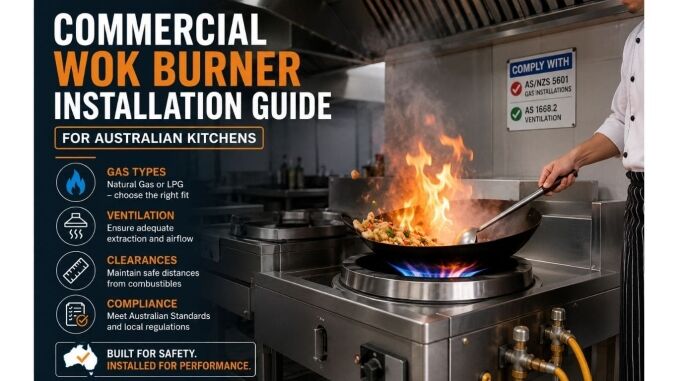
Commercial Wok Burner Installation Guide for Australian Kitchens
A commercial wok burner installation involves more than just finding a spot in your kitchen line. Wok burners run at far higher heat output than standard cooktops, so your kitchen needs the right gas supply, ventilation, and clearances before the unit goes in. Whether you’re fitting out a new Asian restaurant or upgrading an existing wok station, getting the planning right saves time, money, and headaches down the track. This guide walks through what to consider before installation day, so you and your gas fitter can get it right the first time.
Checking your gas supply before you install
Wok burners use a lot of gas. A single chimney or duckbill burner can run anywhere from 100 to over 200 MJ/h, and multi-burner ranges add up quickly. Before you commit to a unit, it’s worth having a licensed gas fitter check that your existing gas line can actually deliver that much flow.
This step gets missed more often than you’d think, especially when a wok burner is being added to a kitchen that was originally set up for lighter cooking equipment. If the supply line is undersized, you may need it upgraded before the wok burner can be connected and run at full output.
How to Check Your Kitchen’s Gas Supply Before Installing a Wok Burner
What you can check yourself
Before you call a gas fitter, there are a few things worth checking on your own. Start with your gas type, natural gas or LPG, since this affects which wok burner model and jets you’ll need. If you’re on natural gas, your gas meter will usually have a rating printed on it in MJ/h, which gives you an idea of the maximum flow your supply can deliver.
It’s also worth doing a quick tally of your existing gas appliances and their MJ/h ratings, which are usually listed on a data plate or in the appliance manual. Add these up along with the wok burner’s MJ/h rating to get a rough picture of your total gas load. A single wok burner can use anywhere from 100 to over 200 MJ/h, and multi-burner ranges add up fast, so this total can climb quickly once a wok station is added.
What needs a licensed gas fitter
Knowing your gas type and meter rating is a good starting point, but it doesn’t tell you whether your actual pipework can handle the extra load. Gas pipe is sized for the load it was originally installed for, and adding a high-output appliance like a wok burner can mean the existing pipework is too small, even if the meter itself is rated highly enough.
This is where a licensed gas fitter comes in. They’ll assess your pipe sizing against your total gas load, run a pressure test to check the supply is performing as it should, and confirm there’s enough capacity for the new wok burner without affecting your other gas appliances. If the pipework needs upgrading, this is the time to find out, rather than after the wok burner has been delivered and is sitting unused.
Why this step matters
A wok burner that isn’t getting enough gas pressure won’t reach the high heat output it’s designed for, which affects cooking performance and can shorten the life of the burner. Getting your gas supply checked before installation means the unit performs as expected from day one, and avoids the cost and disruption of discovering a supply issue after everything else is in place.
Clearances to combustible materials
Like all gas cooking equipment, wok burners need to be installed with proper clearance from walls, benches, and any combustible material nearby. Under AS/NZS 5601.1, there are minimum clearances both to the sides and above the burner, and these are measured from the highest point of the burner or trivet.
If your kitchen layout doesn’t allow for the full clearance, the affected surfaces can usually be protected with non-combustible material, but this needs to be confirmed with your gas fitter rather than worked out on the fly during installation.
Floor space and positioning
Commercial wok burners are freestanding units, built on their own stainless steel stand with legs, so they don’t need a cut-out in an existing bench. What matters is having a clear, level, non-combustible floor space in the right spot in your kitchen line, with enough room around the unit for safe operation and cleaning.
Position is everything with a wok burner. It needs to sit directly under your exhaust canopy, close enough to your gas connection point to avoid long pipe runs, and with enough clearance from walls and neighbouring equipment to meet AS/NZS 5601.1 requirements. If you’re slotting a wok burner into an existing kitchen line, it’s worth measuring up before ordering to make sure the unit’s footprint and height work with the benches either side.
Water-cooled vs waterless wok burners
Some wok burners use a water-cooled design, where water continuously circulates to manage heat build-up around the burner body. These units need a plumbed water supply and drainage, which adds another trade to coordinate during installation.
Waterless wok burners, which are now the more common choice in Australian kitchens, skip this entirely. They’re air-cooled, simpler to install, and avoid ongoing water costs. If you’re not sure which type suits your kitchen, our wok burner range includes both styles from brands like Luus, Goldstein, and B+S.
Water-Cooled vs Waterless Wok Burners: Which One Suits Your Kitchen
Waterless wok burners
Waterless wok burners use an air gap design to keep the burner deck cool, rather than running water. This cuts water use by up to 90 percent compared with older water-cooled units, which means lower water bills and less steam build-up in the kitchen. Installation is also simpler, since the unit only needs a gas connection, with no extra plumbing or drain required.
Most new commercial wok burners sold in Australia now use this waterless design, including popular models from Luus, Goldstein, and B+S. They suit cafes, takeaway shops, food trucks, and new kitchen fitouts where running a water line to the wok station would add cost and complexity.
Water-cooled wok burners
Water-cooled wok burners use a continuous flow of water around the burner deck to manage heat, with a tap at the rear that also doubles as a rinse point for washing down the wok between dishes. This design has been the traditional choice in Asian restaurant kitchens for decades, particularly in high-volume operations running long service hours.
The trade-off is higher water usage and the need for a plumbed water supply and drain, which adds another trade to coordinate during installation and ongoing running costs over time.
Which one is better for whom
For most new kitchens, cafes, and takeaway businesses, a waterless wok burner is the easier and more cost-effective choice. It’s simpler to install, cheaper to run, and keeps the kitchen cooler during service.
For established high-volume Asian restaurants that already have water-cooled wok stations plumbed in, sticking with a water-cooled replacement can make sense, especially if the existing plumbing is already in place and working well. However, many busy kitchens are now switching to waterless models during refits, since modern waterless burners can handle the same heat output without the ongoing water costs.
If you’re planning a new wok station from scratch, it’s worth starting with a waterless model unless you have a specific reason to need water cooling, such as matching an existing multi-burner setup in the same kitchen.
Hiring a licensed gas fitter
In Australia, all gas appliance connections must be carried out by a licensed gas fitter to meet AS/NZS 5601 requirements and keep your manufacturer’s warranty valid. This applies to every commercial wok burner installation, regardless of whether it’s a single benchtop unit or a multi-burner range.
Your gas fitter will handle the final connection, pressure testing, and certification, and can also advise on supply line capacity and clearances specific to your kitchen. Booking this trade early, ideally before your wok burner is delivered, helps avoid the unit sitting unused while you wait for a fitter to become available.
Pre-installation checklist
In Australia, all gas appliance connections must be carried out by a licensed gas fitter to meet AS/NZS 5601 requirements and keep your manufacturer’s warranty valid. This applies to every commercial wok burner installation, regardless of whether it’s a single benchtop unit or a multi-burner range.
Your gas fitter will handle the final connection, pressure testing, and certification, and can also advise on supply line capacity and clearances specific to your kitchen. Booking this trade early, ideally before your wok burner is delivered, helps avoid the unit sitting unused while you wait for a fitter to become available.
What to Expect When Your Gas Fitter Installs a Commercial Wok Burner
Before the gas fitter arrives
A good gas fitter does most of the important work before they even touch a spanner. They’ll check the gas type and connection point against your wok burner’s specifications, confirm the existing gas line can handle the unit’s MJ/h rating, and look at where the burner will sit in relation to your exhaust canopy and any combustible surfaces nearby. This is also when they’ll check the appliance itself has a valid AGA approval or compliance plate, since it’s illegal for a gas fitter to connect an appliance that isn’t approved for use in Australia.
Tools and equipment a gas fitter brings
For a commercial wok burner installation, a gas fitter typically brings a set of pipe wrenches and adjustable spanners for connecting fittings, a pipe cutter and threading kit if new gas pipe needs to be run, jointing compound or thread tape rated for gas use, and a flexible gas connector or bayonet fitting suited to commercial appliances. They’ll also carry a manometer or digital pressure gauge for testing gas pressure, a gas leak detection solution or electronic leak detector, and an isolation valve if one isn’t already fitted near the appliance.
Connecting the wok burner
Once the site checks are done, the gas fitter connects the wok burner to the gas supply using fittings rated for the appliance’s gas type and pressure. They’ll fit or check for an isolation valve close to the burner, so the gas supply can be shut off quickly if needed. If the unit is water-cooled, this is also when the water supply and drain connections are made, usually by a plumber working alongside the gas fitter.
Testing for gas tightness
Before the wok burner can be used, the entire installation needs to pass a pressure test to confirm there are no leaks anywhere along the line. Under AS/NZS 5601, there’s no acceptable leakage rate, so every joint and connection needs to hold pressure with zero drop. The gas fitter will also check that the gas pressure at the appliance matches the manufacturer’s specifications, since too high or too low can affect how the burner performs.
Final checks before handover (Commissioning)
With the gas connection tested, the gas fitter does a final check of the whole setup. This usually covers confirming clearances to walls and combustible surfaces meet AS/NZS 5601.1, checking the exhaust canopy is operating and positioned correctly over the burner, and running the wok burner through its full range to make sure it ignites properly, burns evenly, and shuts off safely.
Paperwork and certification
Once everything is checked out, the gas fitter will issue a compliance certificate (called different things depending on your state, such as a Certificate of Compliance or Notice of Completion) and may also attach a compliance plate to the installation. This paperwork is your proof that the work was done by a licensed professional and meets Australian Standards. It’s worth keeping a copy on file, since it can be needed for insurance, lease requirements, or council inspections down the track.
Frequently Asked Questions
Yes. All gas appliance connections in Australian commercial kitchens must be completed by a licensed gas fitter to comply with AS/NZS 5601 and keep your warranty valid.
Clearances depend on the model and whether nearby surfaces are combustible, but AS/NZS 5601.1 sets out minimum side and overhead clearances. Your gas fitter can confirm the exact figures for your unit and kitchen layout.
Often, yes. Wok cooking produces more heat and steam than standard cooking equipment, so a canopy sized for general cooking may not provide enough capture for a dedicated wok station.
Many commercial wok burners can run on either, but the burner jets are gas specific. Confirm your gas type before ordering so the correct jets are fitted.
No. Wok burners are freestanding units with their own stainless steel stand. They sit on the floor in your kitchen line and don’t need a bench cut-out.
Yes. Water-cooled models need a connected water supply and drainage for the cooling system, while waterless models only need a gas connection.