
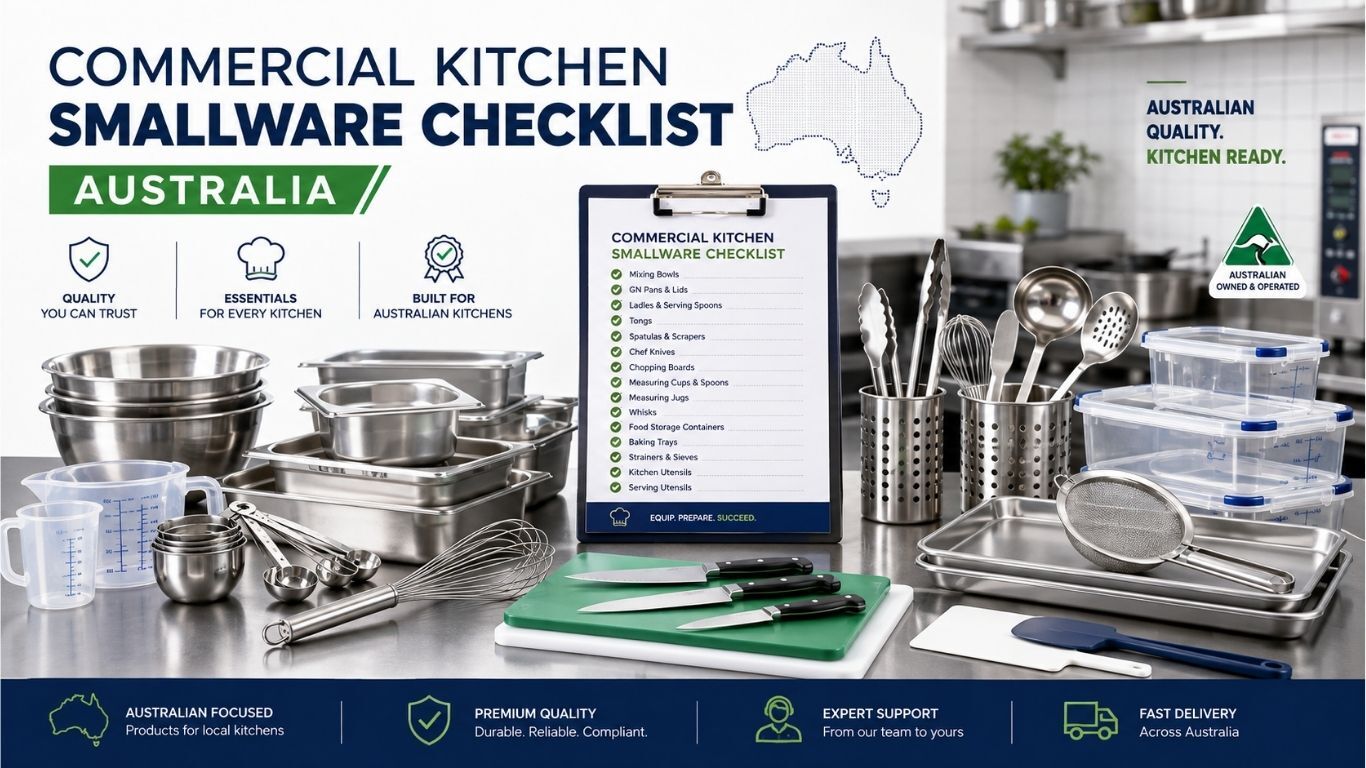
Commercial Kitchen Smallware Checklist Australia
When people plan a commercial kitchen fit-out, most of the attention goes to the big equipment: fridges, ovens, dishwashers. But a kitchen doesn’t actually run on big equipment alone. It runs on smallware, the everyday tools your chefs and kitchen hands reach for constantly, tongs, cutting boards, gastronorm pans, mixing bowls, ladles. Forget these and even the best-equipped kitchen grinds to a halt on day one.
This checklist covers the smallware every Australian café, restaurant, takeaway or catering kitchen needs, organised by how a kitchen actually uses them.
What Counts as Kitchen Smallware?
Smallware is the term for the hand tools, cookware and small storage items used to prepare, cook and serve food, as opposed to the larger fixed equipment like ovens and fridges. It’s low cost per item, but it’s also high rotation, meaning it wears out, goes missing or breaks more often than major equipment, and needs restocking regularly rather than being a one-off purchase.
Because each item is inexpensive on its own, it’s easy to underestimate the total smallware budget for a new kitchen. Most operators find they need more of each item than they first expect, since prep, cooking and service often happen at the same time across different stations.
Cutting and Prep Tools
Every station needs its own set of prep tools rather than sharing between sections, since chefs constantly need boards and knives on hand mid-service. A well-stocked kitchen has a set of chef’s knives, paring knives and a bread knife at minimum, colour-coded cutting boards to separate raw meat, seafood, vegetables and cooked food, and enough of each colour that no station is left waiting on a board. Peelers, box graters, mandolines and kitchen shears round out the core prep kit. For kitchens doing high volumes of chopping, slicing or grating, a commercial food processor takes the load off hand prep and keeps service moving when time is tight.
Gastronorm Pans and Inserts
Gastronorm pans, often just called GN pans, are one of the most important smallware categories in any Australian commercial kitchen, since they’re the standard size format used across fridges, ovens, bain maries and hot food displays. Getting your GN pan sizing right means food moves between prep, storage, cooking and service without ever needing to be transferred to a different container.
A typical kitchen needs a mix of full-size GN 1/1 pans for bulk storage and bain marie service, GN 1/2 and GN 1/3 pans for smaller batches and toppings, and a range of depths to suit different foods, shallow pans for garnishes and condiments, deeper pans for soups, curries and stews. We’ve covered this in detail in our Gastronorm Pans in Australia guide, and our full range is available on the Gastronorm Pans collection page.
Pots, Pans and Cookware
Cookware needs vary by menu, but most kitchens rely on a core set: stockpots for stocks, soups and large-batch cooking, saucepans in a few sizes, frypans in both non-stick and stainless steel, and a stack of baking trays for anything that goes in the oven. Cast iron pans are worth having for searing and high-heat cooking where good heat retention matters. Buy commercial-grade cookware rather than domestic, it’s built to handle daily high-heat use without warping or failing early.
Utensils and Serving Tools
These are the tools that live on the line during service: tongs, ladles in a few sizes, spatulas, whisks, slotted spoons and turners. Because these get used constantly and go missing easily, most kitchens keep a working stock plus spares in the storeroom rather than buying the exact number needed. Serving tools like carving boards, service trays and platters matter too, especially for venues plating food at the pass or running a buffet or grazing style service.
Mixing and Measuring
Mixing bowls in stainless steel, in a range of sizes, cover everything from whisking eggs to tossing large batches of salad. Measuring jugs, scales and thermometers round out this category. A digital probe thermometer, in particular, isn’t optional; it’s how your kitchen proves food is cooked and held at safe temperatures, which matters for food safety compliance as much as for food quality.
Storage and Food Safety Smallware
Food storage containers, both for the coolroom and for staff taking food off-site, need to be stackable, clearly labelled and dishwasher safe. Cambro-style containers with dated labelling systems help kitchens stay on top of stock rotation and health department requirements. If your venue does takeaway, this is also where packaging comes in, disposable trays, bowls and containers that hold up for delivery and reheating. Our Kitchenware and Servingware range covers both catering smallware and takeaway packaging in one place.
How Much Smallware Should You Actually Buy?
A common mistake is buying the exact quantity needed for one full service. Smallware breaks, goes missing, and needs washing between uses, so most kitchens buy roughly one and a half to two times what a single service requires, more for high-turnover items like tongs, ladles and cutting boards, less for durable items like stockpots that see less daily wear. Building in that buffer from the start avoids the scramble of running short mid-service.
Frequently Asked Questions
Smallware refers to hand tools, cookware and small storage items like utensils, pots, pans and gastronorm pans. Commercial kitchen equipment usually refers to the larger, fixed appliances, fridges, ovens, dishwashers and cooking equipment.
Yes. Sticking to the gastronorm standard means your pans fit consistently across fridges, ovens, bain maries and hot food displays, so food can move between stations without being transferred into a different container each time.
It varies by venue size and menu, but smallware is often underestimated in fit-out budgets since each item is low cost individually. It’s worth listing every category above against your menu and stations, rather than guessing a lump sum.
For the full picture on planning a new kitchen from the ground up, see our Complete Guide to Opening a Restaurant in Australia.