

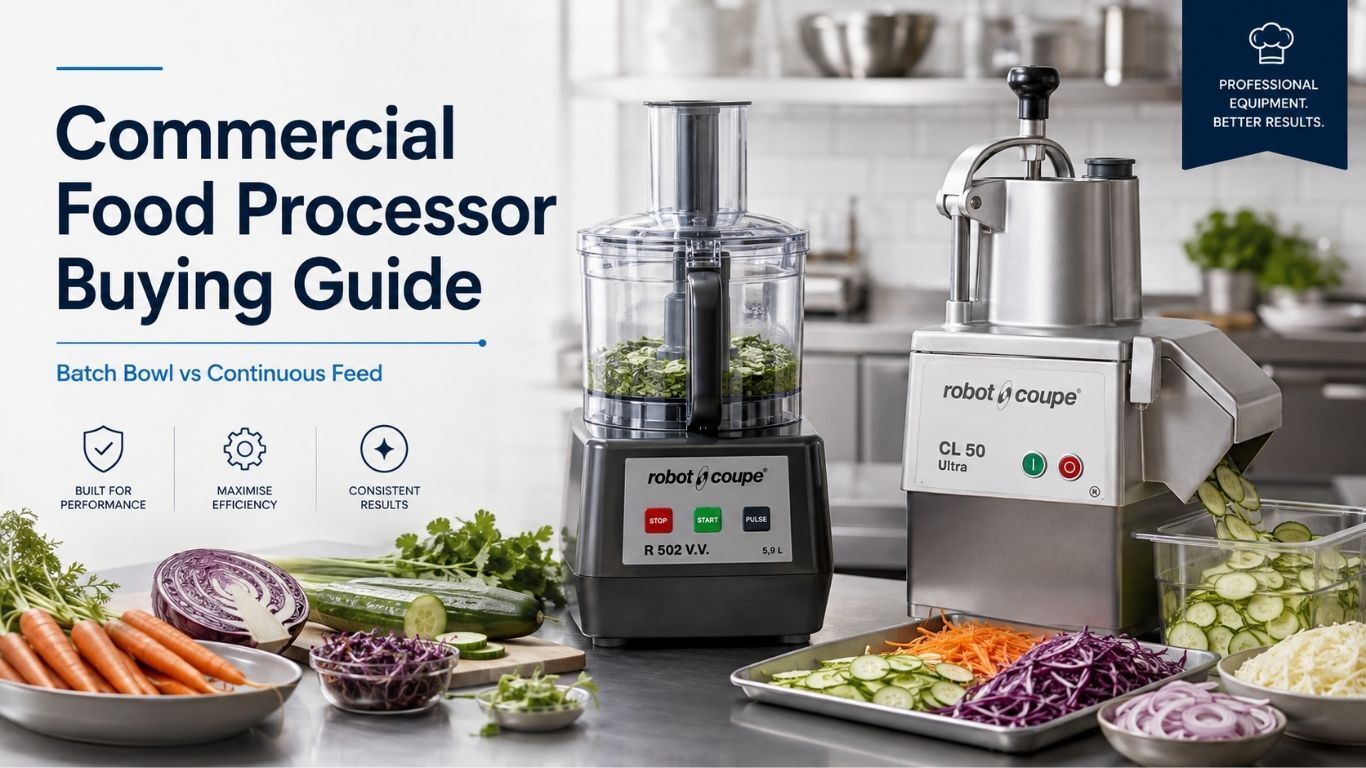
Commercial Food Processor Buying Guide: Vegetable Cutters, Slicers and Cutter Mixers Explained
If you run a busy kitchen anywhere in Australia, you already know how much time gets swallowed up by prep work. Chopping onions, slicing potatoes, grating cheese, dicing carrots. It all adds up, and doing it by hand every single day is slow, tiring and hard on your staff. A good commercial food processor takes that load off your team and gets it done faster, safer and more consistently.
The tricky part is that “commercial food processor” actually covers a whole family of machines. Vegetable cutters, slicers, cutter mixers and combination units all fall under this umbrella, and each one is built to do a slightly different job. Picking the wrong type for your kitchen means you either end up with a machine that can’t keep up, or one that’s far more powerful (and expensive) than you actually need.
This guide walks through what each type of machine does, what people are actually searching for when they shop for one, and what to look at before you buy. By the end, you should have a clear idea of which commercial food processor suits your kitchen, whether you run a café, restaurant, pub, catering business or a central production kitchen.
What is a commercial food processor?
A commercial food processor is a powered kitchen machine built to handle food preparation tasks in bulk, things like chopping, slicing, dicing, grating, shredding, mixing and pureeing. Unlike a domestic food processor you’d find in a home kitchen, commercial models are built for daily heavy use, with stronger motors, tougher housings and parts designed to be pulled apart and washed quickly between services.
Under this broad category, you’ll come across several different machine types. Knowing the difference matters, because they’re not interchangeable.
Bowl-style food processors
These are the classic style, with an enclosed bowl that usually holds between 2 and 5 litres. Food goes into the bowl and a blade or disc spins to chop, blend, grate or slice it. Bowl processors are great for smaller batches, sauces, dips, pastes, dressings and fine chopping work where you need a smooth, even result.
Continuous feed vegetable cutters
Rather than working in a closed bowl, a continuous feed vegetable cutter has a hopper or chute that you keep feeding vegetables into while the machine runs. This makes it far better suited to high-volume slicing, dicing and grating, since you’re not limited by bowl size and can keep production moving without stopping to empty and refill. If your kitchen gets through sacks of onions, potatoes or cabbage every day, this is usually the better option.
Cutter mixers
A cutter mixer combines a rotating blade with a bowl that also turns, which mixes the ingredients as they’re being cut. This gives a more even, thorough result than a simple chopping blade, which is why cutter mixers are popular for things like pâtés, fine mince, purees, dips and emulsified sauces. Some models can also take a vegetable slicer attachment, giving you two machines in one footprint.
Mandoline and manual slicers
Not every slicing job needs a powered machine. Manual mandoline slicers are a low-cost option for kitchens that only need occasional thin, even slices of vegetables like potatoes, cucumbers or tomatoes. They take more hands-on effort but cost a fraction of a powered unit and need almost no maintenance.
Commercial vegetable cutters: what they do best

A commercial vegetable cutter is built for one job above all else, turning raw vegetables and fruit into consistent, uniform cuts as fast as possible. Interchangeable discs let one machine produce slices, julienne strips, grated shreds and diced pieces, so you don’t need a separate machine for every cut on your menu.
People searching for a vegetable cutter online are usually trying to solve a specific prep bottleneck. Maybe it’s a pub kitchen going through 10kg of cabbage a night for coleslaw, or a café that’s tired of a junior chef spending the first hour of every shift slicing cucumbers by hand. If that sounds familiar, a continuous feed vegetable cutter is likely to be the right fit.
Before buying one, think about:
- How many kilograms of vegetables you actually get through in a typical service, not just on your busiest day
- Which cuts your menu needs (slicing, dicing, grating, julienne, chipping) and whether the machine takes a disc for each one
- Whether the hopper size suits whole vegetables or if you’ll need to pre-cut larger items to fit
- How easily the discs, hopper and pusher come apart for daily cleaning, since Australian food safety practice requires food-contact parts to be stripped and sanitised after every use
Commercial slicers: precision cuts made easy
Slicers, whether they’re a dedicated disc-driven vegetable slicer or a manual mandoline, are about getting the same thickness on every single cut. That matters more than people think. Uneven tomato slices on a burger, or inconsistent potato slices in a gratin, make a dish look unprofessional even if the taste is fine.
A powered vegetable slicer usually offers a few interchangeable discs at different thicknesses, so you can switch between a fine 2mm slice for garnishes and a thicker 5mm slice for something like a bake or a salad. Some combination units pair a slicer function with a cutter mixer bowl, which is worth considering if your kitchen needs both fine slicing and bulk mixing but doesn’t have room for two separate machines.
If your volume is lower, say a small café doing garnish work rather than bulk prep, a manual mandoline slicer might be all you need. It’s a much smaller investment and takes up almost no bench space, though it does need more hands-on time and care with the blade.
Cutter mixers: when you need more than just chopping

A cutter mixer earns its keep in kitchens that produce a lot of fine, evenly blended mixtures. Think pâté, terrines, fish mousse, dips, purees, breadcrumbs, nut butters and emulsified sauces. Because the bowl itself rotates while the blade spins, everything in the bowl gets worked through evenly, rather than just chopped near the blade and left untouched further out. Many commercial cutter mixers on the Australian market, from brands like Dito Sama and Robot Coupe, are sold as combination units with an attachment hub. This lets you swap between the cutter mixer bowl and a vegetable slicer attachment on the same base machine, which is a smart way to cover both jobs without buying two separate pieces of equipment.
Bowl size is worth checking closely, since cutter mixers commonly come in 2.9L, 3.6L and 4.5L sizes. A 2.9L bowl is plenty for small batches of dips, dressings or garnish work, while a 4.5L bowl suits kitchens producing larger volumes of pâté or terrine mix in one run. Buying a bowl that matches your typical batch size saves you from either running the machine constantly or overloading it.
Speed options matter too. Some cutter mixers run on a single fixed speed, while others offer variable speed control. Variable speed gives you more say over the final texture, since a shorter run on a lower speed keeps a coarser, chunkier mix, while a longer run on high speed gives a smooth, spreadable result. Many models also have a pulse function alongside continuous run, which is handy when you want a controlled, chunky texture rather than risking delicate ingredients turning to paste.
Because a cutter mixer has a blade spinning inside the bowl, safety interlocks are a genuine feature to look for, not just a compliance checkbox. A good interlock stops the blade the instant the lid is opened, so staff can’t reach into the bowl while it’s running.
Beyond pâté and mousse, cutter mixers also earn their place in kitchens making stuffing mixes, quiche fillings, dumpling fillings and, for larger catering operations, baby food production. Anywhere you need a large batch mixed to a consistent, even texture, a cutter mixer will usually do it faster and more evenly than mixing by hand.
As a buying tip, if your kitchen mostly needs bulk slicing and only occasionally needs a fine mix, a combination cutter mixer with a slicer attachment usually works out cheaper than buying two separate dedicated machines.
What Australian buyers should actually look for
Once you know which type of machine suits your prep work, the next step is comparing models properly. Here’s what actually makes a difference over the life of the machine, not just on the spec sheet.
Motor power and speed
Commercial food processors in Australia typically run somewhere between 1500 and 2600 RPM. Lower speeds, around 1500 to 1800 RPM, handle tougher, denser ingredients and give a coarser cut. Higher speeds, up to 2600 RPM, are better suited to fine chopping and smooth, even textures. If your kitchen handles a mix of both, look for a model with variable speed control rather than a single fixed setting.
Bowl size and hopper capacity
Match the bowl or hopper size to your real daily volume, not your busiest possible day. Too small and you’ll be constantly stopping to refill. Too large and you’re paying for capacity you rarely use, while it also takes up more bench space than necessary.
Discs and attachments
List out every cut your menu actually needs, slicing, dicing, grating, shredding, julienne, before you buy. Then check the machine takes a disc for each one and that spare discs are easy to get hold of in Australia. A machine that only covers half your prep list isn’t going to save you as much time as you’d hope.
Cleaning and food safety compliance
Under Australian food safety practice, anything that touches food needs to be stripped down and sanitised daily. Look for models where the bowl, discs, blades and hopper detach without tools, and check whether parts are dishwasher safe. A machine that’s a hassle to clean tends to get cleaned less thoroughly, which is a real risk in a commercial kitchen.
Build quality and materials
Stainless steel housings and food-contact parts hold up far better than plastic under daily commercial use, and they’re easier to keep properly sanitised. A solid, well-built base also means less vibration and noise during long prep sessions.
Electrical compliance
Never assume an imported machine is automatically approved for commercial use in Australia. Confirm the exact model carries the correct Regulatory Compliance Mark, runs on the right Australian voltage and plug configuration, and comes with proper safety interlocks and guards. A reputable Australian supplier should be able to confirm all of this before you buy.
Warranty and local service support
Even the best-built machine will need a service or a spare part eventually. Check what the commercial warranty actually covers, and just as importantly, whether the supplier has local support and parts on hand in Australia. A machine that has to be shipped overseas for repairs means days or weeks without a working prep station.
Price and finance options
Commercial food processors, vegetable cutters, slicers and cutter mixers span a wide price range depending on capacity and brand. Many Australian suppliers, including Ben’s Hospitality Equipment, offer finance options such as SilverChef, which can make it easier to get the right machine now rather than settling for a cheaper unit that can’t keep up with your kitchen.
Matching the machine to your kitchen
There’s no single “best” commercial food processor, it depends entirely on what your kitchen actually does day to day.
A small café or takeaway shop doing light garnish work and the occasional sauce is usually well served by a compact bowl-style food processor or a manual mandoline slicer. There’s no need for a heavy-duty continuous feed unit if you’re only prepping a few kilograms a day.
A busy restaurant, pub kitchen or bistro turning over hundreds of meals a service is a much better fit for a continuous feed vegetable cutter or a cutter mixer with disc attachments. These kitchens need speed and consistency across a high volume of vegetables, and a bowl processor alone will quickly become a bottleneck.
Caterers, central production kitchens, hospitals and canteens producing large batches for hundreds of meals a day generally need the highest capacity continuous feed cutters, sometimes paired with a separate cutter mixer for sauces, dips and purees. At this scale, output per hour matters as much as the quality of the cut.
Keeping your machine running well
Whatever type of machine you end up with, a few simple habits go a long way. Strip down and clean all food-contact parts after every use, not just at the end of the day. Check blades and discs regularly for wear, since a blunt blade forces the motor to work harder and produces a worse cut. Keep an eye on the motor for unusual noise or heat, which can be an early sign it’s struggling with a job it’s not really built for. And book in a professional service on the schedule your supplier recommends, rather than waiting until something actually breaks.
Frequently asked questions
A food processor usually works in an enclosed bowl and is suited to chopping, blending and pureeing smaller batches. A vegetable cutter uses a continuous feed hopper and interchangeable discs, and is built for high-volume slicing, dicing and grating rather than mixing or pureeing.
Combination units are available, where a cutter mixer base takes both a mixing bowl and a vegetable slicer attachment. These are a good option if your kitchen needs both functions but doesn’t have the bench space or budget for two separate machines.
Base it on your typical daily volume rather than your busiest possible day. A small café might only need a 2 to 3 litre bowl, while a caterer or production kitchen may need a continuous feed unit rated for 50kg an hour or more.
Good ones aren’t. Look for a model where the hopper, discs and pusher detach without tools, so staff can strip it down and sanitise it quickly as part of the normal cleaning routine.
Ready to find the right machine for your kitchen?
Ben’s Hospitality Equipment stocks a full range of commercial food processors, vegetable cutters, slicers and cutter mixers from trusted brands, with Australia-wide delivery and SilverChef finance available. Browse our commercial food processor range or get in touch on 1300 434 125 and our team can help you match the right machine to your daily prep volume and budget.
