
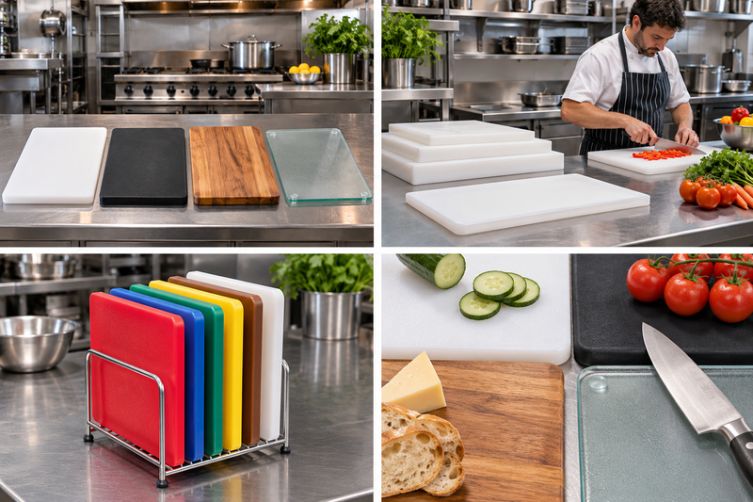
What Are Commercial Cutting Boards Made Of? Plastic, Rubber, Wood and Glass Compared
Most commercial cutting boards are made of polyethylene, a tough, food-safe plastic. Restaurants, cafés, butchers and takeaway shops choose it because it doesn’t soak up moisture or smells, it handles hot washing, and it’s cheap enough to replace when it wears out. Wood, rubber and glass all have a place somewhere, but not usually on a busy prep bench.
Here is how each material compares, plus what to check before you buy commercial chopping boards in Australia.
Polyethylene is the standard for commercial kitchens
Polyethylene comes in two main grades, and you’ll see both in commercial ranges.
Low density polyethylene (LDPE) is lighter and a little softer, which is kinder to your knife edges. It suits everyday prep and stations where boards get moved around a lot. Our Hygiplas low density chopping board sets are a good example.
High density polyethylene (HDPE) is harder. It stands up to knife marks and suits heavy chopping, butchery and portioning. Boards in this grade are often thicker and heavier, like our high density set with steel rack.
Plastic chopping boards are okay for commercial use while the surface stays smooth
Plastic gets a bad name in home kitchens, but in a commercial kitchen it’s the safe choice for one simple reason. It’s non-porous, so juices don’t sink in, and it’s easy to wash and sanitise. Australian food safety rules expect food contact surfaces to be easy to clean and sanitise, and smooth plastic does that well.
The catch is wear. Once knives cut deep grooves, food and bacteria can hide where a cloth or sanitiser can’t reach. That’s when a plastic board stops being safe. Our guide on how to clean, resurface and replace commercial cutting boards shows how to spot that point.
Rubber boards grip well but not every cook likes them
Rubber boards stay put on the bench and can be resurfaced. The downside is that some cooks find the surface grabs at the knife blade. They also cost more, and most kitchens find polyethylene easier to live with, which is why polyethylene is the material we stock.
Wooden boards suit serving, not raw prep
Wood is porous. It stays damp for longer and it’s harder to sanitise fully. HACCP Australia says most food safety authorities, including auditors and government inspectors, don’t allow wooden boards in commercial food handling premises. Rules can vary, so check with your local council before you use wood for any raw food.
Where wood does shine is on the table. A timber board is a great way to serve bread, cheese or cooked meats.
Glass looks clean, but it is not a good commercial choice
Glass doesn’t stain and looks spotless, which is why people ask whether glass cutting boards are hygienic. Looks aren’t the test. Glass is hard on knife edges, it can be slippery, and it can chip or break. HACCP Australia lists glass boards as unsuitable for commercial kitchens. Marble and stone boards have the same problem with blunting knives.
What makes a chopping board commercial grade
The words commercial grade get used loosely. When you compare boards, check these things:
- Non-porous material. Polyethylene is the usual choice.
- Enough thickness. Thicker boards of 20mm or more resist warping and take heavy chopping.
- Flat and stable. A board that rocks on the bench is a knife slip waiting to happen.
- Easy to clean. Check whether the board is dishwasher safe. Our antibacterial dishwasher safe board set is marked for it, and each product page lists what applies.
- Colour coding. Separate colours help you keep raw and cooked foods apart.
Commercial chopping board sizes and thickness
Size depends on what you cut and how much bench you have.
- 450 x 300mm is the all-round working size for most prep stations.
- 600 x 450mm is the large size for butchery, portioning or prepping a full tray at once.
- 10mm and 12mm thick boards are light and easy to handle for everyday jobs.
- 20mm and 25mm thick boards suit heavy chopping and last longer.
Need a board longer than 600mm? Call us on 1300 434 125 and ask what we can organise.
Colour-coded sets keep food groups apart
A colour-coded set gives each food its own board, which cuts the risk of cross-contamination. Our six-board sets cover dairy, fruit and vegetables, raw meat, raw poultry, cooked meat and raw fish. There is no single colour chart every kitchen must follow, so pick one, write it into your food safety plan and make sure every staff member knows it. See the colour-coded chopping board sets with a storage rack.