
Best Electric Griddle – How To Choose One For My Kitchen
If you are shopping for a commercial griddle, it is easy to get stuck between sizes, plate materials, power requirements, and brand options. A griddle might look simple, but choosing the right one can affect how fast your kitchen works, how evenly your food cooks, and how smoothly service runs during busy periods.
For cafés, takeaways, burger shops, food trucks, and restaurants across Australia, a commercial electric griddle can be one of the most useful pieces of countertop cooking equipment. It gives you a flat, versatile cooking surface for everything from eggs and bacon to burgers, steaks, pancakes, onions, wraps, and toasted sandwiches.
This guide will help you compare electric griddle sizes, plate materials, and brands, so you can choose the right model for your kitchen setup and service volume.
Why Buy a Commercial Electric Griddle?
A commercial electric griddle is a smart choice for businesses that want consistent cooking performance without the complexity of a full cookline. Electric griddles are especially useful in kitchens where gas is not available or where simple installation matters. They are popular with operators who want steady heat, easy temperature control, and a practical cooking solution for daily service.
They work well for:
- cafés serving breakfast and lunch
- takeaway shops cooking burgers and sandwiches
- food trucks with limited space
- small restaurants needing extra cooking capacity
- kitchens looking for a reliable benchtop cooking station
For many businesses, an electric griddle is a great balance of performance, simplicity, and flexibility.
What Size Electric Griddle Do You Need?
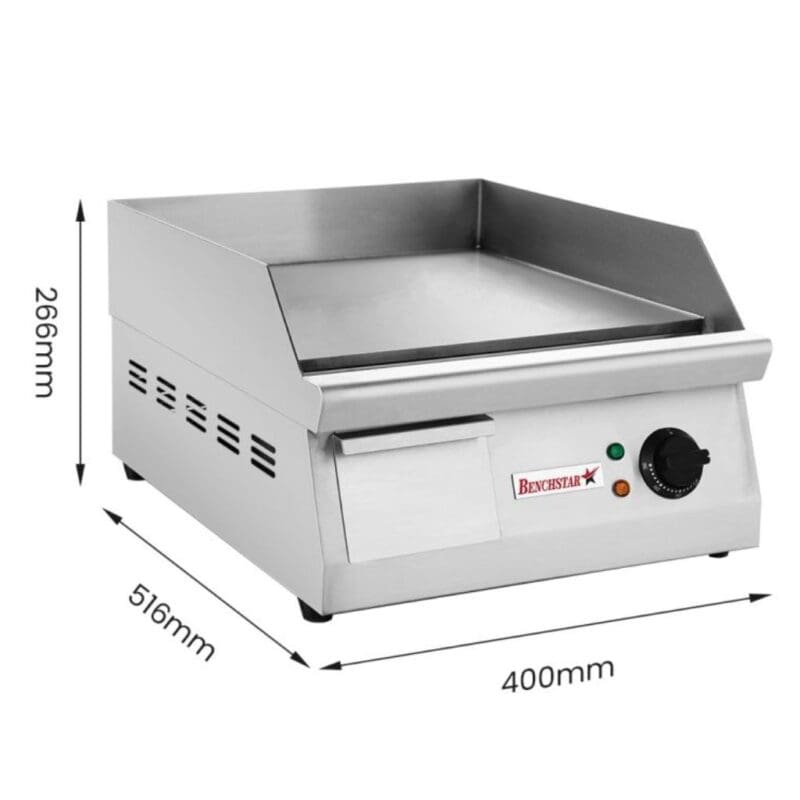
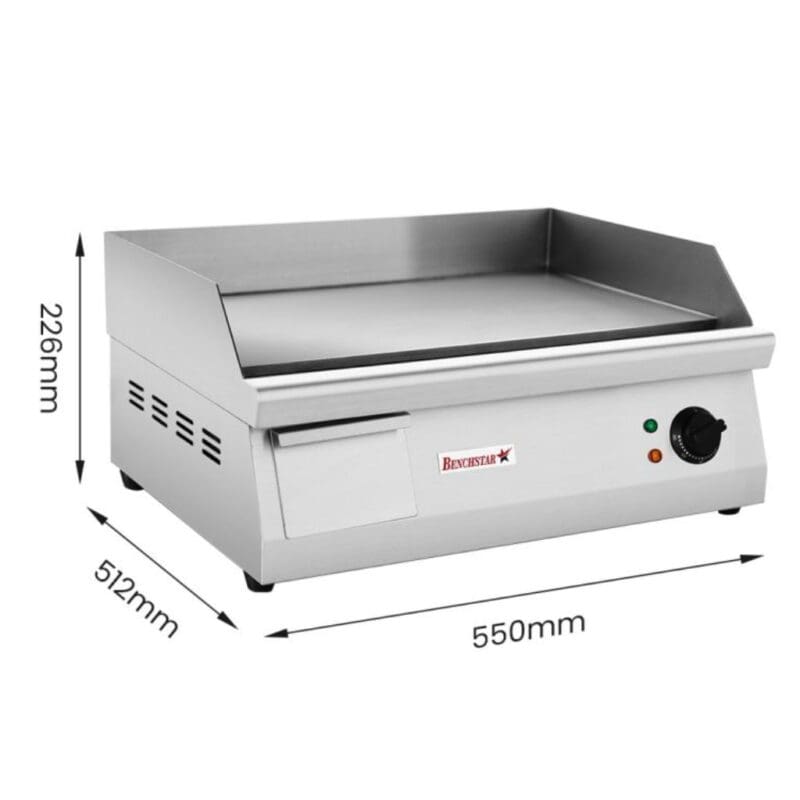
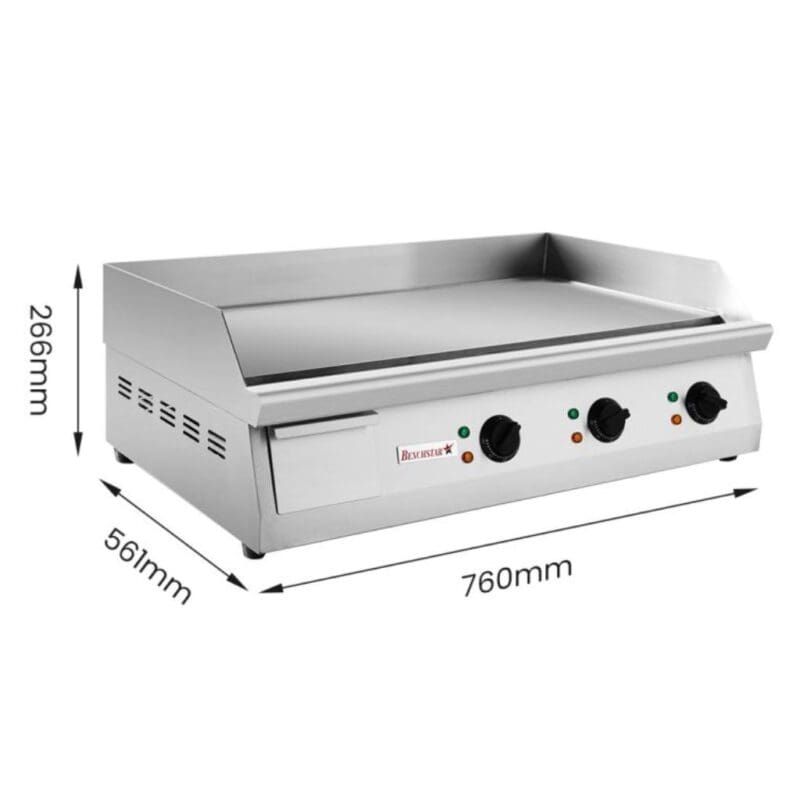
One of the first things to think about is griddle size. The right width depends on your menu, your available bench space, and how much food you need to cook during busy service.
Small Griddles: Around 400mm to 525mm Wide
Small electric griddles are ideal for businesses with limited space or lower cooking volume. These are often a good choice for kiosks, coffee shops, compact cafés, and side prep stations. If you are mainly cooking smaller batches, a compact griddle can do the job well without taking over your bench.
A smaller griddle suits you if:
- You are short on bench space
- You cook made-to-order in smaller batches
- You are fitting out a small café or food truck
- You want an affordable entry point into commercial griddle cooking
Medium Griddles: Around 550mm to 610mm Wide
For many hospitality businesses, this is the sweet spot. Medium-sized griddles offer more cooking space without becoming too bulky or power-hungry. They work well for breakfast service, burger stations, sandwich prep, and mixed menus where you need a practical all-rounder.
This size is a strong option if you need:
- more output than a compact unit
- enough space for breakfast rush cooking
- a good balance between footprint and productivity
- one main griddle for everyday service
Large Griddles: Around 730mm to 760mm and Above
Large electric griddles are better suited to busy commercial kitchens that need higher output and a wider cooking surface. These are ideal for venues that rely on griddle cooking throughout the day and want one main flat-top station that can handle rush periods more comfortably.
A larger unit makes sense if you run:
- a busy café
- a burger shop
- a takeaway with peak periods
- a restaurant with regular griddle cooking
- a venue needing more batch cooking space
Don’t Forget the Power Supply
When buying a commercial electric griddle, power requirements matter just as much as the size of the cooking surface. Many operators focus on plate width first, but getting the power setup wrong can lead to expensive surprises during installation.
Most commercial electric griddles in Australia run on 15A power. Single-phase power at 10A or 15A suits most small-to-medium commercial kitchens, but larger or higher-output models may require 20A, 32A single-phase, or even three-phase power. Electric griddles typically draw between 3–7 kW per zone, and are available in single phase 20A–32A or three phase options, depending on the model.
A commercial electric griddle with a standard 10A plug does exist, but is not common. Most will need at least a 15A socket, and some of the larger units must be hard wired by a licensed electrician.
Before buying, make sure you know:
- What power is available at your site: 10A, 15A, 20A, single phase, or three phase
- Whether the unit comes with a plug or requires hard wiring
- Whether a licensed electrician is needed for installation
- Whether the griddle is going into a permanent kitchen line or a movable benchtop setup
- Whether the power output of the model suits your volume of service
It is important to verify your kitchen’s existing electrical infrastructure before purchasing major equipment, as upgrading from single phase to three phase involves a high cost and may not be feasible in all locations. A licensed electrician should assess your power requirements before you commit to a hard-wired unit.
The right commercial electric griddle is not just about plate width. It also has to match the electrical setup of your kitchen. Otherwise, installation can become far more expensive and complicated than expected.
Griddle Plate Material: Cast Iron vs Steel Plate
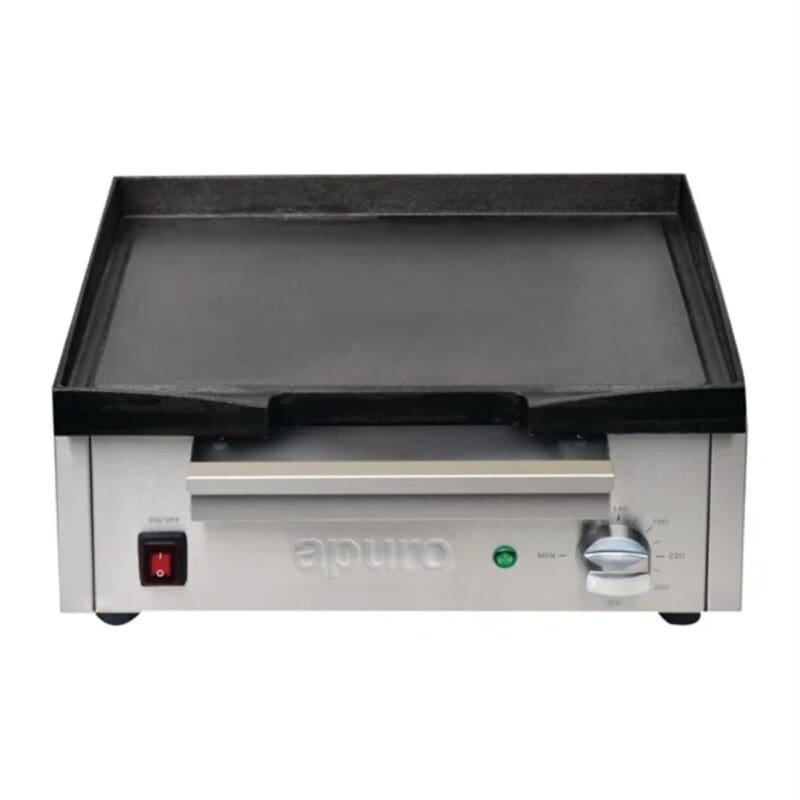

Griddle Plate Material: What You Are Actually Cooking On Matters
Most people shopping for a commercial electric griddle spend a lot of time looking at size and price. The plate material often gets overlooked, but it has a real effect on how your griddle cooks, how it recovers between batches, and how much work it takes to keep clean at the end of a shift.
The two most common plate materials you will come across in the Australian market are cast iron and steel plate. Here is what each one actually means for your kitchen.
Cast Iron Plates: Built for Heat, Not Speed
Cast iron is dense and heavy, and that is exactly the point. Once it gets up to temperature, it holds that heat well, even when cold food hits the surface. That consistent warmth across the plate is what gives you reliable browning and a proper sear without the plate dipping in temperature every time you load it up.
For kitchens running burgers, steaks, or bacon through a busy service, that heat stability makes a real difference. You are not constantly chasing temperature. The plate does the work.
The trade-off is that cast iron takes longer to heat up, it is heavier to handle, and it needs a bit more attention when it comes to cleaning and maintenance. It has to be seasoned, which means coating it with oil and heating it, to keep the surface protected and stop it from rusting. Skip that step too often, and the plate will let you know about it.
Cast iron tends to suit kitchens that:
- run a focused menu with proteins as the main item
- cook continuously through a long service
- keep the griddle in a fixed position rather than moving it around
- want a cooking surface that builds up character and performance over time
Steel Plate: The Practical Workhorse
Steel plate is the most common choice in commercial kitchens across Australia, and for good reason. It heats up faster than cast iron, it handles a wide variety of food without much fuss, and it is generally easier to work with day to day.
Cafés, takeaways, breakfast spots, and general hospitality kitchens tend to get on well with steel plate because it suits mixed cooking. Eggs, bacon, pancakes, toasties, vegetables, chicken – steel plate handles the lot without you having to think too hard about it.
One thing worth checking is plate thickness. A thinner steel plate will heat up quickly but drop in temperature faster when you load it. A thicker plate, anything from 8mm upward, is a reasonable starting point for commercial use, holds heat better and gives you more even cooking across the surface. If you are comparing two steel plate griddles on price, check the plate thickness before assuming they perform the same way.
Steel plate also needs seasoning after a deep clean to protect the surface and keep food from sticking, but day-to-day it is straightforward to maintain.
Steel plate tends to suit kitchens that:
- cook across a broad menu
- want a reliable griddle that is easy to get started with
- need something practical and low-fuss during service
- may need to move or reposition the griddle at times
So, Which One Should You Choose?
For most Australian cafés, takeaways, and hospitality businesses, steel plate is the default for good reason. It is versatile, easy to manage, and will handle whatever you throw at it.
If your kitchen runs a high volume of proteins such as burgers, steaks, breakfast meats and heat consistency is a real priority for you, cast iron is worth the extra attention it needs.
Neither material is wrong. It comes down to what you are cooking, how busy your service is, and how much time your team has at the end of the day.
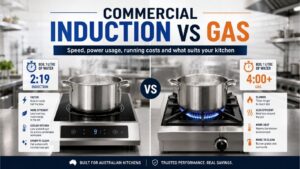
Electric vs Gas Griddle: Which One Actually Suits Your Kitchen?

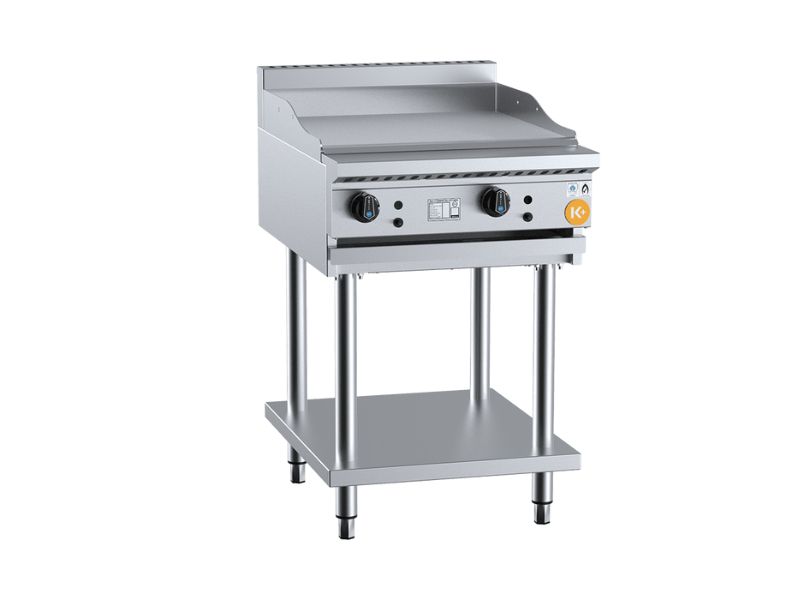
This is one of the most common questions we get asked, and honestly, there is no single right answer. Both electric and gas griddles do the same job, cook food on a flat plate, but they do it differently, and the one that suits you comes down to your setup, your menu, and how hard your kitchen works during service.
Here is a straightforward look at both.
Electric Griddles
Electric griddles have come a long way. Modern commercial electric models heat evenly across the plate, hold temperature consistently, and give you precise control through a simple dial or thermostat. For a lot of Australian café and hospitality operators, that steady, predictable heat is exactly what they need.
Where electric really shines is heat distribution. Because the heating elements sit directly under or are embedded into the plate, the heat spreads evenly across the whole cooking surface. There are no burner hot spots to worry about, which makes electric a strong choice for delicate items like eggs, pancakes, or fish, where uneven heat causes problems.
Electric is also the simpler option when it comes to installation. If you have the right power supply available, you plug it in, and you are ready to go. No gas plumber, no gas line, no compliance certificates for gas fitting. For businesses setting up in a space that does not already have gas, electric removes a significant layer of cost and complexity before you even start cooking.
Electric griddles tend to suit your kitchen if:
- your site does not have gas connection
- you run a café, breakfast spot, sandwich bar, or light-to-medium volume kitchen
- you want consistent, even heat across the plate
- you want simple controls and easy day-to-day operation
- you are setting up in a food truck, kiosk, or pop-up where portability matters
- you want lower upfront installation costs
The main limitation of electric is the recovery time. When a cold batch of food hits the plate during a rush, an electric griddle can be slower to bounce back to temperature than a gas unit. For very high-volume kitchens cooking continuously through a long service, that can slow things down.
Gas Griddles
Gas griddles heat up fast and recover faster. That is their strength. When you are running a busy takeaway or restaurant kitchen and food is hitting the plate constantly for hours on end, the ability to get back to cooking temperature quickly after each batch really matters. Gas delivers that.
Gas also gives chefs a more hands-on feel for temperature control. Adjusting the flame is instant. You turn the knob, and the heat responds immediately. Electric griddles respond more slowly to temperature changes, which suits steady cooking but can feel limiting when you need to react quickly during a hectic service.
From a running cost perspective, natural gas is generally cheaper than electricity in most parts of Australia, particularly for high-volume operations that run equipment for many hours each day. If your kitchen is cooking all day, every day, that difference in energy cost adds up over time.
The trade-off with gas is installation. A commercial gas griddle needs to be connected to a gas line by a licensed gas fitter, and the installation must comply with Australian Gas Association standards. If you are going into a site that already has gas plumbing in place, that is straightforward. If you are starting from scratch, it adds cost and time to your setup.
Gas griddles tend to suit your kitchen if:
- you already have natural gas or LPG connected at your site
- you run a busy restaurant, takeaway, or high-volume kitchen
- you need fast heat recovery during continuous service
- you cook a lot of proteins — burgers, steaks, bacon — at high volumes
- you want the lowest possible running costs for heavy daily use
- your kitchen has proper ventilation and extraction already in place
So Which One Should You Choose?
For most smaller cafés, breakfast spots, sandwich bars, and general hospitality businesses across Australia, electric is the practical starting point. It is easier to install, simpler to run, and gives you reliable, even heat for a broad range of menu items.
For busier kitchens running high volumes through long services, think busy takeaways, burger joints, or full-service restaurants, gas tends to win on performance and long-term running costs, provided you already have gas available or are willing to factor in the installation.
If you are genuinely unsure, the simplest question to ask yourself is this: how many covers are you cooking for, and how hard is your griddle working each day? The answer will point you in the right direction.
Comparing Griddle Brands
Not all commercial griddles are built the same, and the brand matters more than people often realise. The plate thickness, build quality, warranty, and after-sales support behind a unit can make a real difference to how long it lasts and how well it performs in your kitchen. Here is an honest look at the brands we stock and what they are best suited for.
Apuro: Practical Value for Startups and Small Kitchens
Apuro is a good starting point for operators who want a proper commercial griddle without the higher price tag that comes with heavier-duty brands. The range covers both steel plate and cast iron options in compact and mid-size formats, with models running on 10A and 15A power, making them some of the more accessible plug-in options in the market.
What Apuro does well is simplicity. The controls are straightforward, the build is solid stainless steel, and the units are easy to clean with front grease channels and removable drip trays. For a small café, food truck, B&B, or operator just getting started, Apuro delivers dependable day-to-day cooking without overcomplicating things.
It is worth keeping in mind that Apuro sits at the more accessible end of the commercial spectrum. It will handle regular service well, but if your kitchen runs continuously at high volume all day, you may find yourself looking at a heavier-duty option sooner than expected.
Best for: Startups, small cafés, B&Bs, food trucks, light-to-medium service
Benchstar: Solid Mid-Range Electric Performance
Benchstar is one of the more well-known commercial kitchen equipment importers in Australia, and their electric griddle range reflects that. Where Benchstar stands out is in plate quality: their MAX Electric series uses 12mm polished mild steel plates, which are noticeably thicker than many entry-level competitors. That extra thickness improves heat retention and gives you more even cooking across the surface during a busy service.
The range covers a good spread of sizes, from compact benchtop models at around 400mm wide through to larger 760mm and 820mm units. The larger models step up to 15A and three phase power, making them a serious option for kitchens that need more output without moving to gas.
Benchstar griddles also come with a hi-limit thermostat as a safety feature on their electrical components, which is a practical addition in a commercial setting.
Best for: Cafés, takeaways, and growing kitchens needing dependable electric griddles with better plate thickness than entry-level units
Woodson: Australian-Designed, Built for Local Conditions
Woodson is an Australian-designed brand with a long-standing reputation in the local hospitality industry, and it shows in how their griddles are built. Rather than being a generic imported product, Woodson equipment is specifically designed for Australian foodservice conditions and commercial kitchen compliance requirements.
Their electric griddle range uses cast steel plates, available in 8mm and 12mm thickness depending on the model, with integrated splashbacks, front grease gutters that drain into a large removable grease drawer, and thermostat control across a wide temperature range. The larger models step up to 20A power for more output, and some are available with twin thermostat controls for half-plate operation, useful for quieter periods when you do not need to run the full surface at once.
Woodson is the kind of brand that operators tend to buy and not replace for a long time. The build quality is solid, the units are designed to be easy to maintain, and the brand has a proper service network behind it in Australia.
Best for: Cafés, restaurants, hotels, and catering kitchens wanting a long-term electric griddle investment from a trusted Australian brand
Goldstein: Australian-Made, Heavy-Duty Commercial Standard
Goldstein is one of Australia’s oldest and most respected names in commercial kitchen equipment, with roots going back to the early 1900s. Their griddles are designed and manufactured at their facility in Smithfield, NSW, built specifically for Australian conditions.
What immediately stands out about Goldstein griddles is the plate thickness. Their gas griddle range uses 20mm thick mild steel plates, which puts them at the top end for heat retention and cooking consistency among benchtop and freestanding commercial griddles. Their electric models use 12mm plates. Both are built with stainless steel fascias, front grease troughs with chutes, and generous grease catchers, all details that matter in a high-volume kitchen where cleaning speed at the end of a shift is important.
Goldstein also offers plate options: smooth mild steel, ribbed, or stainless steel, depending on your cooking needs, which gives more flexibility than most brands in this category.
This is a brand that suits operators who are serious about their equipment investment and want something built to last in a demanding commercial environment.
Best for: High-volume restaurants, hotels, catering facilities, and operators who want Australian-made equipment built for long-term heavy-duty commercial use
Roband: Australian-Made, Engineered for Precise Electric Cooking
Roband is a family-owned Australian business with a long-standing reputation in the local hospitality industry. Their griddles are not just imported and relabelled, but they are genuinely engineered with a specific focus on how the heating element interacts with the cooking plate, and that engineering difference shows up in real cooking performance.
All Roband griddles feature uniquely designed elements built to provide maximum temperature penetration specifically into the thick steel griddle plate, resulting in a smooth, controllable, and even temperature across the entire cooking surface. This is the key differentiator with Roband. The element design is engineered around the plate rather than being a generic setup, which gives better heat consistency and faster recovery between batches.
Roband also offers a strong griddle toaster range (GT series) for operators who need both a griddle plate and a top toasting function in a single compact benchtop unit, which is a popular choice for cafés and takeaways doing a lot of toasted sandwiches and breakfast items alongside their griddle cooking.
The build quality across the Roband range is solid, stainless steel construction with a large forward-positioned grease box that is dual-skinned to keep the outer surface cooler to the touch, reducing burn risk during service. The grease box is integrated into the machine rather than being an add-on, which keeps the bench space tighter and reduces the risk of spills.
Roband is a brand that operators tend to be very loyal to once they have used it. The precision of the thermostat, the consistency of heat across the plate, and the reliability over long service hours are what make it stand out from many competitors in the electric griddle space.
Best for: Cafés, breakfast spots, sandwich bars, and busy food service operations wanting precise electric griddle performance from an Australian-made brand with a strong engineering reputation
How to Choose the Right Electric Griddle for Your Business
Before buying, ask yourself a few simple questions.
1. What do I cook most often?
If you mainly cook eggs, bacon, pancakes, sandwiches, and light lunch items, an electric griddle can be a very good fit. If you are pumping out high volumes of burgers and meat all day, you may need a larger plate or even a gas unit.
2. How busy is my peak service?
Buy for your busiest hour, not your quietest one. A griddle that works fine during slow periods may become a bottleneck during the morning rush or lunch service.
3. How much bench space do I have?
Always check your available width and surrounding clearance before choosing a larger model. Bigger is not always better if it disrupts workflow.
4. What power do I have available?
Do not overlook the outlet requirement. A 15A unit can create problems if your site is only set up for 10A.
5. Do I want a general-purpose griddle or something heavier-duty?
Steel plate is usually the safer all-round pick. Cast iron is better if you prefer stronger heat retention and a more solid cooking feel.
In Conclusion
The best commercial griddle is the one that matches your menu, kitchen layout, available power, and service volume. A smaller model may be perfect for a compact café, while a larger or gas-powered unit may be better for a high-volume takeaway or restaurant. The key is to choose based on real workload, not just price or appearance.
If you are comparing commercial electric griddles for your business, focus on size, plate material, power requirements, and brand suitability. Those four areas will usually tell you which model is worth buying and which one may cause headaches later.