
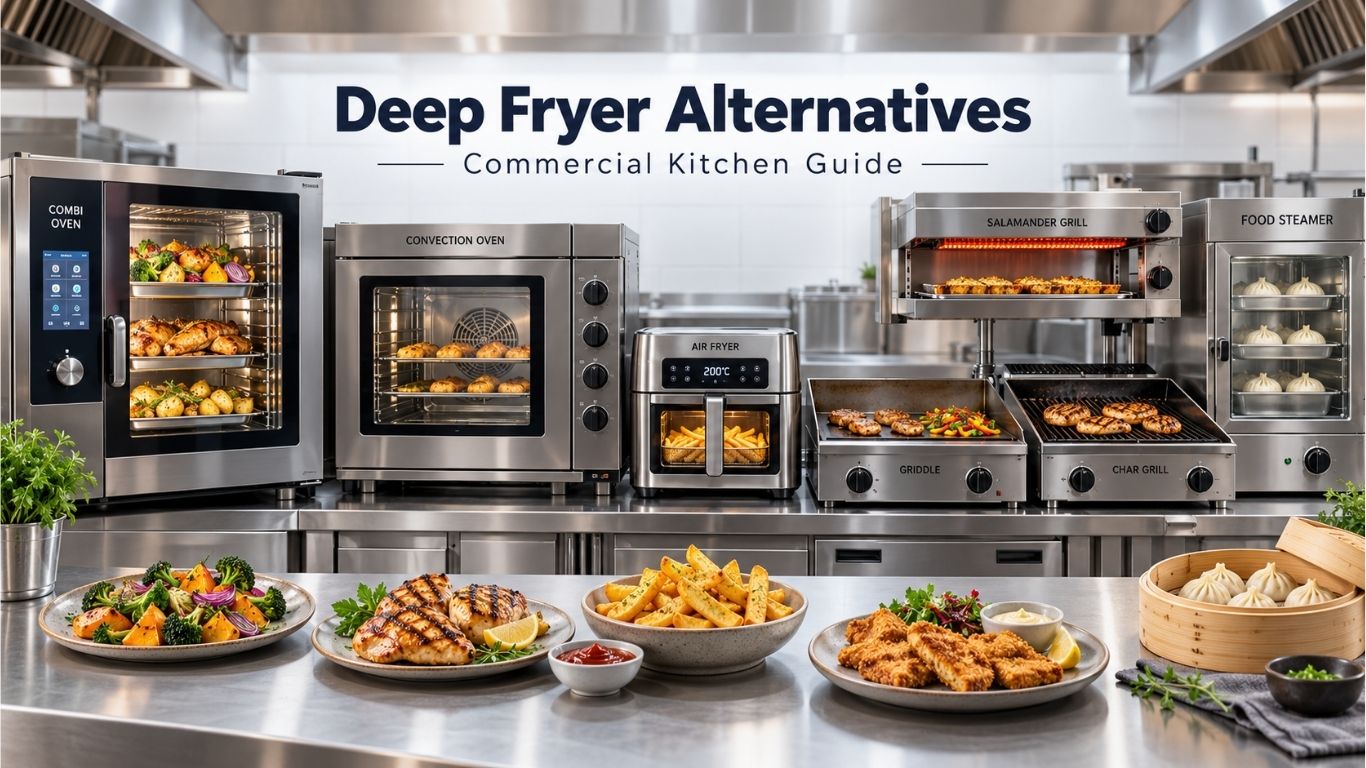
Alternatives to a Deep Fryer for Your Commercial Kitchen: What Works, What Doesn’t and the Cooking Results to Expect
A commercial deep fryer is hard to beat when you need fast cooking, deep golden colour and that familiar crispy finish. But it isn't the only way to prepare popular menu items such as chips, chicken, vegetables, dumplings and snack foods in a commercial kitchen.
For some restaurants, cafés and takeaways, reducing deep frying can mean less cooking oil to buy, store, filter and dispose of, easier cleaning and more flexibility in how the menu is prepared. Other venues may simply not have the space, extraction setup or cooking volume to justify a full-size fryer.
The important thing to understand is that different cooking equipment produces different results. A combi oven can make frozen chips crisp and golden, for example, but the result won't be exactly the same as immersing them in hot oil. A char grill can produce beautifully caramelised chicken, but it will taste grilled rather than fried.
So instead of simply asking "What can replace a commercial deep fryer?", it is often more useful to ask:
"What cooking result does my menu actually need?"
Below, we compare the most practical commercial deep fryer alternatives, what the finished food is like, what each appliance does well and where a conventional fryer still has the advantage.
Why Is Deep-Fried Food Difficult to Replicate?
Deep frying surrounds almost the entire surface of food with hot oil. This transfers heat quickly, removes moisture from the outside of the food and promotes rapid browning.
That is why properly fried food can develop a crisp exterior while remaining moist inside.
Most fryer alternatives use a different form of heat, such as:
- high-speed circulating hot air
- direct contact with a hot cooking plate
- radiant heat
- steam
- char grilling
- or a combination of heat and humidity
Because the cooking method changes, the final texture, moisture level, colour and flavour can change as well. That doesn't necessarily make the food worse – in many cases, it can create a completely different and equally appealing menu item.
1. Combi Ovens
A commercial combi oven combines fan-forced heat with controlled steam, giving a commercial kitchen far more flexibility than a fryer alone.
For fryer-style foods, operators will generally use strong circulating dry heat, sometimes with a light coating or spray of oil. The exact cooking functions available vary between combi oven models.
What cooking result can you expect?
A good combi oven can produce a dry, crisp and evenly browned exterior, particularly with frozen pre-cooked or pre-fried products.
It can work very well for:
- frozen chips
- potato wedges
- crumbed chicken
- chicken wings
- arancini
- spring rolls
- hash browns
- crumbed seafood
- roast potatoes
The result is generally lighter and less oily than conventional deep frying.
Deep-fried chips will usually have a more pronounced fried crust because hot oil contacts the entire surface. Combi-oven chips can still be very crisp, but the finish may be slightly drier and more oven-cooked.
Frozen and crumbed foods work particularly well
Many commercially produced frozen chips, nuggets, hash browns and similar products already contain some oil from processing. This makes them particularly suitable for high-temperature fan-assisted cooking.
Crumbed products can also brown well, especially when a small amount of oil is applied before cooking.
What doesn't work as well?
Fresh wet batter is more difficult.
Traditional beer-battered fish, tempura and similar products rely on the batter setting rapidly when it enters hot oil. In an oven, loose batter can spread or dry differently before forming a crust.
Why choose a combi oven?
The real advantage of a combi oven isn't just its ability to cook fryer-style food. One appliance may also be used for roasting, steaming, baking, regenerating prepared food and cooking vegetables, proteins and bakery products.
For a kitchen with a broad menu and limited equipment space, that versatility can be a major advantage.
Best suited to: restaurants, cafés, hotels, clubs, catering operations, schools, healthcare kitchens and venues with mixed menus.
Main limitation: if freshly battered fish, tempura, doughnuts or heavily fried foods are a major part of your menu, a conventional fryer will generally produce the more traditional result.
2. Convection Ovens
A commercial convection oven uses a fan to circulate hot air through the cooking chamber.
It doesn't normally provide the same level of humidity control and cooking flexibility as a combi oven, but it can be a very practical option for kitchens that mainly bake, roast and reheat.
What does the food come out like?
Expect food to be golden, evenly browned and relatively dry on the outside, rather than having the richer fried crust produced by oil immersion.
For example:
- Frozen chips: golden and crisp outside with a soft centre when cooked correctly.
- Chicken wings: skin can become crisp as the natural fat renders during cooking.
- Crumbed chicken or schnitzel: can brown nicely with a light coating of oil, although usually not as evenly crunchy as deep frying.
- Battered fish: generally not the best application for a convection oven.
When does a convection oven make sense?
If fried-style food represents only a small part of your menu, installing another dedicated appliance may not be necessary.
A café already using its oven for pastries, roasting, prepared meals and reheating may be able to cook trays of wedges, chips or crumbed food in the same appliance.
Best suited to: cafés, bakeries, catering kitchens, smaller restaurants and venues where oven cooking is already a major part of production.
3. Commercial Benchtop Air Fryers
A commercial air fryer works by circulating very hot air rapidly around the food. In practical terms, it operates similarly to a compact high-speed convection oven.
What cooking result can you expect?
For the right product, an air fryer can produce a surprisingly crisp result with very little added oil.
They are particularly suited to:
- chips
- wedges
- nuggets
- chicken wings
- spring rolls
- hash browns
- frozen snacks
- reheating previously fried food
The finished food tends to have a dry, crisp exterior without the same oily surface finish you get from deep frying.
Where air fryers struggle
The biggest issue in a commercial kitchen is often capacity.
A small basket can produce an excellent batch of chips, but during a busy service a full-size fryer with multiple baskets may have substantially greater throughput.
Overloading an air fryer can also restrict airflow, which may result in:
- slower cooking
- uneven browning
- softer food
- inconsistent batches
What about wet batter?
Loose wet batter can drip or move before it has time to set. Air fryers therefore tend to work better with crumbed, breaded, dry-coated and frozen pre-fried foods than fresh wet-battered products.
Best suited to: cafés, kiosks, bars with small snack menus, food businesses with lower fried-food volume and kitchens wanting a secondary fryer-style cooking option.
Important: always check the appliance manufacturer's installation, electrical and ventilation requirements and any requirements that apply to your premises before installation.
4. Commercial Griddles and Flat-Top Grills
A commercial griddle doesn't try to copy deep frying. Instead, food cooks directly against a hot metal surface, usually with only a small amount of oil or fat.
What does the food come out like?
The direct contact creates strong browning and caramelisation where the food touches the plate.
A useful way to compare the results is:
- Deep fryer: crispness around most of the food surface.
- Griddle: deep browning and crispness mainly on the surfaces touching the hot plate.
A griddle works extremely well for:
- burger patties
- bacon
- eggs
- sausages
- hash browns
- chicken
- halloumi
- onions
- mushrooms
- dumplings
- toasted sandwiches
Hash browns are a good example
A deep-fried hash brown can become crispy almost all over. On a griddle, you can develop a very crisp golden surface on each cooked side while keeping the centre softer.
It is a different result, but for many menus it can be just as appealing.
Could a griddle remove the need for a fryer?
For some breakfast cafés, absolutely.
If your menu is mainly bacon, eggs, sausages, mushrooms, tomatoes, toasties, burger patties and hash browns, a well-sized griddle may handle most of your cooking without needing a fryer solely for one or two menu items.
Best suited to: breakfast cafés, burger shops, takeaways, pubs and high-volume short-order kitchens.
5. Char Grills
A commercial char grill doesn't replace fried texture. Instead, it gives food something a deep fryer cannot – strong grilled flavour, caramelisation and char marks.
What cooking result can you expect?
Char-grilled foods typically develop:
- a browned exterior
- distinct grill marks
- roasted and charred flavours
- a juicy interior when cooked correctly
They're particularly effective for:
- steaks
- chicken
- burger proteins
- fish
- prawns
- skewers
- zucchini
- capsicum
- eggplant
- corn
- halloumi
Think about changing the dish, not imitating frying
Instead of trying to reproduce a fried chicken burger without a fryer, you could offer a char-grilled chicken burger.
The customer is getting a different product rather than a weaker imitation of deep-fried food.
Best suited to: steakhouses, burger venues, pubs, Mediterranean-style restaurants and kitchens where grilled meats and vegetables are important.
6. Salamander Grills
A commercial salamander grill applies intense radiant heat from above.
Its biggest strength is finishing and browning rather than replacing the primary cooking process.
What does the food come out like?
A salamander is excellent for creating:
- bubbling cheese
- browned surfaces
- caramelised toppings
- crisp edges
- toasted breadcrumbs
Common applications include:
- lasagne
- gratins
- nachos
- garlic bread
- cheese melts
- open sandwiches
- finishing plated dishes
You could, for example, cook a crumbed product in an oven and briefly finish it under a salamander to increase surface browning.
What it won't do: a salamander cannot turn raw wet-battered fish into the same product you would get from a deep fryer.
Think of it as a finishing appliance rather than a direct fryer replacement.
7. Commercial Food Steamers
A commercial food steamer produces almost the opposite cooking result to deep frying.
Rather than removing moisture to develop crispness, steam helps keep food moist and tender.
What does steamed food come out like?
Steamed food tends to be:
- soft
- moist
- tender
- clean tasting
- without surface browning
Steam works particularly well for:
- dumplings
- bao
- dim sum
- seafood
- vegetables
- rice
- some chicken dishes
A dumpling shows the difference perfectly
Deep-fried dumpling: crunchy wrapper with a richer fried flavour.
Pan-fried dumpling: crisp underneath with softer sides.
Steamed dumpling: soft, moist wrapper with a delicate texture.
None of these cooking methods is necessarily better. They're simply different products, which is an important point when considering alternatives to a deep fryer.
8. Bratt Pans and Tilting Fry Pans
A commercial bratt pan or tilting fry pan is another option worth considering, particularly in larger commercial kitchens.
Depending on the appliance, it may be used for:
- shallow frying
- sautéing
- searing
- braising
- boiling
- reducing sauces
- large-batch cooking
What cooking result can you expect?
Because the food can cook directly against a heated surface with a shallow layer of oil, a bratt pan can produce significantly more browning than steaming and can handle much larger batches than many benchtop appliances.
It still will not reproduce traditional fully submerged deep frying, but it can remove the need for a fryer where shallow frying is sufficient.
Best suited to: large restaurants, caterers, institutions, hospitals, aged care kitchens and high-volume production kitchens.
What About a Pressure Fryer?
A pressure fryer sometimes appears when people research alternatives to conventional fryers, but it is important to understand that it is still an oil fryer.
Food cooks in hot oil inside a pressurised cooking chamber. Pressure frying is particularly associated with products such as bone-in chicken.
The method can produce:
- a crisp fried exterior
- a moist interior
- reduced moisture loss
- efficient cooking of suitable products
So if your real objective is producing a particular style of fried chicken rather than eliminating cooking oil, a pressure fryer may be worth considering. If your goal is to remove deep frying altogether, it isn't a true alternative.
Fresh, Frozen, Crumbed or Battered? It Makes a Big Difference
Frozen pre-fried products
Commercial frozen chips, hash browns, spring rolls and similar products are often some of the easiest fryer foods to prepare successfully in:
- combi ovens
- convection ovens
- commercial air fryers
These products are generally designed to brown and crisp when reheated, making them much easier to cook without full oil immersion.
Crumbed food
Crumbed chicken, schnitzel, crumbed seafood and similar foods can work well with fan-assisted cooking, particularly when a small amount of oil is applied.
The coating can become golden and crisp, although the finished texture is usually a little drier and lighter than conventional deep frying.
Wet-battered food
This is where a commercial deep fryer still has a major advantage.
Wet batter needs rapid heat so that the coating sets quickly around the food.
Examples include:
- beer-battered fish
- tempura
- fresh battered onion rings
- battered prawns and seafood
If these products are central to your menu, retaining a commercial fryer will often make more sense than trying to force another appliance to produce the same result.
Commercial Deep Fryer Alternatives Compared
| Equipment | Crispness | Browning | Typical Result | Best For | Not Ideal For |
|---|---|---|---|---|---|
| Deep Fryer | Very high | Very high | Crisp outside, moist inside | Chips, batter, crumbed foods | Kitchens wanting to eliminate frying oil |
| Combi Oven | High | High | Crisp, lighter, less oily | Frozen chips, crumbed food, wings | Fresh wet batter |
| Convection Oven | Medium | High | Golden with a drier baked finish | Frozen snacks, crumbed foods, roasting | Traditional battered foods |
| Air Fryer | High | High | Dry and crisp exterior | Chips, wings, frozen snacks | High-volume continuous service |
| Griddle | Low to medium | Very high | Seared, caramelised surfaces | Burgers, breakfast, chicken | Chips and wet batter |
| Char Grill | Low | Very high | Smoky, grilled, caramelised | Meat, seafood, vegetables | Foods requiring a fried crust |
| Salamander | Low | Very high | Browned or crisp surface | Finishing, melts, gratins | Primary fryer replacement |
| Steamer | None | None | Soft, moist and tender | Dumplings, seafood, vegetables | Anything requiring crunch |
| Bratt Pan | Low to medium | High | Shallow-fried or seared | Large batch cooking | Traditional immersion frying |
Which Alternative Gives the Closest Result to a Deep Fryer?
For frozen chips, wedges and crumbed foods, a good combi oven or commercial high-speed air-circulation appliance will generally come closest to fryer-style cooking without completely immersing the food in oil.
For smaller volumes, a commercial air fryer can also produce very good results.
However, for foods such as:
- freshly battered fish
- tempura
- doughnuts
- heavily battered chicken
- products where a classic fried crust is essential
a conventional commercial fryer remains difficult to replace.
Don't Compare Equipment on Purchase Price Alone
The cheapest piece of equipment isn't necessarily the cheapest option for your kitchen over time.
Before choosing a fryer alternative, consider how the appliance will actually perform during service.
Cooking Capacity
Ask how many portions the machine can realistically produce during your busiest period.
An appliance that performs perfectly when cooking one small batch may become a bottleneck when several orders arrive together.
Temperature Recovery
Cold or frozen food absorbs heat from the appliance.
With a fryer, the oil temperature drops when food is loaded and the heating system must recover. Ovens and air fryers face a similar challenge when large amounts of cold food are loaded into the cooking chamber.
Good recovery and sufficient cooking capacity are especially important for busy takeaway, pub and restaurant kitchens.
Labour and Cleaning
Consider the whole cooking process, including:
- loading food
- turning or shaking products where required
- unloading
- cleaning trays or baskets
- filtering fryer oil
- disposing of used oil
- daily appliance cleaning
Menu Flexibility
A fryer is excellent at frying, but that is its main job.
A combi oven may potentially roast, steam, bake, regenerate and cook fryer-style products from one appliance.
For some businesses, that flexibility can justify a higher initial purchase price.
Available Services and Installation
Before purchasing any commercial cooking equipment, check what is available at the installation location, including:
- electrical supply
- three-phase power where required
- gas supply
- ventilation and exhaust
- water connections
- drainage
- bench and floor space
- clearances around the appliance
Installation requirements vary significantly between equipment types and models, so it is worth checking before placing an order.
Sometimes the Best Solution Is to Use Both
A commercial kitchen doesn't necessarily have to choose between having a fryer and having no fryer at all.
Many kitchens can reduce their dependence on deep frying by assigning different cooking jobs to the equipment that does them best.
For example:
- Combi oven: frozen chips, roast vegetables, crumbed foods and batch cooking.
- Griddle: breakfast, burgers, bacon, eggs and short-order cooking.
- Char grill: steaks, chicken, seafood and vegetables.
- Small commercial fryer: reserved for battered fish or other foods where genuine deep frying makes a noticeable difference.
This type of setup can reduce fryer use without compromising the dishes that customers genuinely expect to be deep fried.
How to Choose the Right Fryer Alternative for Your Commercial Kitchen
Start with your menu rather than the equipment.
If your menu is built around chips, crumbed chicken and frozen finger foods, a combi oven or commercial air-frying solution may be worth considering.
If fried food is only a small part of a broader café menu, a convection oven may already cover many of those products.
If you're happy to change the style of the dish rather than imitate frying, a griddle or char grill can introduce completely different flavours and textures.
And if battered fish, tempura or other freshly battered foods are central to your business, a commercial deep fryer may still be the right equipment for the job.
The best choice depends on your menu, required output, available space, services, budget and the cooking result your customers expect.
If you're comparing commercial fryers, combi ovens, convection ovens, griddles or other commercial cooking equipment, speak with the team at Ben's Hospitality Equipment. We can help you compare equipment based on what you actually need to cook and how your kitchen operates.
Call 1300 434 125 or browse our commercial kitchen equipment online with Australia-wide delivery available.
Frequently Asked Questions
Can a combi oven replace a commercial deep fryer?
A combi oven can replace a fryer for some foods, particularly frozen chips, wedges, crumbed products and other oven-suitable items. However, it generally won't reproduce the same result as deep frying fresh wet-battered foods such as beer-battered fish or tempura.
What is the closest alternative to a commercial deep fryer?
For frozen and crumbed products, a combi oven or commercial air fryer can produce some of the closest results without full oil immersion. The best choice depends on the volume you need to cook and the type of food on your menu.
Can you cook commercial frozen chips without a deep fryer?
Yes. Many frozen commercial chips can be cooked in suitable combi ovens, convection ovens and air fryers. The texture is usually slightly different from deep frying, with a drier and lighter exterior.
Can an air fryer handle a busy restaurant?
It depends on the model, capacity and number of portions required. Smaller benchtop air fryers may suit low-volume snack service but can become a bottleneck when many orders need to be cooked continuously.
Is a griddle a good replacement for a deep fryer?
A griddle is not a direct fryer replacement, but it can remove the need to fry many breakfast and short-order foods. It is particularly useful for burgers, bacon, eggs, sausages, chicken, hash browns and vegetables.
What equipment is best for battered fish?
For traditional freshly battered fish with a crisp fried coating, a commercial deep fryer will generally give the most familiar result because the hot oil rapidly sets the batter around the food.