Spiral Mixer vs Planetary Mixer: Which One is Right For You?
If you run a bakery, café, pizzeria, or any food business that involves mixing dough or batter, choosing the right commercial mixer is one of the most important decisions you’ll make. Get it right, and your mixer becomes the hardest-working piece of equipment in your kitchen. Get it wrong, and you’re dealing with poor dough quality, slow production, and a machine that’s not built for the job you’re asking it to do.
The two most common types of commercial mixers used in Australian kitchens are spiral mixers and planetary mixers. Both are excellent machines, but they’re designed for very different purposes. Understanding the difference between them will help you choose the right one for your business.
At Ben’s Hospitality Equipment, we supply both spiral mixers and planetary mixers to food businesses all across Australia. This guide breaks everything down in plain, simple terms so you can make a confident buying decision.
What Is a Planetary Mixer?
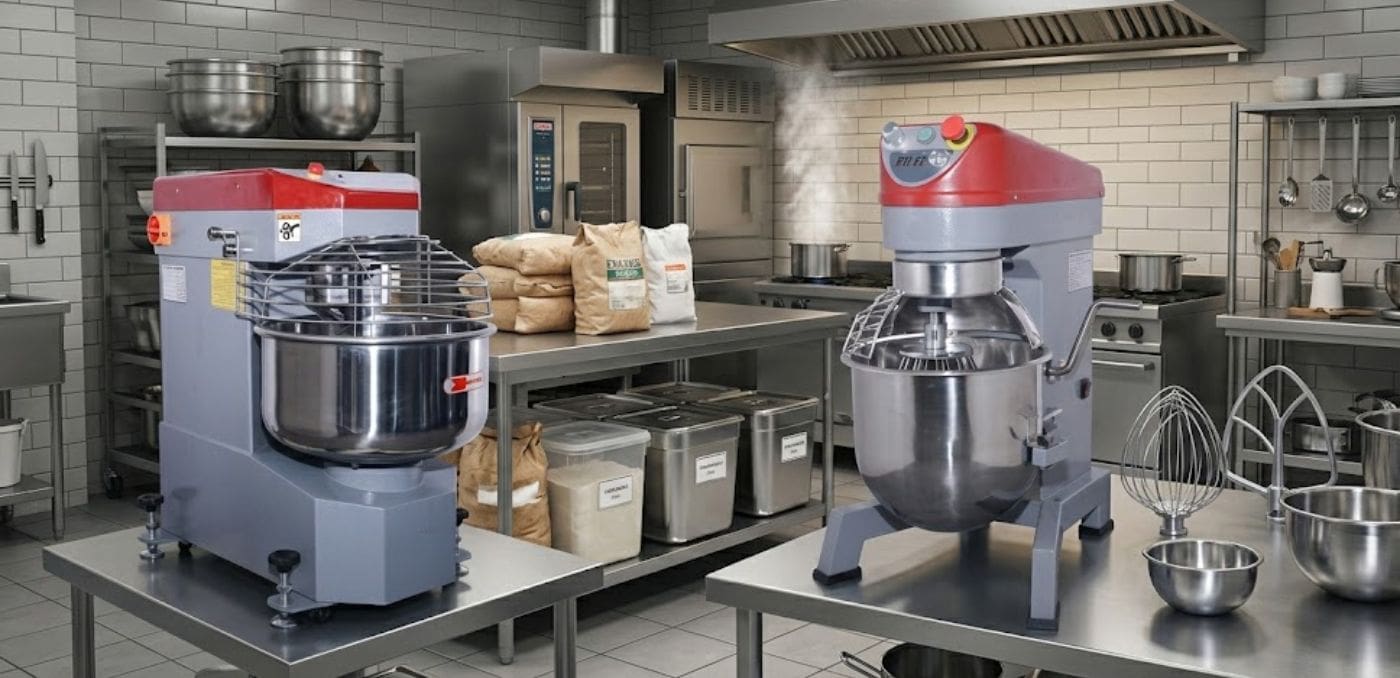
A planetary mixer gets its name from the way the mixing attachment moves. The attachment, whether it’s a dough hook, a flat beater, or a wire whisk, rotates on its own axis while also moving around the inside of the bowl in a circular, orbiting motion. It’s the same way a planet moves around the sun. This sweeping action covers the entire bowl, making sure all ingredients are mixed evenly.
The bowl on a planetary mixer stays fixed and stationary while the attachment does all the work. This is an important detail, and we’ll come back to why it matters.
Planetary mixers are available in a wide range of sizes, from compact benchtop models starting at around 5 litres all the way up to large floor-standing models with 60-litre or 80-litre bowls. They’re one of the most widely used pieces of commercial kitchen equipment in Australia, and it’s easy to see why they’re incredibly versatile.
What Is a Spiral Mixer?
A spiral mixer is designed specifically for dough production and operates very differently from a standard mixer. Instead of a fixed bowl with a single rotating attachment, a spiral mixer uses a dual-action system — the spiral hook turns while the bowl rotates at the same time.
This combined movement creates a folding and stretching action that closely replicates hand-kneading, developing strong gluten structure and consistent dough texture.
Unlike planetary mixers, where only the attachment moves around the bowl, spiral mixers allow both the hook and the bowl to rotate. The rotating bowl ensures ingredients are evenly incorporated, producing smooth, uniform dough with proper hydration and elasticity.
Spiral mixers are purpose-built for serious dough work. They’re commonly used in bakeries, pizza shops, commercial kitchens, and production facilities where consistent, high-quality dough is essential.
Because they are heavy-duty machines, spiral mixers are floor-standing units. They are larger and more robust than planetary mixers and are built to handle continuous daily use in demanding commercial environments. Space planning is important before installing one, as they require adequate floor area and clearance.
How They Work
To properly understand the difference between a planetary mixer and a spiral mixer, it helps to look at what each machine is actually doing to your mixture or dough.
Planetary Mixer
A planetary mixer works by having the attachment rotate around a stationary bowl. The beater or hook moves in an orbiting motion, pushing and folding ingredients together at speed.
This design is excellent for whipping, creaming, blending, and incorporating air into mixtures of different consistencies, from cake batter to mashed potatoes.
However, because the bowl doesn’t move, friction builds up as the attachment repeatedly works through the mixture. Over time, this can generate heat, which isn’t always ideal when working with temperature-sensitive dough.
Spiral Mixer
A spiral mixer operates using a slower, more controlled movement. The spiral hook turns while the bowl rotates at the same time, creating a continuous folding and stretching action.
This motion develops gluten gradually without overworking the dough. Because the action produces less friction, dough temperatures remain cooler, which is critical for proper fermentation and structure development in bread and pizza dough.
For bakeries and pizza shops, temperature control and gluten development make a noticeable difference in the final texture, rise, and consistency.
What Each Mixer Is Best For
Choosing between a planetary mixer and a spiral mixer really comes down to one thing: what does your kitchen produce every day?
Different machines are built for different priorities.
Planetary Mixer: Best for Versatility
If your kitchen produces a wide range of products, a planetary mixer is usually the smarter choice.
Planetary mixers are designed for flexibility. With interchangeable attachments, one machine can handle multiple tasks: mixing, whipping, kneading, slicing, grating and more. That’s why they’re common in cafés, patisseries and retail bakeries where variety matters.
A planetary mixer is ideal for:
Cake batters: light, even mixing with good aeration
Cookie dough: smooth, consistent blends
Pastry dough: shortcrust, choux and puff pastry
Whipped cream and meringue: fast air incorporation
Icings and buttercream: smooth and fluffy texture
Food prep tasks: cheese grating, vegetable slicing, meat mincing (with attachments)
Small batches of bread dough
For kitchens that produce cakes in the morning, cookies in the afternoon and mashed potatoes for lunch service, a planetary mixer offers serious convenience: one machine, multiple functions, which is a big advantage when space and budget are tight.
Spiral Mixer: Best for Dough Production
If your focus is bread or pizza, spiral mixers are purpose-built for that job.
Spiral mixers are designed specifically to knead and develop dough properly. While a planetary mixer can handle bread dough, it doesn’t develop gluten as efficiently or as gently as a spiral mixer.
A spiral mixer is ideal for:
Artisan breads: sourdough, baguettes, ciabatta
Pizza dough: including high-hydration styles
Bagels: dense dough requiring strong gluten development
Focaccia and flatbreads
High-volume dough production
Any yeast dough where temperature control is critical
Spiral mixers excel at handling high-hydration doughs, often 70% to 90% water content. These wetter doughs produce lighter, airier bread with better structure and flavour, but they require proper gluten development and gentle mixing.
Because the bowl and spiral rotate together, the dough is stretched and folded consistently without overheating. That cooler mixing temperature improves fermentation control and final texture, something serious bakeries and pizza shops rely on.
The Dough Temperature Difference: Why It Matters
One of the most important and often overlooked advantages of a spiral mixer is its ability to control dough temperature during mixing.
When dough becomes too warm, yeast activity speeds up. That might sound harmless, but uncontrolled fermentation can affect flavour development, texture, structure and final rise. For artisan bread especially, where slow fermentation builds complexity, keeping dough cool from the start is critical.
Spiral mixers naturally generate less heat. Because both the bowl and spiral hook rotate together, the dough is folded and stretched in a smooth, controlled motion rather than aggressively pushed around. This reduces friction, which means lower dough temperatures and better gluten development.
That temperature stability is particularly important in warm Australian kitchens, where ambient heat can already accelerate fermentation.
Planetary mixers, on the other hand, create more friction as the attachment repeatedly works through a stationary bowl. Over time, that friction raises the dough temperature more quickly, which can lead to over-fermentation and inconsistent results.
If your business relies on consistent, high-quality bread or pizza dough, the spiral mixer’s ability to keep dough cooler during mixing isn’t just a small benefit, but it’s a major performance advantage.
Attachments and Accessories
One of the biggest differences between planetary and spiral mixers comes down to flexibility versus focus.
Planetary Mixer Attachments
Planetary mixers are popular largely because of their versatility. Most commercial models come standard with three core attachments:
Dough hook: for bread and pastry dough
Flat beater (paddle): for cake batters, cookie dough and general mixing
Wire whisk: for whipping cream, eggs and meringue
Beyond the basics, many models offer optional add-ons such as meat mincers, vegetable slicers, graters, and pasta rollers. Depending on the brand and size, a planetary mixer can effectively become a multi-function prep station.
This attachment system is what makes planetary mixers a favourite in cafés, catering kitchens and bakeries producing a wide range of products.
Spiral Mixer Attachments
Spiral mixers take a completely different approach. They are purpose-built for one primary job, dough mixing.
Most spiral mixers come fitted with a single spiral hook, which is specifically engineered to knead and develop gluten properly. Some models may include a secondary mixing arm for lighter doughs or smaller batches, but generally, that’s it.
There’s no attachment swapping system, which means fewer moving parts, less cleaning, and less maintenance. It’s a simpler setup, designed for performance rather than versatility.
If you need one machine to do many things, planetary wins.
If you need one machine to do dough exceptionally well, the spiral is the clear choice.
Size and Capacity
Choosing the right mixer size isn’t just about today’s workload, but it’s about planning for your busiest day.
Planetary Mixers
Planetary mixers come in multiple sizes to suit different kitchen types:
5–7L: Compact benchtop models for light café use or small batches
10–20L: Popular mid-range size for cafés, patisseries and small restaurants
30–60L: Large floor-standing units for high-volume production
They’re flexible and scalable, which makes them suitable for many types of food businesses.
Spiral Mixers
Spiral mixers are generally designed for heavier, higher-volume dough production:
8–10L: Small single-phase units ideal for pizza shops
20–40L: Suitable for busy bakeries and restaurants
50–100L+: Commercial and industrial bread production
When selecting capacity, always think about your largest single batch, not your average one. As a rule of thumb, never fill the bowl beyond 60–70% capacity. Overloading strains the motor and reduces mixing performance.
Space Requirements
Before purchasing, consider your kitchen layout carefully.
Spiral mixers are floor-standing machines and require dedicated space. They are heavier and bulkier, so you’ll need adequate clearance for safe operation and cleaning.
Smaller planetary mixers can sit on a bench or prep table, making them more practical for kitchens with limited floor space.
Large planetary mixers (30L+) and all spiral mixers are floor units, so allow room for:
Safe operator access
Bowl removal or tilting
Proper ventilation
Cleaning access
If your kitchen footprint is tight, a benchtop planetary mixer may be the more practical choice, even if a spiral mixer is technically better for dough.
Maintenance and Running Costs
Both mixers are designed for commercial use, but they behave differently over time.
Spiral Mixers
Fewer moving parts
Lower friction during operation
Designed specifically for heavy dough loads
Generally lower maintenance in dough-heavy environments
Often more energy-efficient
Spiral mixers are built to knead dense dough continuously without overloading the motor.
Planetary Mixers
More components and attachment systems
Greater versatility
May require more frequent servicing in heavy-duty dough environments
That said, a quality commercial planetary mixer will still provide many years of reliable service when properly maintained.
Daily cleaning is essential for both types. Spiral mixers can be quicker to clean thanks to the rotating bowl, which allows easier access to the hook.
Cost Comparison (Australia Guide)
Pricing varies by brand and features, but as a general guide:
Planetary Mixers
Small benchtop: $800–$1,500
Mid-range 20L: $2,000–$5,000
Large 60L floor models: $5,000–$12,000+
Spiral Mixers
Entry-level single-phase: $1,500–$2,500
Mid-range 20–40L: $3,000–$7,000
Large 3 phase industrial: $10,000+
While spiral mixers may cost more upfront, they can be more cost-effective long term for dough-focused operations due to durability and efficiency.
Which One Is Right for Your Kitchen?
Choose a Planetary Mixer If:
You produce a wide variety of products
Cakes, pastries, batters and creams are core items
You need one machine to perform multiple tasks
Space is limited
Bread and pizza are not your main focus
Choose a Spiral Mixer If:
Bread or pizza dough is your primary product
You need consistent, large dough batches
Gluten development and dough quality are critical
You operate a bakery or pizzeria
Heavy-duty dough mixing is daily work
Consider Both If:
You run a high-volume bakery
You produce both bread and pastry
You have the space and budget for dedicated machines
To Sum Up
Both spiral and planetary mixers are excellent commercial tools, but they’re built for different purposes.
The right choice depends on:
What you produce
How much you produce
Your available space
Your long-term growth plans
If you’re unsure which mixer suits your business, our team at Ben’s Hospitality Equipment works with cafés, bakeries and pizzerias across Australia every day. We can help you choose the right capacity, power type and configuration for your kitchen.