

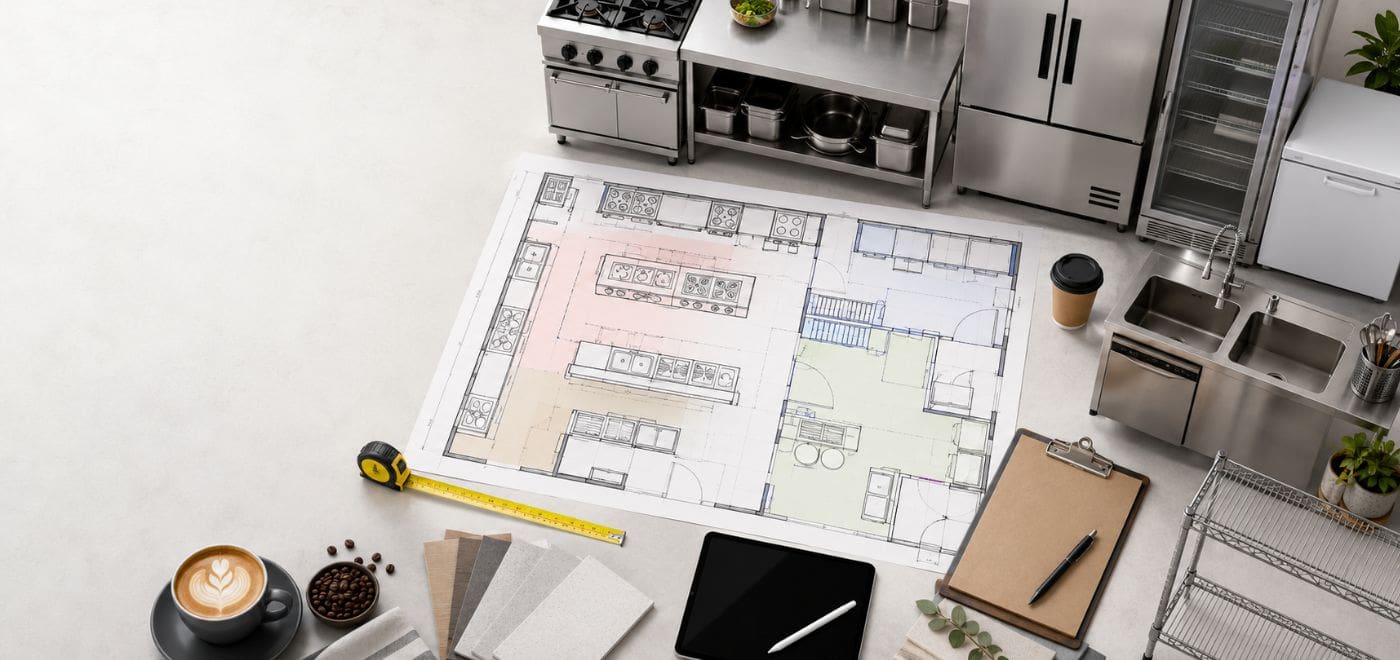
How to Plan a Commercial Kitchen Layout for Your Australian Restaurant or Cafe
Planning a commercial kitchen layout is one of the most consequential decisions you will make when opening or refitting a hospitality venue in Australia. Get it right and your kitchen runs efficiently from the first service. Food moves cleanly from storage through prep to the cooking line, staff are not crossing each other mid-service, and compliance is built into the structure from day one.
Get it wrong and the problems follow you for years. Staff backtrack between stations. Cross-traffic between clean and dirty zones creates contamination risk. Refrigeration placed too close to the cooking line runs hard, draws more power, and fails well before it should. These are not issues you can paper over with better equipment. They are structural, and fixing them after the build is expensive.
This guide covers the key principles of commercial kitchen layout design for Australian restaurants and cafes, from the work zones every kitchen needs to the four main layout configurations, what FSANZ requires, and the equipment decisions that lock in your layout before a single tile goes down.
The 5 Work Zones a Commercial Kitchen Needs
Regardless of the size or style of your venue, every commercial kitchen operates through the same 5 core work zones. Your layout job is to arrange them so that food moves in a single direction and staff can work together without conflict.
Delivery and storage
This is where stock arrives, is checked, and is held until it is needed in service. Dry storage, refrigeration, and frozen storage all sit in this zone. The delivery area should have its own access point, separate from customer-facing areas, with enough space to receive and check deliveries without blocking kitchen workflow.
One principle that matters here more than most operators realise is to position your commercial fridges and freezers away from the cooking line. A commercial upright fridge sitting directly next to a bank of gas burners or a deep fryer works against itself every service. The compressor cycles harder to maintain temperature, energy costs increase, and the unit will fail sooner than it should. Separation between cold storage and heat-generating equipment is one of the easiest things to plan for and one of the most expensive to fix after the fit-out.
Food preparation
This is where raw ingredients are cleaned, portioned, and assembled before they go to the cooking line. The prep zone needs sufficient stainless steel bench space, a dedicated handwashing basin, and access to refrigeration. Under AS 4674-2004 and FSANZ Standard 3.2.3, a handwashing facility must be accessible without a food handler having to travel more than 5 metres. That basin needs to be dedicated to handwashing only, not shared with food prep or cleaning tasks.
If you are running a pizza operation, a salad-heavy menu, or any kitchen where pre-portioned cold ingredients are assembled to order, a saladette or pizza prep fridge positioned at the prep bench is one of the better investments you can make. Ingredients stay at a safe temperature, are within arm’s reach, and your prep workflow moves faster.
The cooking line
This is the highest-traffic, highest-temperature zone in the kitchen. Ovens, ranges, fryers, grills, wok burners, induction cooktops, and any other heat-generating equipment sit here. The cooking line drives the ventilation specification for the entire fit-out, which is why you need to plan it before anything else is finalised.
Under the National Construction Code, a kitchen exhaust canopy is required wherever any single cooking appliance exceeds 8kW of electric power input or 29MJ per hour of gas input. Most commercial cooking lines exceed this easily. Undersized ventilation is one of the most common and most expensive mistakes in commercial kitchen fit-outs. Unlike most equipment decisions, it is not something you can simply upgrade later without significant structural work.
Service and plating
This zone sits directly at the end of the cooking line and connects the kitchen to front-of-house. Finished dishes are assembled, checked, and passed here. It needs direct access to the pass and enough space for two or three staff to work simultaneously during a busy service. Hot holding equipment such as bain maries and heated display units belongs here, keeping food at a safe service temperature while front-of-house is ready.
Wash-up
The wash-up zone handles warewashing, pot washing, and waste disposal. It must be physically separated from food preparation and cooking zones to prevent contamination. This separation is required under FSANZ Standard 3.2.3 and is something your local council Environmental Health Officer (EHO) will look for on inspection.
A common mistake is treating the wash-up zone as whatever space is left over after everything else is placed. Commercial dishwashers need inlet benches to stack dirty crockery, outlet benches to hold clean items as they come out, adequate drainage, plumbed hot and cold water, and ventilation to deal with the heat and steam they produce. Plan the full footprint of your dishwasher setup from the beginning, not as an afterthought.

The Four Main Layout Configurations
The shape of your space, the style of your menu, and the number of staff working during service will guide which layout configuration suits your operation best.
The island layout works well in large, square kitchens with enough floor area to place cooking equipment in a central island, with prep benches running around the perimeter. A head chef has clear sightlines across the kitchen and can monitor every station from one position. This layout is common in hotel kitchens, high-volume restaurant kitchens, and institutional settings. For smaller venues, it is rarely practical.
The assembly line layout arranges equipment in a straight run in the order it is used, so food moves from one end to the other without staff crossing paths. It suits high-volume operations with a consistent and repetitive menu. Quick service restaurants, burger operations, and high-turnover lunch venues typically use this configuration. It is efficient, easy to train new staff on, and does not require a large floor area.
The zone layout divides the kitchen into clearly defined sections based on function: a cold zone for prep and refrigeration, a hot zone for the cooking line, and a clean zone for warewashing. It handles a varied menu well because each zone can be staffed and managed independently. Most full-service Australian restaurants and cafes will find this layout the most practical choice.
The galley layout uses two parallel runs of equipment and benching facing each other, which is the only realistic option for narrow kitchens. Small cafes, food trucks, and shopfront restaurants with limited floor depth often use this configuration. It is efficient in terms of footsteps when only one or two staff are working, but becomes a bottleneck during busy services when multiple staff need to pass each other.
What FSANZ Standard 3.2.3 and AS 4674-2004 Require
Any commercial kitchen in Australia must comply with FSANZ Standard 3.2.3 (Food Premises and Equipment) and Australian Standard AS 4674-2004 (Design, Construction and Fit-Out of Food Premises). These are not aspirational guidelines. They are legally enforceable standards that your local council EHO will assess your premises against before you open.
The key design requirements to build in from the start are: impervious, easy-to-clean wall and floor surfaces such as ceramic tiling, vinyl sheeting, or stainless steel panels in food preparation and cooking areas; adequate drainage in any area where water is used during food handling or cleaning; a dedicated handwashing basin in each zone where food is handled; compliant ventilation above the cooking line and above the dishwasher; and adequate lighting throughout food preparation and storage areas.
Most councils offer a free pre-fit-out consultation where an EHO will review your proposed plans and flag any compliance issues before construction starts. This takes one meeting and can save you from structural changes that cost far more to fix after the build. Take it up before you commit to a layout or purchase any fixed equipment.
5 Mistakes That Cost Money to Fix After Opening
- Placing refrigeration adjacent to the cooking line is the most common mistake and the most expensive one to live with. It shortens equipment life, increases power consumption, and increases the risk of food being held at unsafe temperatures during a busy service.
- Underspecifying bench space is the second. Prep takes more room than most operators expect, especially during service when multiple tasks are happening simultaneously. Stainless steel kitchen benches are relatively inexpensive compared to the bottlenecks that come from not having enough of them.
- Not planning the dishwasher footprint properly is the third. When the wash-up zone is squeezed into a corner with no inlet bench, no outlet bench, and no room for drainage, you end up with a dirty workflow that creates contamination risk and slows down the whole kitchen.
- Skipping the council consultation before construction is the fourth. A handwashing basin retrofitted after tiling, or a drainage point added after the floor is poured, costs significantly more than the same fixture planned from the start.
- The fifth is treating the service zone as part of the cooking line rather than a distinct area. When plating and service space are not clearly defined, dishes slow down at the pass and the cooking line backs up.
Frequently Asked Questions
For most small cafes with limited floor space, either a galley layout or a simple zone layout works best. The key is to keep the coffee station, the prep zone, and the wash-up physically separated from each other. Even in a compact space, mixing these zones creates cross-traffic and compliance issues.
Yes. All commercial food businesses in Australia need to notify their local council before opening and must have their premises assessed by an EHO. Most councils offer a free pre-fit-out consultation. Submit your plans before you begin construction, not after.
As far as practically possible. The warmer the ambient temperature around a commercial fridge or freezer, the harder the compressor works and the more energy it draws. Even a metre or two of separation makes a measurable difference. If your floor plan does not allow significant separation, consider a unit with a remote condenser that can be positioned outside the kitchen.
All surfaces in food preparation and cooking areas must be smooth, impervious, and easy to clean. Acceptable materials include ceramic tiling, vinyl sheeting, and stainless steel panelling. Painted surfaces and raw timber are not compliant in these areas. Floors must also be impervious and slope toward drains in wet areas.
Need Assistance?
Bens Hospitality Equipment supplies commercial fridges and freezers, stainless steel prep benches, commercial cooking equipment, dishwashers, prep fridges, bain maries, and hot food displays, all shipped Australia-wide with free delivery. Browse our full range at bendgs.com.au, or get in touch with our team for assistance.