

Hot Water Urn Buying Guide: How to Choose the Best Electric Urn for Your Business
A hot water urn is one of those simple appliances that can make a noticeable difference during a busy service. Instead of filling and boiling a kettle repeatedly, an electric urn heats a larger quantity of water and keeps it ready for tea, coffee, instant drinks and general beverage service.
Commercial water urns are widely used in cafés, restaurants, offices, staff rooms, hotels, churches, community halls, sporting clubs, mobile catering businesses and function venues. However, choosing the best hot water urn is not just about buying the largest model available.
Capacity, heating power, insulation, temperature control, cleaning requirements and expected customer demand all need to be considered.
This guide explains how electric urns work, what they cost to run and how to choose the right model for your business.
What Is a Hot Water Urn?
A hot water urn is a benchtop appliance that heats and stores a larger volume of water than a standard electric kettle.
Most commercial electric urns include:
- A stainless steel water tank
- An electric heating element
- An adjustable thermostat
- A keep-warm function
- A dispensing tap
- A water level gauge
- Boil-dry or overheating protection
Manual-fill urns are filled from a tap or jug before use. They do not normally require a permanent plumbing connection, making them easy to position in offices, meeting rooms, mobile catering setups and temporary beverage stations.
Once the selected temperature has been reached, the thermostat cycles the heating element on and off to maintain the water temperature.
What Is the Best Hot Water Dispenser in Australia?
There is no single hot water dispenser that will be best for every Australian business. The right model depends on where it will be used, how many drinks you serve and whether the unit needs to remain switched on throughout the day.
For a small office or staff room, a compact 10 litre urn may be sufficient. A café, church, training facility or community event may benefit from a 20 litre model, while busy functions and large self-service stations may require a 30 or 40 litre commercial water urn.
The best hot water urn for most businesses will have:
- Enough capacity for the busiest service period
- A commercial-grade stainless steel tank
- Adjustable temperature control
- A visible water gauge
- Reliable boil-dry protection
- A stable dispensing tap
- An easy-to-clean interior
- Suitable electrical requirements
- Local warranty support
An energy-saving, double-wall urn may be a better choice when the appliance will remain switched on for several hours each day. Additional insulation reduces heat loss, meaning the heating element does not need to cycle as frequently.
What Features Should I Look for in a Water Urn?
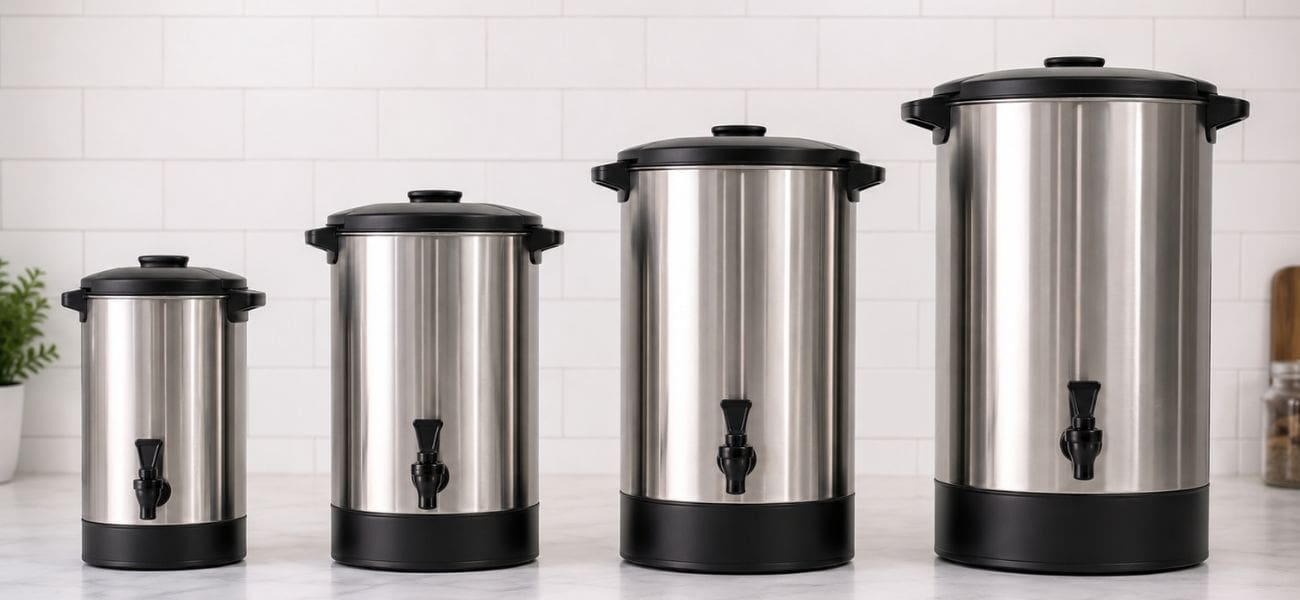
Suitable Capacity
The urn should hold enough water to cover your busiest period without requiring constant refilling.
Common sizes include:
| Urn Capacity | Approximate Use |
|---|---|
| 8–10 litres | Small offices, meeting rooms and low-volume service |
| 16–20 litres | Cafés, workplaces, breakfast areas and medium events |
| 30 litres | Busy catering, churches, functions and community venues |
| 40 litres | Large functions, canteens and high-volume beverage service |
A typical cup of tea or instant coffee uses approximately 200 to 250ml of water. In theory, a 20 litre urn can provide around 80 cups of 250ml each.
The practical number will be lower because the urn should not be completely drained during service, some water may be lost through steam, and cup sizes vary.
Double-Wall Insulation
Traditional single-wall urns can release a noticeable amount of heat from the exterior body. A double-wall electric urn places an insulated layer around the hot water tank to reduce heat loss.
The potential benefits include:
- Lower standby energy consumption
- Faster recovery after heating
- Better heat retention when switched off
- A cooler exterior surface
- Less heat released into the room
Some insulated Apuro water urns are advertised as using up to 60% less energy than comparable traditional single-wall models. Actual savings will vary according to capacity, room temperature, thermostat setting, usage and how often the lid is opened.
Adjustable Temperature Control
Tea and coffee do not always need water to remain at a full rolling boil.
An adjustable thermostat allows the operator to select and maintain a suitable serving temperature. It may also help reduce unnecessary energy use compared with continuously maintaining the maximum setting.
Check whether the temperature dial displays exact temperatures or general low-to-high settings.
Water Level Gauge
A visible water gauge allows staff to check how much water remains without opening the lid.
This is particularly useful during self-service events because staff can refill the urn before it runs empty.
Boil-Dry Protection
Boil-dry protection switches off or limits the heating element when there is insufficient water in the tank.
Commercial urns may also include an external thermal reset button. If the safety system activates, the operator generally needs to allow the appliance to cool, refill it correctly and reset it according to the manufacturer’s instructions.
Boil-dry protection is an important backup feature, but it should not replace regular water-level checks.
Concealed Heating Element
A concealed element sits beneath the base of the water tank rather than being directly exposed inside it.
This creates a smoother interior that is generally easier to wipe clean and descale. It also reduces the number of areas around which mineral deposits can accumulate.
Tap Height and Cup Clearance
Check the distance between the dispensing tap and the drip tray or benchtop.
A higher tap may accommodate larger mugs, coffee plungers and insulated jugs. A low tap may be perfectly suitable for standard cups but inconvenient when filling taller containers.
Electrical Connection
Many commercial water urns in Australia operate from a standard 10-amp power point. Larger models may still use a 2.2kW element so that they remain suitable for a normal outlet, although their initial heating time will be longer.
Always confirm:
- Voltage
- Amperage
- Power rating
- Plug type
- Manufacturer installation instructions
Avoid using overloaded power boards or unsuitable extension leads.
Which Brand of Hot Water Dispenser Is Best?
The best brand depends on your budget, service volume and expected level of use.
Apuro is a popular commercial catering equipment brand offering water urns in several capacities, including energy-saving double-wall models. The brand is generally positioned as practical commercial equipment at an accessible price point.
Kitchenknock electric urns may suit businesses looking for straightforward stainless steel models with adjustable temperature controls and several capacity options.
When comparing brands, look beyond the name on the front of the appliance. Consider:
- Warranty terms
- Availability of replacement taps and components
- Local technical support
- Construction quality
- Tank material
- Thermostat design
- Cleaning access
- Safety features
- Product reviews
- Suitability for commercial use
A well-supported mid-range urn may be a better long-term purchase than the cheapest model if spare parts and warranty assistance are readily available.
How Much Electricity Does a Hot Water Urn Use?
The electrical power rating tells you how much electricity the urn uses while its heating element is operating.
For example, a 2.2kW urn uses up to 2.2 kilowatt-hours of electricity if the element runs continuously for one hour.
The basic calculation is:
Electricity used in kWh = appliance power in kW × operating time in hours
A 2.2kW urn running continuously for 45 minutes would use approximately:
2.2kW × 0.75 hours = 1.65kWh
At an electricity rate of 28 cents per kWh, that heating cycle would cost approximately:
1.65kWh × $0.28 = $0.46
Electricity rates vary substantially by state, retailer and plan. Published Australian comparisons have shown indicative usage rates ranging from around 20 cents per kWh in parts of Queensland to more than 30 cents per kWh in some other areas.
Check the cents-per-kWh usage rate on your latest business electricity bill for a more accurate calculation.
How Much Does It Cost to Heat a 20 Litre Urn?
Heating 20 litres of water from approximately 20°C to 100°C requires about 1.86kWh in ideal laboratory conditions.
Real appliances generally use a little more because some heat escapes through the tank, lid and surrounding air.
A practical estimate may be approximately 1.9 to 2.2kWh for the initial heat-up, depending on insulation and efficiency.
At 28 cents per kWh, this would cost approximately:
- 1.9kWh: $0.53
- 2.2kWh: $0.62
This is the estimated cost of initially heating a full 20 litre tank. Additional electricity will be used to maintain temperature throughout the day.
The actual cost depends on:
- Starting water temperature
- Selected thermostat setting
- Room temperature
- Urn insulation
- Frequency of dispensing
- Frequency of refilling
- Whether the lid is repeatedly opened
- Electricity tariff
Does a Hot Water Urn Use a Lot of Electricity?
A hot water urn uses a relatively high amount of power while initially heating, but it does not normally draw its full rated power continuously once the desired temperature has been reached.
The thermostat switches the element off and turns it back on when the water temperature drops. An insulated urn should lose heat more slowly and therefore require fewer reheating cycles.
An urn may consume unnecessary electricity when:
- It is much larger than required
- It remains switched on after service
- The thermostat is always set to maximum
- Heavy scale covers the heating surfaces
- The lid is not secured correctly
- It has poor insulation
- It is regularly topped up with large quantities of cold water
Choosing the right capacity is one of the easiest ways to control running costs.
A 40 litre urn may be useful for a large event, but it is inefficient to heat 40 litres every day when the workplace only prepares 10 or 15 drinks.
Are Hot Water Urns Expensive to Run?
Hot water urns are not necessarily expensive to run when their capacity matches demand and they are operated properly.
The initial heating cycle may cost somewhere between several dozen cents and just over a dollar, depending on the urn size, water temperature, power tariff and appliance efficiency.
The larger expense can come from leaving an inefficient urn maintaining temperature for many hours when very little water is being used.
To reduce running costs:
- Fill only to the level required for the expected demand
- Use an insulated double-wall model
- Reduce the temperature during quiet periods where appropriate
- Switch the urn off when it is no longer needed
- Descale it regularly
- Keep the lid properly closed
- Avoid positioning it in cold draughts
- Repair dripping taps and damaged seals
Electricity prices and plan structures change over time, so businesses should use their current tariff when estimating operating costs. Australian energy regulators publish reference and default-offer information, but an individual business plan may differ significantly.
Is an Urn Cheaper to Run Than a Kettle?
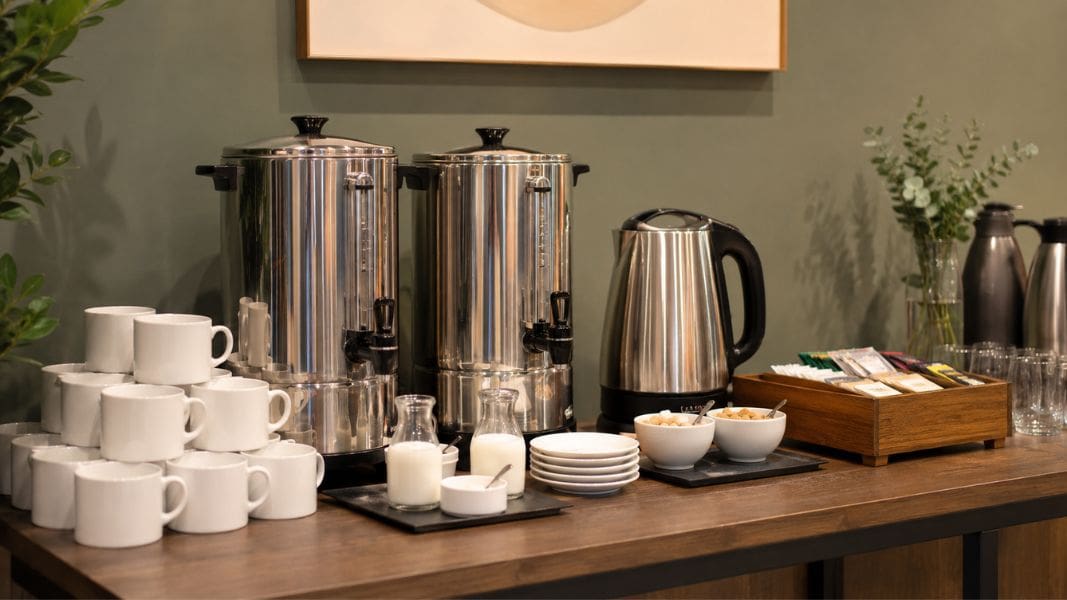
An urn is not automatically cheaper than a kettle.
Both appliances need a similar fundamental amount of energy to heat the same quantity of water to the same temperature. The difference comes from how they are used.
A Kettle Is Usually Better When:
- Only one or two drinks are made occasionally
- Water does not need to remain hot
- Demand is unpredictable and low
- Staff can boil only the amount required
Boiling 500ml in a kettle is likely to use less electricity than heating and maintaining 10 or 20 litres in an urn.
An Urn Is Usually Better When:
- Many drinks are prepared close together
- Water must remain available over a service period
- Customers use a self-service station
- Repeated kettle boiling would interrupt staff
- Several kettles would otherwise be operating
For a busy breakfast buffet or catered meeting, one correctly sized urn may be more practical and potentially more efficient than repeatedly boiling several partly filled kettles.
The real saving is often labour and convenience rather than electricity alone.
How Long Does a 20 Litre Urn Take to Heat Up?
A 20 litre urn with a 2.2kW heating element will theoretically take around 51 minutes to heat water from 20°C to 100°C under ideal conditions.
In real use, allow approximately 50 to 70 minutes.
Heating time will vary according to:
- Element power
- Starting water temperature
- Amount of water
- Insulation
- Ambient temperature
- Scale build-up
- Lid position
- Selected temperature
If the urn only needs to reach approximately 90°C rather than 100°C, it may heat faster.
For an event starting at 9:00am, filling and switching on a 20 litre urn at 8:00am is a safer approach than relying on a last-minute heat-up.
Never add already boiling water unless the product manual specifically permits it.
How Long Does a Hot Water Urn Last?
A commercial hot water urn may provide several years of service, but there is no guaranteed lifespan that applies to every model.
Its life will depend on:
- Daily operating hours
- Water hardness
- Descaling frequency
- Build quality
- Tap and seal condition
- Thermostat cycling
- Whether it is allowed to boil dry
- Transport and handling
- Availability of replacement parts
In a low-volume office, a well-maintained urn may last considerably longer than one used for continuous high-volume catering.
Mineral scale is one of the most common avoidable problems. It can slow heating, increase noise and place additional stress on the element and thermostat.
How Often Should I Change My Hot Water Dispenser?
A hot water dispenser does not need to be replaced according to a fixed calendar.
Replace or professionally inspect it when you notice:
- Water leaking from the tank or base
- Rust or corrosion in a food-contact area
- Damaged electrical components
- Repeated tripping or overheating
- Unreliable temperature control
- A thermostat that no longer switches correctly
- A cracked or unstable tap
- Significantly slower heating after descaling
- Repair costs approaching the price of replacement
A worn tap or seal may be repairable and does not always mean the whole urn needs replacing.
However, an urn with damage to the tank, wiring or heating system should be disconnected and assessed by a qualified technician.
How Often Should a Water Urn Be Descaled?
There is no universal descaling interval because Australian water hardness varies between locations.
A heavily used urn in a hard-water area may require descaling every few weeks. A lightly used unit in a soft-water area may need it only every few months.
Signs that an urn needs descaling include:
- White or chalky deposits
- Longer heating times
- Increased heating noise
- Flakes appearing in the water
- Reduced temperature performance
- Frequent thermal cut-out operation
Follow the manufacturer’s cleaning instructions and use a food-safe descaling product suitable for the appliance.
After descaling, rinse the tank thoroughly before returning it to service.
What Size Electric Urn Do I Need?
Choose capacity according to the number of drinks required during the busiest period.
A rough guide based on 250ml servings is:
| Capacity | Theoretical 250ml Servings |
| 10 litres | 40 |
| 16 litres | 64 |
| 20 litres | 80 |
| 30 litres | 120 |
| 40 litres | 160 |
These figures are theoretical maximums. Allow a safety margin because usable capacity, serving size and water loss vary.
For example, when serving 70 guests, a 20 litre urn may look sufficient on paper. In practice, a 30 litre urn may provide a better buffer, particularly if guests use large mugs or return for a second drink.
For a venue with steady demand throughout the day, a smaller urn that can be refilled during quiet periods may be more economical than heating a large tank every morning.
Manual-Fill Urn or Automatic Hot Water Boiler?

Choose a Manual-Fill Urn When:
- You need portable equipment
- Plumbing is unavailable
- The beverage station is temporary
- The urn will be used at events
- Purchase and installation costs need to remain low
- Demand is moderate or occasional
Choose an Automatic-Fill Boiler When:
- Demand is continuous
- Staff cannot regularly refill the tank
- The equipment has a permanent location
- Suitable water and drainage connections are available
- Fast recovery is important
- The venue serves a high number of drinks every day
A manual-fill electric urn is generally simpler and easier to install. An automatic-fill boiler can provide greater convenience in a busy café, canteen or commercial kitchen.
Hot Water Urn Safety Tips
Hot water urns contain a large quantity of near-boiling water, so correct placement and handling are important.
- Place the urn on a strong, level and heat-resistant surface
- Keep it away from the edge of the bench
- Make sure customers cannot pull the power lead
- Do not fill above the maximum level
- Keep the lid secured during operation
- Use the handles only as instructed
- Never move a full urn containing hot water
- Allow it to cool before cleaning
- Do not immerse the electrical body in water
- Keep the tap area clear
- Check the power lead regularly for damage
- Follow the manufacturer’s operating instructions
Remember that a 20 litre urn weighs at least 20kg from the water alone, before the appliance weight is added. Larger urns can become very heavy when full.
Position the empty unit first and fill it where it will be used.
Shop Commercial Hot Water Urns
Bens Hospitality Equipment supplies electric urns and commercial water urns for cafés, offices, catering businesses, community venues and hospitality operations across Australia. Browse top quality hot water urns in Australia
Explore compact 10 litre models, versatile 20 litre tea urns and high-capacity 30 and 40 litre water urns. Compare insulation, temperature controls, electrical requirements and safety features to find a suitable unit for your service needs.
For help choosing a hot water urn, call Bens Hospitality Equipment on 1300 434 125. Australia-wide delivery options are available.