

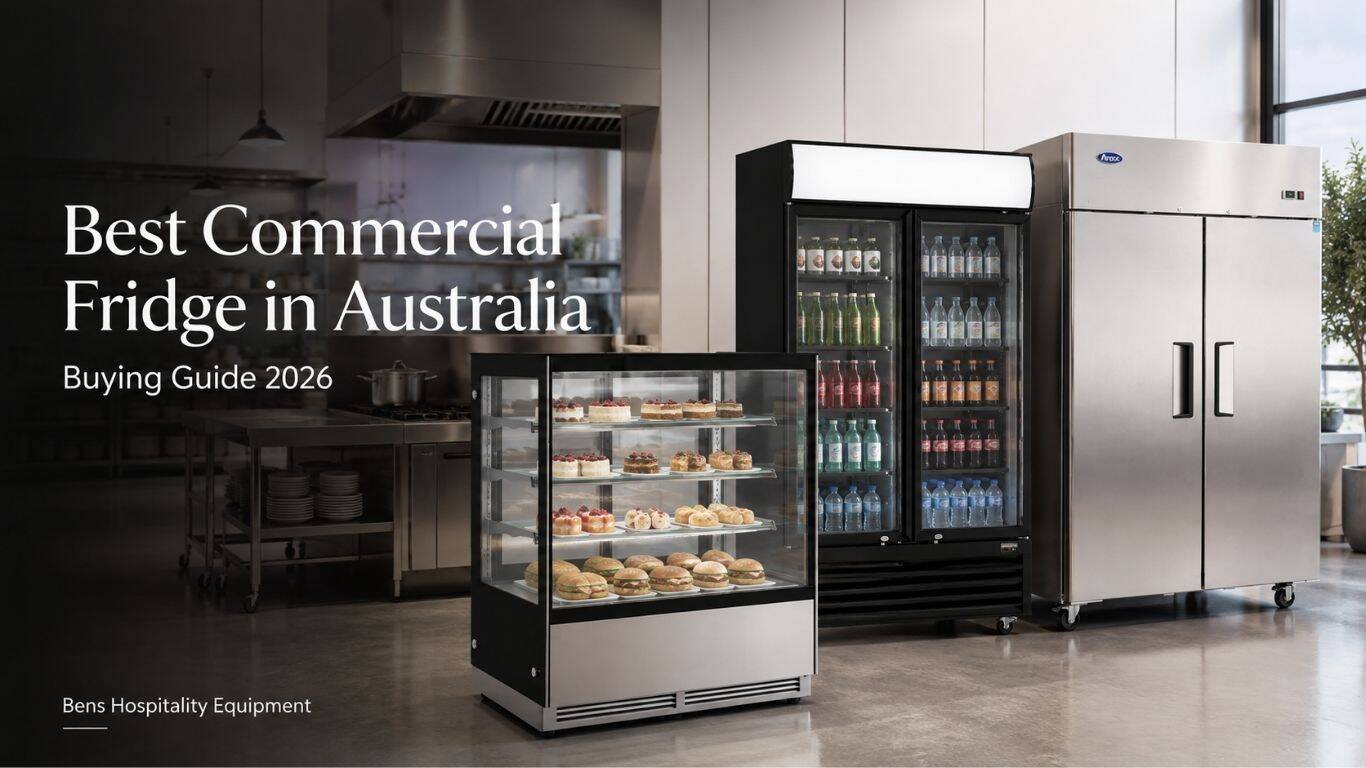
Best Commercial Fridge in Australia: A Buyer’s Guide for Every Business
There is no single best commercial fridge in Australia, since the right choice depends entirely on your business, your space and what you are storing. A cafe needs something very different from a butcher or a supermarket. Rather than pointing you to one model, this guide walks through the fridge types available, the features that actually matter, and the buying rules every Australian food business needs to know, so you can work out exactly what fits your kitchen before you spend a cent.
Start with the type of fridge your business needs
Most commercial kitchens end up with a mix of fridge types rather than just one, so it helps to think about what job each fridge is doing.
- Upright fridges are the workhorse of most kitchens, giving you bulk storage close to prep areas. If you are comparing specific models, our 2 door upright fridge comparison covers six popular options in detail.
- Under bench fridges sit below your bench or cooking line, keeping ingredients within arm’s reach during service without eating into floor space.
- Display fridges put your stock in front of customers, which matters for cafes, bakeries and takeaway shops selling drinks or grab and go food. Our display fridge picks go into more detail on the best options here.
- Bar fridges are built for drinks service in pubs, bars and clubs, usually with glass doors and lockable access.
- Salad prep and chest fridges suit specific workflows like sandwich bars, pizza prep or bulk cold storage.
If your business also needs frozen storage, our commercial freezer guide covers the same buying process for freezers.
Which fridge is best for my business?
| Business | Usually worth considering | Why |
|---|---|---|
| Small café | Underbench fridge + upright fridge | Fast access at the coffee/prep station with backup storage |
| Busy restaurant | 2 or 3 door upright + underbench fridge | Bulk storage plus ingredients close to the cooking line |
| Pizza shop | Pizza prep fridge + upright storage fridge | Ingredients stay organised directly under the prep area |
| Sandwich/takeaway shop | Salad prep fridge + drinks display fridge | Faster assembly plus customer-facing drink sales |
| Bakery/café | Upright storage fridge + cake display fridge | Separate production storage from customer display |
| Pub or bar | Underbench/back-bar glass door fridge | Quick access and easy visibility during service |
| Butcher | Heavy-duty upright fridge or coolroom | Larger loads and frequent stock turnover |
| Convenience store | Upright glass door display fridge | Makes drinks and chilled products clearly visible |
| Supermarket | Multi-door display or open display refrigeration | High-volume merchandising and customer access |
Example 1
Imagine a café serving breakfast and lunch with around 60 seats. They store milk, cheese, eggs, sauces, prepared ingredients, cakes, and bottled drinks. Buying one large upright fridge might technically provide enough litres, but staff would constantly walk away from the preparation area to retrieve ingredients. A more practical setup might be:
- one double door upright fridge for bulk storage
- one underbench fridge beneath the main preparation bench
- one display fridge for drinks or cakes
The “best” fridge setup isn’t necessarily the cabinet with the biggest capacity. It is the combination that reduces unnecessary movement during service.
Example 2
Consider a takeaway shop processing hundreds of orders on Friday and Saturday nights. A cheap light-duty refrigerator may appear suitable because its stated temperature range is correct. But during peak service:
- doors may be opened every few minutes
- warm ingredients may occasionally be loaded
- kitchen temperature may rise
- airflow around the condenser may be limited
In this situation, compressor capacity, ambient-temperature rating and recovery performance can matter more than saving a few hundred dollars on the initial purchase.
Example 3
A 100 seat restaurant may have plenty of total refrigeration capacity but still have a poor setup. Imagine the main 2 door upright fridge is positioned 6 metres away from the cookline. During a busy Saturday service, chefs repeatedly walk across the kitchen for butter, sauces, vegetables and garnishes. Adding a smaller underbench fridge beside the preparation area may improve workflow more than replacing the main fridge with a larger upright unit.
This is why buying commercial refrigeration should be based on workflow as well as litres.
Choose capacity around your busiest service
It is tempting to buy the cheapest fridge that fits the space, but undersizing is one of the most common mistakes new food businesses make. Think about your busiest trading day, not your average day, and measure how much stock you realistically need on hand during peak service. A fridge that is too small gets overpacked, which blocks air flow and makes it work harder to stay cold. A fridge that is too big wastes power and floor space. Measure your available space carefully, including clearance for ventilation and door swing, before you start comparing models.
1000 litres doesn’t always mean 1000 litres of useful storage
Two upright fridges may both be advertised as approximately 1000L, yet one may suit your kitchen better because of:
- shelf spacing
- internal width
- GN tray compatibility
- compressor compartment position
- number of shelves
- door configuration
For example, a restaurant storing gastronorm containers may value GN-compatible shelf dimensions more than headline litre capacity. A bottle shop, on the other hand, may care much more about vertical shelf adjustment. Therefore, compare how you actually intend to load the fridge rather than choosing purely by litres.
Check the energy rating before you buy
Many commercial refrigerated cabinets sold in Australia are covered by the Australian Government’s GEMS energy-efficiency requirements. When comparing models, don’t look at purchase price alone; check the stated energy consumption, such as kWh per 24 hours, and compare similar-sized cabinets designed for the same type of use. So any fridge you are looking at should already comply. That said, models vary a lot in running cost even within the same rating. Since a commercial fridge runs continuously, a slightly higher purchase price on an efficient model often pays for itself in lower power bills over a few years, particularly for a fridge that gets opened and closed constantly during service.
Example: comparing two fridges
Fridge A uses 4.0 kWh per 24 hours.
Fridge B uses 6.0 kWh per 24 hours.
The difference is:
2 kWh × 365 days = 730 kWh per year.
Multiply 730 kWh by your business electricity rate to estimate the annual cost difference.
For example, if your business rate were $0.30/kWh, the difference would be about $219 per year.
Over 5 years that would be roughly $1,095, before allowing for changes in electricity pricing.
The Australian Government specifically regulates a range of commercial refrigerated cabinets through minimum energy-performance requirements, although the exact rules depend on the cabinet class.
Understand the food safety temperature rules
Under Australian food safety standards, potentially hazardous food needs to be held at 5 degrees or below. This is not just a guideline, it is the standard your local council will check during an inspection. Look for a fridge with reliable digital temperature control and a compressor rated for how often the doors will be opened, since a lighter duty fridge in a high traffic kitchen can struggle to hold temperature during a busy service.
Can the fridge handle your kitchen temperature?
Do not only look at the fridge’s operating temperature range. A cabinet might advertise a storage temperature of, for example, 2°C to 8°C, but you also need to know the maximum ambient conditions it is designed to operate in. This becomes particularly important in Australian kitchens during summer. Before buying, check the manufacturer’s specifications:
- maximum ambient temperature
- relative humidity rating
- ventilation requirements
- clearance around the condenser
If your kitchen regularly becomes very hot, tell the supplier where the fridge will be installed before choosing a model.
Storage temperature and ambient temperature are not the same thing
If a fridge says: “Temperature range: 2°C to 8°C”, that tells you the temperature it is designed to maintain inside the cabinet.
If it says: “Maximum ambient: 38°C”, that refers to the surrounding room temperature under specified operating conditions.
A fridge may have the correct internal temperature range but still be unsuitable for an extremely hot kitchen if its ambient rating is too low.
Understand the refrigerant type
Most modern commercial fridges use one of a few common refrigerants, and the choice affects both running cost and environmental impact. R290 and R600a are natural refrigerants that are becoming the standard in newer models, since they use less energy and have a much lower global warming impact than older gases like R404a. You will not usually need to choose the refrigerant yourself, but it is worth asking your supplier what a model uses, since a fridge running on an older, less efficient refrigerant can cost more to run over its lifetime even if the purchase price looks similar. Browse our full range of commercial fridges to compare current models and refrigerant types.
Should I choose R290 refrigerant?
R290 is increasingly common in modern commercial refrigeration, but refrigerant alone should not determine the purchase. Compare the complete cabinet: performance, energy consumption, temperature range, ambient rating, warranty, service availability and intended use.
How often will you open the doors?
Think about door openings during peak service
Two restaurants can buy exactly the same refrigerator and get very different results. A storage fridge opened 5 times an hour has a very different workload from a preparation fridge opened every minute during dinner service. When doors open, cold air escapes and warmer kitchen air enters. The refrigeration system then needs to pull the cabinet temperature back down. For frequently accessed areas, consider:
- smaller doors rather than one huge door
- underbench refrigeration close to staff
- stronger commercial-duty refrigeration
- self-closing doors
- good door seals
- appropriate ambient rating
Solid doors or glass doors
Solid doors hold temperature better and suit back of house storage where customers do not need to see inside. Glass doors cost you a little on energy efficiency but are worth it for anything customer facing, like drinks, desserts or grab and go items, since visibility drives impulse sales.
Solid door
Best where storage is purely functional.
Typical examples:
- restaurant kitchen
- preparation room
- bakery production area
Advantages:
- generally better insulation
- stock is hidden
- less visual clutter
- suited to back-of-house use
Glass door
Best when seeing stock saves time or helps sell products.
Typical examples:
- café drinks fridge
- supermarket
- convenience store
- bottle shop
- customer-facing takeaway area
Furthermore, in a busy kitchen, staff being able to see stock through a glass door fridge before opening the door can also reduce unnecessary door openings.
location of the refrigeration unit
Top-mounted refrigeration
Can be useful when floors tend to collect dust, flour or debris, because the condenser is higher from the floor.
Bottom-mounted refrigeration
Can be easier for servicing and may place frequently used lower shelves slightly higher, depending on the cabinet design.
Think about the environment where the fridge will operate rather than assuming compressor position is just a design detail.
Think about maintenance before you choose
A commercial fridge can have excellent specifications and still perform poorly if the condenser becomes blocked with grease and dust. This is especially relevant in restaurants where refrigeration sits close to cooking equipment. Before purchasing, ask:
- Where is the condenser located?
- How easy is it to access?
- Can staff clean the filter or condenser easily?
- Does the model have a removable filter?
- Does it use a self-cleaning condenser system?
A fridge that is easy to maintain may prove much more practical over several years than one that is difficult to service.
Turbo Air fridges and freezers are easy to maintain thanks to their self-cleaning condenser system. It automatically helps remove dust build-up from the condenser, reducing the need for regular manual brushing and helping the refrigeration system stay cleaner and operate efficiently.


New versus second hand
A second hand commercial fridge can save money upfront, but check its service history and remaining warranty before you buy, since an old compressor is one of the most expensive things to replace. For many businesses, finance options through providers like SilverChef make new equipment with a full warranty more affordable than the upfront cost of buying outright.
When looking at a used fridge, check:
- how old it is
- whether the compressor has previously been replaced
- condition of door gaskets
- rust or corrosion
- evaporator condition
- condenser cleanliness
- whether temperature is stable
- unusual compressor/fan noise
- whether spare parts are still available
- whether any warranty transfers to the new owner
Don’t judge a used commercial fridge simply because it feels cold when you inspect it. Ask to see it maintain temperature over time.
Measure before ordering
Before ordering a commercial fridge, measure:
- overall available width
- available depth
- ceiling/height clearance
- doorway width
- corridor width
- lift dimensions if applicable
- door swing
- ventilation clearance
- distance to the power outlet
- access route from the delivery truck to final position
For instance, a 1200mm wide fridge is no use if the narrowest doorway into the kitchen is 900mm. Remember that manufacturer dimensions may not always tell you everything about access. Check whether castors, handles or doors can be removed for delivery if the access route is tight.
Warranty and after sales support
A commercial fridge is one of the hardest working pieces of equipment in your kitchen, so warranty and local service support matter as much as the specs on paper. Look for a supplier who can back the fridge with genuine parts and servicing in Australia, not just a warranty certificate with no local support behind it.
Still unsure which commercial fridge you need?
Need bulk ingredient storage?
→ Start with an upright fridge.
Need ingredients directly beside your cookline?
→ Look at an underbench fridge.
Preparing pizzas or sandwiches?
→ Consider a pizza or salad prep fridge.
Selling chilled products directly to customers?
→ Consider a glass door or open display fridge.
Displaying cakes or desserts?
→ Consider a refrigerated cake display.
Running a bar?
→ Look at underbench or back-bar refrigeration.
Need to rapidly cool cooked food?
→ You may need a blast chiller rather than another storage fridge.
The best commercial fridge is the one that suits the job
Choosing a commercial fridge isn’t really about finding the biggest cabinet or the cheapest deal. Start with what you are storing, how much stock you carry on your busiest day, how often staff will access it and where the fridge will sit in your kitchen.
Then compare the practical details: usable storage space, ambient temperature rating, energy consumption, door configuration, ventilation requirements, warranty and access to service and spare parts.
A small café may be better served by an upright fridge paired with an underbench unit, while a takeaway shop might benefit more from a prep fridge and customer-facing drinks display. The right setup is the one that keeps food safely chilled while making day-to-day service easier.
If you’re unsure, tell us what type of business you’re running, what you need to store and the space available. Bens Hospitality Equipment can help narrow down suitable commercial fridges before you buy.
Frequently Asked Questions
Commercial fridges are designed around commercial operating conditions, frequent access and food-service workflows. A food business should choose refrigeration equipment that is fit for its intended use and capable of maintaining required food temperatures. FSANZ guidance specifically notes that refrigeration equipment used for potentially hazardous food needs to be capable of keeping it at 5°C or colder, unless another appropriate temperature-control system is used.
It refers to the surrounding conditions in which the manufacturer specifies that the cabinet is designed to operate. It is different from the internal storage-temperature range.
Choose based on stock volume, available width and how staff use the fridge. More doors can provide better stock organisation and mean staff only need to open one section at a time.
Follow the individual manufacturer’s installation instructions. Required clearance varies depending on cabinet and condenser design.
A standard storage refrigerator should not automatically be treated as rapid-cooling equipment. Australian food-safety requirements include specific cooling timeframes for potentially hazardous cooked foods. Businesses cooling large batches regularly should consider whether dedicated rapid-cooling equipment such as blast chillers is more appropriate.
It depends on your stock volume and how often you restock. Small cafes and food trucks can often get by with an under bench fridge, while restaurants and supermarkets with higher turnover need larger upright or multi door units. Base your sizing on your busiest trading day, not your average day.
Australian food safety standards require potentially hazardous food to be held at 5 degrees or below. Your fridge needs reliable temperature control to maintain this consistently, even during busy service periods.
It can be, if the unit has a clear service history and some warranty remaining. Compressors are expensive to replace, so factor potential repair costs into your decision when comparing second hand prices against new.
Prices vary widely by type and capacity, from a few thousand dollars for a compact under bench fridge to significantly more for large multi door upright or display units. Get quotes on a few specific models once you know the type and size you need.